The promises of everyday life
A water filter subtracts, it adds nothing: what activated carbon changes (and does not change) on your tap
The family argument about the filter confuses two gestures that everything sets apart, removing and adding, and two technologies that nothing brings together, so that we gain by asking first which filter we are talking about
0. Introduction: one filter, two misunderstandings
The scene is ordinary. A carbon filter is screwed onto the tap, the water tastes better, and the conversation flares up: one claims the filter “enriches” the water, the other that it makes it “distilled” and “dead”, and no one is talking about exactly the same object. The disagreement is not trivial, for it blends two symmetrical misunderstandings that can be cleared up separately, provided one does not confuse them. The first holds to what a filter is supposed to do; the second, to the technology one speaks of without naming it.
The first misunderstanding bears on the very nature of the operation. A filter is a subtractive device: it retains part of what passes through, it introduces nothing new into the water. To believe that a filter “adds minerals” or “improves” the water beyond what it removes is to credit it with a power that no physical principle grants it. If the starting water is laden with a contaminant, the best a filter can do is remove a fraction of it; it does not transmute mediocre water into superior water.
The second misunderstanding bears on the word “filter”, used as if it designated a single thing. Yet the technology decides almost everything that matters, and an activated carbon filter, a reverse osmosis membrane and a distiller produce different waters from the same starting water. Saying “the filter makes the water demineralised” is true for reverse osmosis and distillation, and false for activated carbon, which removes almost none of the dissolved minerals. The first question to ask, before any worry and any hope, is therefore: which technology are we talking about?
This text follows a simple march, dictated by these two misunderstandings. It first establishes the principle, a filter subtracts, then distinguishes the technologies, then measures what water really supplies in minerals, then examines the particular case of demineralised water and the position of the World Health Organization, then names the only risk a filter really adds, the poorly maintained cartridge, before setting the whole back in the Swiss context and sorting what is established from what merely convinces. This order avoids the two pitfalls of the dinner-table debate: the fear that credits the filter with harms it does not have, and the enthusiasm that credits it with virtues it does not have either.
A framing precaution, at the outset. We treat here the physics and biology of domestic filtration of drinking water, and what the health institutions say about it, without arbitrating brand quarrels or entering into the fine chemistry of industrial water treatment. The concrete case serves as a thread, an activated carbon filter fitted to a tap in Switzerland, but the principles hold wherever one filters one’s water at home.
1. A filter subtracts, it does not add
Let us begin with the principle, for on its own it settles half the debate. A domestic filter is a passive device: water passes through it, part of what it carries stays caught or is blocked there, and the rest comes out. No step of this course manufactures matter; the filter therefore cannot give back to the water more than it contained, it can only take away from it. This is a direct consequence of the conservation of matter, not a property of any particular model.
From this the first received idea falls. A carbon filter does not “add minerals” to the water, because it has no mechanism to introduce any: it adsorbs and it retains, it does not enrich. The impression of “better” water after filtering comes from the filter having removed what was bothersome, the taste of chlorine for instance, and not from its having brought in something new. Improving by subtraction and enriching by addition are two distinct gestures, and a mere filter does only the first.
The family formula is right in substance: if the starting water is polluted, you do not get gold at the outlet. A filter is capped at the quality of the water it is given, minus what it is able to retain; it never raises that water above its point of departure. To expect a filter to “purify” in the sense of making the water better than its source is to ask it for the impossible.
An honest nuance must be laid down, for it feeds part of the confusion. There exist so-called remineralisation cartridges, which do indeed add calcium or magnesium to the water, but they do so through a distinct stage placed downstream, designed expressly for that, and not through filtration itself. These devices are found above all after a reverse osmosis, precisely to compensate for a demineralisation, and have nothing to do with a mere carbon filter on a tap. That an addition is technically possible downstream does not contradict the principle: filtration, for its part, only subtracts.
We can therefore close this first point. To credit a filter with the power to enrich water proceeds from a confusion between two opposed operations, and the debate gains by cleanly separating what one device removes from what an altogether different device could add. What follows shows that the core of the disagreement then holds to a single forgotten variable: the technology employed.
2. The technology decides everything
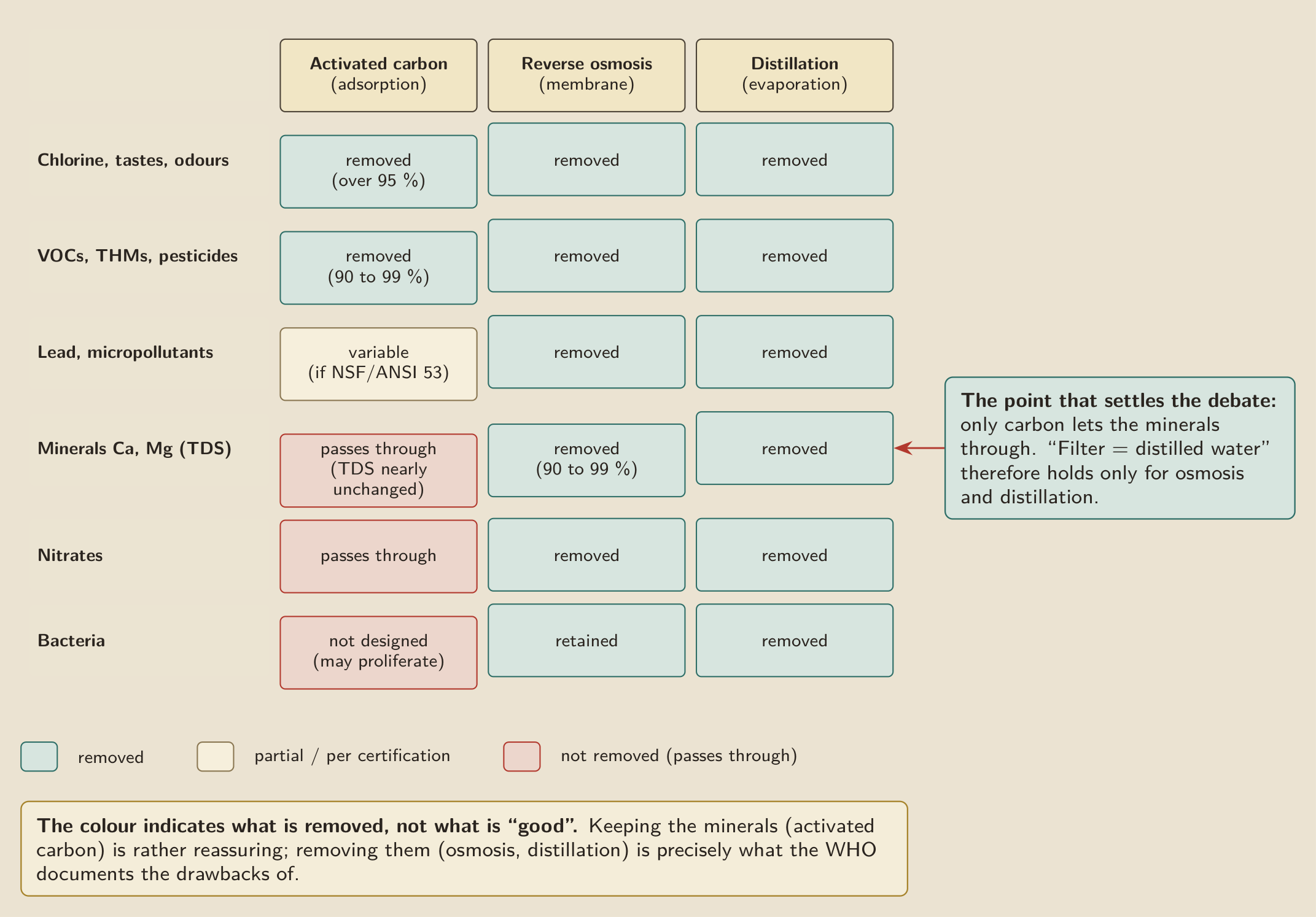
The word “filter” covers processes whose effects have almost nothing in common, and that is the source of the second misunderstanding. Activated carbon works by adsorption: its internal surface, extremely developed, traps molecules that cling to it as the water passes. This mechanism excels on compounds that adhere well to carbon and stays without effect on what does not adhere to it, which explains a very marked selectivity according to the nature of the contaminant.
What activated carbon removes is fairly well delimited. It effectively eliminates free chlorine, often at more than 95%, along with the associated tastes and odours, which is its most visible function at the tap (NSF International 2022). It also reduces part of the volatile organic compounds, chlorination by-products such as trihalomethanes, and certain pesticides or herbicides, the best-adsorbed compounds being cut down by 90 to 99% (NSF International 2022). Depending on its quality and its certification, a carbon can also retain lead and certain micropollutants, which amounts to a health performance and not mere comfort (NSF International 2022).
Standards make this distinction legible, and it is worth knowing them. The NSF/ANSI 42 standard covers aesthetic effects, chlorine, taste and odour, whereas the NSF/ANSI 53 standard covers health effects, such as the reduction of lead, of certain volatile organic compounds or of parasite cysts (NSF International 2022). A filter certified 42 only handles comfort, not dangerous contaminants, whereas a 53 certification attests to a verified performance on health parameters (NSF International 2022). Reading a cartridge’s certification therefore tells you more about what it does than any commercial argument (NSF International 2022).
Performance also depends on material conditions one often forgets. A dense carbon block retains more than a granular carbon passed through too fast, for adsorption demands a sufficient contact time between the water and the carbon. A flow that is too fast or a cartridge close to saturation lets through what a new and slow filter would have retained, so that the stated performance presupposes a compliant use and a timely replacement.
On emerging contaminants, the picture is nuanced and deserves to be stated without exaggeration. A dedicated standard, NSF/ANSI 401, verifies the reduction of certain drug residues and emerging pollutants, which good carbons partially cut down (NSF International 2022). Carbon also reduces certain perfluorinated compounds, the PFAS, but unevenly and decliningly as it saturates, which makes it an imperfect barrier rather than a guaranteed solution (NSF International 2022). On the other hand, dissolved fluoride is not retained by an ordinary activated carbon, contrary to a widespread belief.
Then comes the decisive point for the family debate: what activated carbon does not do. Carbon barely demineralises the water at all, for dissolved calcium, magnesium, sodium and potassium do not adsorb onto the carbon and pass through it almost entirely. The total dissolved solids, the overall indicator of mineralisation, remains practically unchanged after a carbon filter, contrary to what those who believe it a “purifier” in the strong sense imagine. Nor does an activated carbon retain nitrates, or most bacteria, or dissolved salts, all of which demand other processes.
Reverse osmosis and distillation belong to an altogether different register. Reverse osmosis pushes the water through a very fine semi-permeable membrane and removes on the order of 90 to 99% of the dissolved solids, minerals included, producing a largely demineralised water (Verma and Kushwaha 2014). Distillation, which evaporates then recondenses the water, reaches a comparable result by leaving behind almost all of the salts (Verma and Kushwaha 2014). It is these two processes, and not carbon, that yield a “demineralised” water close to distilled water.
Hence the central clarification of the text. The claim “the filter makes the water distilled and poor” is exact for reverse osmosis and distillation, and false for activated carbon, which leaves the minerals in place. The same word, “filter”, thus designates objects with opposed effects on mineralisation, and confusing the two is the error that fuels the whole debate. The useful question is never “does one need a filter” in general, but “which technology, to remove what”.
3. Is water an important source of minerals?
It remains to be seen whether demineralisation, when it occurs, really deprives one of an intake that counts. The answer requires comparing what water supplies with what food supplies. Food is the main source of calcium and magnesium, milk and cheeses alone providing a large share of the calcium ingested (World Health Organization 2009). Drinking water comes as a complement, not as a pillar, which from the outset puts into perspective the stakes of a less mineralised water for whoever eats a balanced diet (World Health Organization 2009).
The orders of magnitude are documented. On average, drinking water supplies on the order of 5 to 20% of the daily intake of calcium and magnesium, the range depending heavily on the local hardness of the water (World Health Organization 2009). For a lightly mineralised tap water, this contribution falls in the lower part of the range, only a few per cent, whereas a hard water or a rich mineral water can climb much higher (World Health Organization 2009). In a French adult population, the contribution of mineral waters reached about 25% of the calcium intake and 6 to 17% of the magnesium intake among regular consumers of rich waters (Galan et al. 2002).
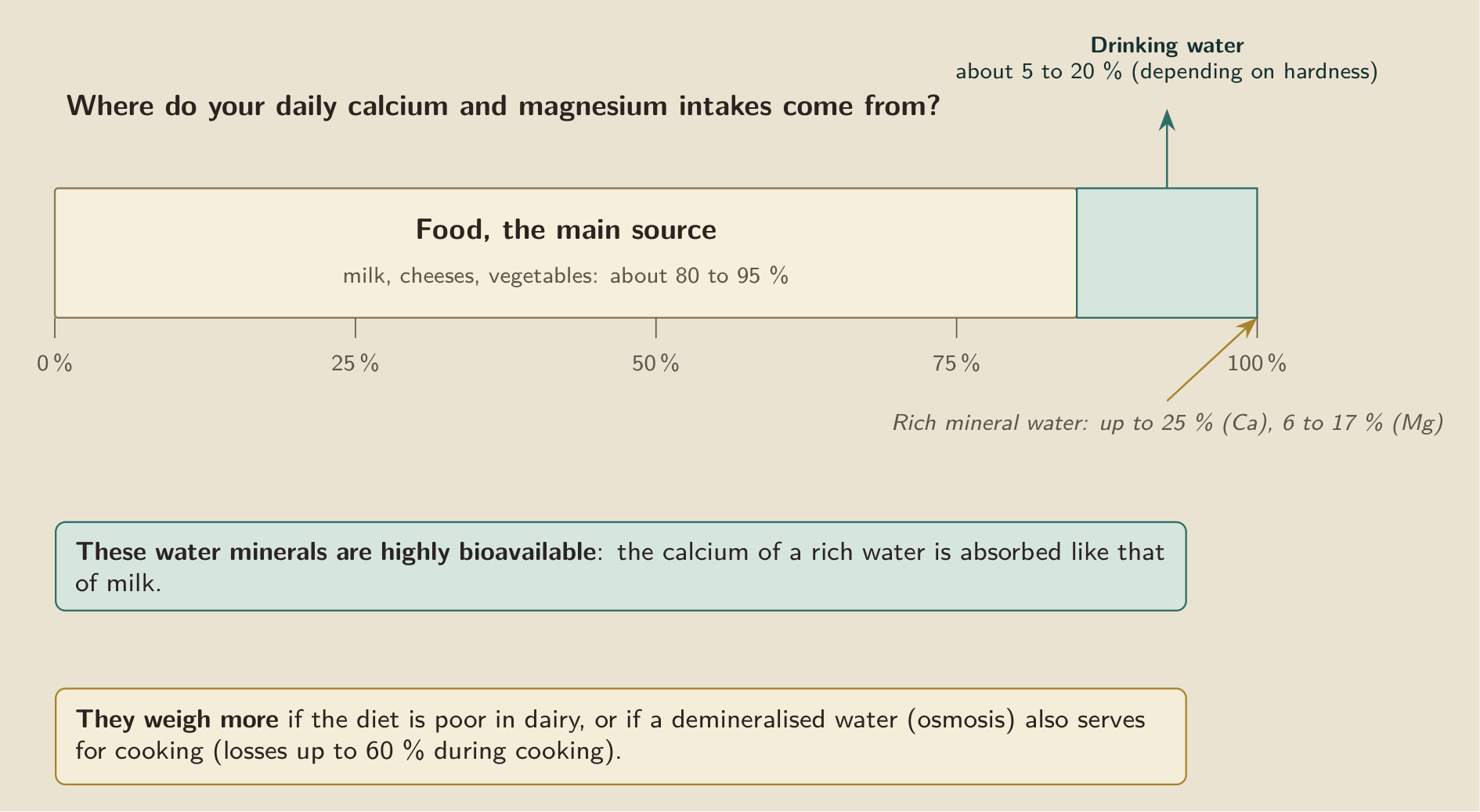
This intake, though a minority, is not negligible for everyone. The minerals dissolved in water are highly bioavailable, the calcium of a rich water showing an absorption comparable to that of milk calcium, and the magnesium of water being absorbed in high proportions (Verhas et al. 2002; World Health Organization 2009). In other words, the calcium and magnesium of water are not discount minerals: the body assimilates them as well, sometimes better, than those of certain foods (Verhas et al. 2002; World Health Organization 2009). For a person whose diet is poor in dairy products or vegetables, the share coming from water can therefore count more than the average suggests.
This question of water minerals and health has a long history, which it is honest to recall. As early as the 1950s and 1960s, ecological studies observed a lower cardiovascular mortality in hard-water regions, rich in calcium and magnesium, than in soft-water regions (World Health Organization 2009). This “hard-water hypothesis” has fed decades of work, whose weight of evidence points above all to magnesium, without ever reaching the force of a causal demonstration (World Health Organization 2009).
One must, however, keep a sense of measure on the daily stakes. For an adult who eats varied, removing the few per cent of calcium and magnesium supplied by a lightly mineralised tap water does not on its own create a deficiency, food covering the essential of the need. The nutritional stake of a demineralisation is therefore real but moderate as long as it concerns only the water drunk, and it changes scale above all when the demineralised water also serves to cook, as we shall see. The right stance is neither to scorn the intake of water nor to overestimate it: it is a bioavailable complement, not a vital source.
This point is enough to defuse the anxiety of “dead water” in the case that concerns us. A carbon filter does not demineralise, so it does not remove this intake of calcium and magnesium, and the question of impoverished water simply does not arise for it. It would arise only for a reverse osmosis or a distillation, and it is to these processes that the next section is addressed.
4. Demineralised water: what the WHO says
Since osmosis and distillation do produce a demineralised water, one must take seriously what the health institutions say about it, without wrongly transposing it to carbon. The World Health Organization has published a review devoted to the risks of demineralised water, an expert chapter that puts forward desirable minimum mineral contents, without these values constituting a binding guideline value (Kozisek 2005). This chapter places the minimum for magnesium around 10 mg per litre, with an optimum of about 20 to 30 mg per litre, and the minimum for calcium around 20 mg per litre, with an optimum of about 40 to 80 mg per litre (Kozisek 2005). These benchmarks explicitly target a water that has been stripped of its minerals, and not ordinary mains water.
The first documented effect concerns not the water drunk but the water that cooks. Cooking with demineralised water leaches the minerals from foods, the losses being able to reach about 60% for calcium and magnesium, and more still for certain trace elements (Kozisek 2005). The same reviews report losses on the order of 66% for copper, 70% for manganese and 86% for cobalt when the cooking water is very soft (Kozisek 2005). It is through this channel, more than through drinking, that a demineralised water can really eat into intake, which explains why the WHO distinguishes water drunk from water used in cooking.
A second effect is indirect and holds to the chemistry of water. A very lightly mineralised water is more corrosive, for it lacks the calcium and the alkalinity that form a protective layer inside the pipes, which increases the leaching of metals such as lead and copper from the plumbing (Kozisek 2005). A soft and acidic water thus dissolves more lead than a hard water, especially after stagnation in the pipes, a phenomenon known as plumbosolvency (Kozisek 2005). The paradox deserves to be noted: demineralising in order to “purify” can, on an old network, reintroduce a serious contaminant through the channel of the pipes.
A third register is cardiovascular, and it is here that one must be the most cautious about the status of the evidence. Several epidemiological studies associate a water richer in magnesium, and to a lesser extent in calcium, with a lower cardiovascular risk, whether of mortality or of incidence, in particular for certain strokes (Helte et al. 2022; World Health Organization 2009). A Swedish cohort of more than twenty-six thousand women thus observed a reduced incidence of ischaemic stroke associated with the magnesium of water, with no clear association with myocardial infarction (Helte et al. 2022; World Health Organization 2009). These results are observational associations, coherent with one another but which do not on their own establish a cause-and-effect link, and they must be presented as convincing rather than as demonstrated.
Other signals, more fragile, complete the picture of very soft water. Some work has associated a mineral-poor water with an increased risk of fractures in children, with certain premature or low-weight births, and with neurological disorders, without causality being established (Kozisek 2005). These associations remain at the rank of converging clues, cited by the institutional reviews as grounds for caution and not as settled facts (Kozisek 2005).
There remains, finally, the taste, which is no small thing for daily use. A demineralised water has a flat taste, sometimes described as bland, because it is in part the dissolved minerals that give water its savour (Kozisek 2005). It is for this reason, moreover, that domestic reverse osmosis installations are often completed with a remineralisation stage, which gives back to taste and to intake what the membrane had removed (Kozisek 2005). This detour confirms, by the opposite example, the principle of the beginning: when one wants to add, a dedicated downstream device is needed, filtration does not do it by itself.
This whole section, it must be stressed, describes demineralised water, hence osmosis and distillation, and does not apply to the carbon filter of the family debate. Carbon does not demineralise, so it does not make the water corrosive, does not leach foods during cooking and deprives of no mineral intake, and transposing these risks to it would be a technology error. The WHO’s concerns about demineralised water are well founded, and they target another apparatus than the one screwed onto this tap.
5. The only risk a filter really adds: the cartridge
If carbon does not demineralise and does not impoverish the water, it nonetheless introduces a risk all its own, and it is here that the worried camp is right to be so. An activated carbon filter is not designed to remove bacteria, and its considerable internal surface, laden with the organic matter it has trapped, on the contrary offers favourable ground for their development (Wu et al. 2021). By removing the chlorine, carbon moreover suppresses the disinfectant that was curbing this growth downstream, which lifts a brake on microbial proliferation in the cartridge (Wu et al. 2021).
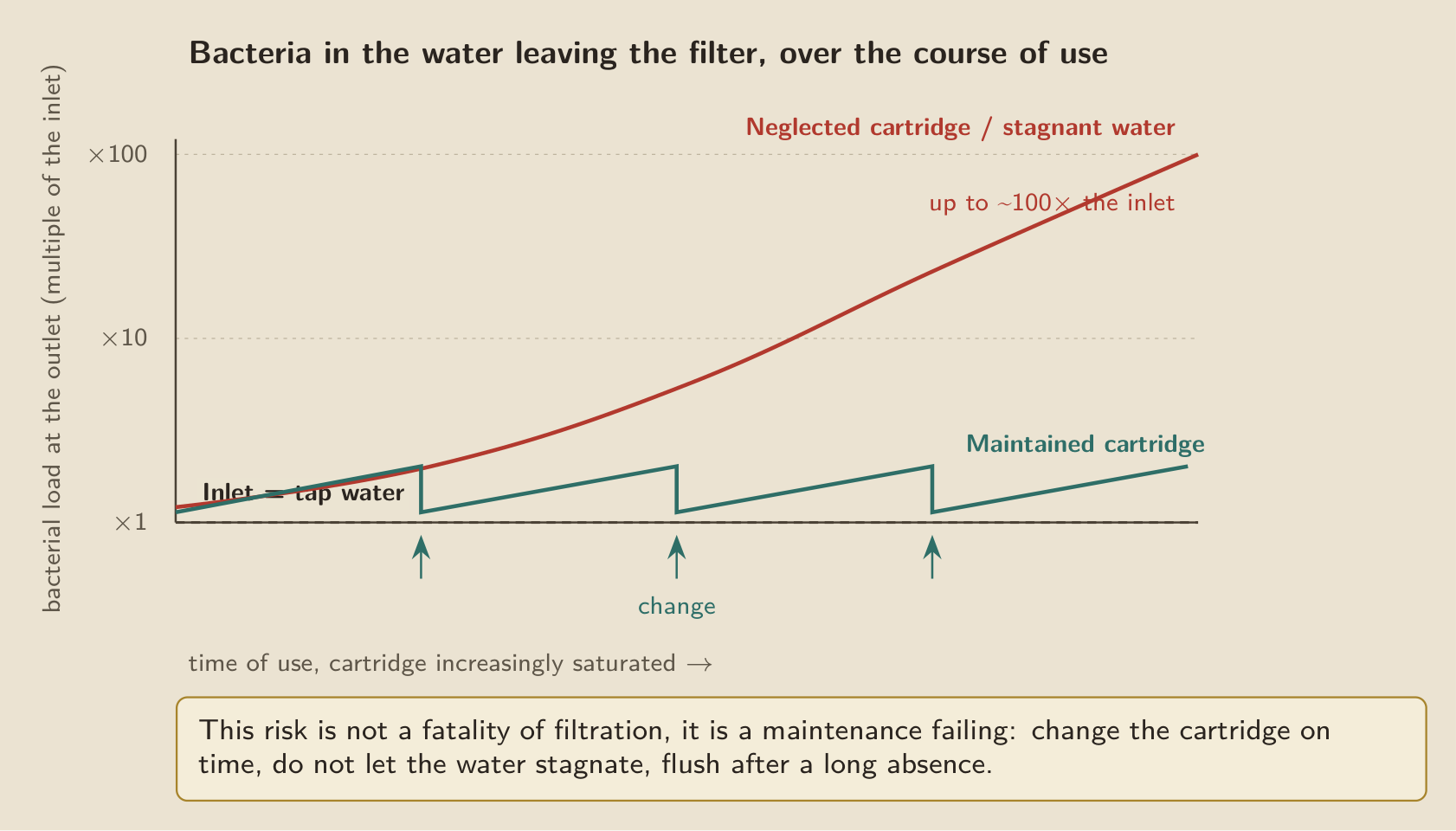
The measurements confirm what the principle gives cause to fear. Older, already classic studies have shown that the heterotrophic bacteria counts in the water leaving a carbon filter can widely exceed those of the incoming water, with effluents reaching up to a hundred times the initial load once the cartridge is colonised (Wu et al. 2021). More recent work on domestic-use carbon blocks describes the same progressive colonisation and the formation of biofilms, those bacterial communities embedded in a matrix that protects them (Wu et al. 2021). Opportunistic germs such as Pseudomonas aeruginosa have been found in the effluents of tested filters, which is not trivial for vulnerable persons (Wu et al. 2021).
Observations under domestic conditions go in the same direction. A study of tap-mounted filters measured an increase in bacterial counts in the filtered water compared with mains water, while also altering the trace-metal contents (Nriagu et al. 2018). Some carbons are impregnated with silver to slow this colonisation, but silver mainly limits coliforms without preventing general bacterial proliferation, which makes it a partial safeguard (Nriagu et al. 2018).
Two factors clearly aggravate the phenomenon, and both are within the user’s hand. The stagnation of water in a cartridge between two uses, and the use of a cartridge beyond its intended lifespan, both favour bacterial multiplication, the effect increasing with the volume of water treated and the time elapsed (Wu et al. 2021; Nriagu et al. 2018). A saturated and rarely rinsed cartridge can thus return a water of poorer microbiological quality than unfiltered tap water, which reverses the expected benefit (Wu et al. 2021; Nriagu et al. 2018). Such is the meaning of the recurrent warning of the studies: a poorly maintained filter can be worse than no filter at all (Nriagu et al. 2018).
A second risk, more recent in the literature, concerns plastic particles. The fine structures of certain cartridges can break down with use and release micro- and nanoplastics into the filtered water, so that the filter meant to retain these particles can also emit them. This phenomenon is still poorly quantified and depends greatly on the materials and the conditions of use, which places it among the signals to watch rather than among solidly quantified facts. It calls for caution without justifying alarm, and above all it points once again to the maintenance and quality of the cartridge.
The practical consequence is simple and reassuring. The cartridge risk is not a fatality of filtration, it is a maintenance failing: changing the cartridge at the intended frequency, not letting the water stagnate and flushing the filter after a long absence are enough to master it. Well kept, a carbon filter brings the comfort expected of it without degrading the quality of the water; neglected, it becomes the only real means by which a filter can actually worsen the water. The worried camp therefore aims true, but on this precise point, maintenance, and not on demineralisation or impoverishment.
6. The Swiss context: necessity or comfort?
It remains to set all this back in the real place of the debate, a Swiss tap. Now the starting point there is particularly favourable, which shifts the question. Swiss tap water is reputed to be of excellent quality and ranks among the most closely monitored foodstuffs in the country, under the supervision of the competent federal authorities (Office fédéral de la sécurité alimentaire et des affaires vétérinaires (OSAV) 2023). It comes very largely from groundwater, about 80% of the supply, a large part of which can be distributed without treatment, the rest often requiring only a simple disinfection (Office fédéral de la sécurité alimentaire et des affaires vétérinaires (OSAV) 2023).
This context changes the function of the filter. Where the mains water is already safe to drink, a carbon filter’s role is not to rescue a dangerous water, but above all to improve the taste, by removing the residual chlorine and the odours that displease some. Its main interest then becomes comfort and pleasantness, not health safety, which is a perfectly legitimate motivation but one that must be named for what it is. To choose to filter for the pleasure of a more neutral-tasting water is an assumed comfort choice, not a health necessity.
A word on chlorine deserves to be added, for it is chlorine that carbon targets first. Chlorine is not in the water through negligence: it ensures disinfection there and protects the water from germs all along its journey through the network, right up to the tap. Removing it at the last metre, for the comfort of taste, is without consequence when the water is drunk at once, but at the same stroke deprives the water of its residual protection, which is one more reason not to keep filtered water and not to let it stagnate in the filter. Carbon therefore trades a taste benefit for the loss of a disinfectant, a harmless trade-off for immediate use and one to watch for any storage.
This does not make the filter useless for all that, and it must be said so as not to tip into the opposite disdain. Even on a good network, a certified carbon filter can bring a real benefit to whoever is sensitive to the taste of chlorine, or whose indoor installation, old pipes or tap fittings, adds something that the public monitoring does not cover all the way to the glass. The monitoring bears on the distributed water, and the last portion, between the meter and the tap, depends on the building, which leaves a narrow but real place for final treatment. The right measure is therefore a filter useful at the margin, not an indispensable filter.
One can then answer frankly the question of context. In Switzerland, on a tap water already very closely monitored, a carbon filter is a matter first of taste comfort and incidentally of last-metre safety, and not of a major health need. Neither the worry that would make it an admission of distrust toward a nonetheless safe water, nor the hope that would make it a miraculous enricher, correctly describes what it does. It does less than some hope and nothing of what others fear.
7. What is established, what convinces, and the tool to take away
At the end of the course, it is worth cleanly separating what one holds as acquired from what remains at the rank of clue, for this distinction is the best safeguard against the two camps of the debate. It is established, in the sense of physics and chemistry, that a filter subtracts without adding, that activated carbon removes chlorine and part of the organic compounds without demineralising, and that reverse osmosis and distillation demineralise strongly. It is established too that a colonisable cartridge can release bacteria if one neglects it, and that Swiss tap water is safe to drink.
Belonging to institutional consensus, solid without being a law of nature, is the whole set of the WHO’s benchmarks on demineralised water: the recommended minimum contents of calcium and magnesium, the leaching of foods during cooking, the increased corrosivity of a water too soft (Kozisek 2005; World Health Organization 2009). These statements rest on a body of converging studies and on expert judgment, which gives them a real authority without making them beyond dispute in the detail of the thresholds (Kozisek 2005; World Health Organization 2009).
Belonging, finally, to what convinces without being demonstrated is the most publicised part of the subject. The link between the magnesium of water and a lower cardiovascular mortality rests on epidemiological associations that are coherent but observational, and the extent of the release of nanoplastics by cartridges remains poorly quantified (Helte et al. 2022). These elements deserve to be taken seriously as signals, without being brandished as proofs, failing which one would fall back into marketing, that of the filter or that of the bottle, which this text strives to avoid on both sides (Helte et al. 2022).
From all this emerges a portable tool, to set against the next dinner-table dispute. Faced with any claim about “the filter”, ask three questions in order: which technology are we talking about, what exactly does it remove, and what am I really looking for, a better taste, a safety, or an intake? The first question separates carbon from osmosis and dissolves half the misunderstandings; the second brings you back from fantasy toward a concrete list of what leaves and what stays; the third reveals whether the need is real or imaginary.
The last word lies in the principle of the beginning, now complete. A filter removes, it adds nothing, and what it removes depends entirely on its technology, so that an activated carbon on a Swiss tap offers above all a better taste, does not demineralise, does not impoverish the water, and presents no other risk than that of a cartridge one has forgotten to change. Worry and enthusiasm then meet in a single measure: neither gold nor poison, a modest and honest service, provided one knows which filter one is talking about.