What does the French word "Dieu" tell us about the first beliefs?
The French word "Dieu" belongs to a very old family of words. Its history intersects with that of a stone sanctuary in Turkey, older than agriculture, and that of the beliefs of hunter-gatherers
Published · Updated
One day, I wondered who had invented the word “Dieu”, and where it came from. I had never asked myself the question. By going back to the first meaning of the word, I thought I might understand part of the origin of religions, or at least the meaning it had before them.
I had seen it said that this word was older than the three monotheistic religions, and that is what caught my attention, because I was looking for answers in those three religions in particular.
One reads almost everywhere that the word “Dieu” is said to come from a five-thousand-year-old root that designated the bright daytime sky. And humans are said to have believed in a higher power long before all religions. Three pieces of evidence are given for this: a forty-thousand-year-old lion-headed statuette, a stone sanctuary built before agriculture, and animism, presented as the very first belief. Animism is the idea that animals, trees, and rivers have a soul.
A word that comes from very far back
A family of words
The word “Dieu” comes from the Latin deus, which has
cousins: the name of the Greek god Zeus, and dyaus, which
means “sky” in Sanskrit, an ancient language of India (Linguistics Research Center, University of Texas at
Austin s. d.a) (Wiktionnaire s. d.). All of them belong
to the same family of words, linked to light, day, and the divine (Linguistics Research Center, University of Texas at
Austin s. d.a). French retains other traces of it: “jour”
(day), “divin” (divine), and even “adieu” (farewell) come from the same
family (Linguistics Research
Center, University of Texas at Austin s. d.a).
A language no one has ever read
These words descend from a language spoken thousands of years ago,
which linguists call Proto-Indo-European (Linguistics Research Center, University of Texas at
Austin s. d.b). It left no texts, and no one has ever read it
(Haak et al. 2015; Hruschka et al.
2015). Linguists reconstruct it by comparing the languages
that descend from it (Linguistics Research Center, University of Texas at
Austin s. d.b). They write its words with a small star in
front, like *Dyeus, as a reminder that a word has been
reconstructed and not found (Linguistics Research Center, University of Texas at
Austin s. d.b).
Looking alike is not enough
To know whether two words are related, linguists do not rely on their resemblance (Hruschka et al. 2015; Blevins 2018). They look for sounds that always correspond in the same way from one language to another, across hundreds of words (Hruschka et al. 2015; Blevins 2018).
The Latin deus and the Greek theos both
mean “god” and resemble each other like two brothers (Hruschka et al. 2015;
Blevins
2018). Yet they do not come from the same word, because their
sounds do not correspond in this way (Hruschka et al. 2015; Blevins
2018).
In 2015, a team showed that a computer program could spot these sound correspondences on its own in word lists (Hruschka et al. 2015; Blevins 2018) (Hruschka et al. 2015). Other linguists point out that tracing back to a single ancestral word requires choices, and that these choices are open to debate (Hruschka et al. 2015; Blevins 2018).
The same ancestor, *Dyeus, is found in the names of
three gods: Jupiter among the Romans, Zeus among the Greeks, and Dyaus
in India (Allen 2004). It is
linked to the sky and to the figure of the father (Allen 2004).
Five thousand years, or more?
Studies do not all give the same age to this language family (Gray and Atkinson 2003; Haak et al. 2015; Kroonen et al. 2022). According to some researchers, it started out from present-day Turkey with the first farmers, around nine thousand years ago (Heggarty et al. 2023; Gray and Atkinson 2003; Bouckaert et al. 2012; Haak et al. 2015; Chang et al. 2015; Kroonen et al. 2022). According to others, it started out from the steppes north of the Black Sea with herders on horseback, five to six thousand years ago (Heggarty et al. 2023; Gray and Atkinson 2003; Bouckaert et al. 2012; Haak et al. 2015; Chang et al. 2015; Kroonen et al. 2022).
The disagreement comes in part from the methods: words date the moment when languages split, whereas DNA recovered from ancient skeletons dates the movements of people (Gray and Atkinson 2003; Haak et al. 2015; Kroonen et al. 2022). Yet a language can travel without those who speak it, and people can move without changing their language (Heggarty et al. 2023; Gray and Atkinson 2003; Bouckaert et al. 2012; Haak et al. 2015; Chang et al. 2015; Kroonen et al. 2022).
In 2023, researchers from the two camps jointly signed a single study (Heggarty et al. 2023; Gray and Atkinson 2003; Bouckaert et al. 2012; Haak et al. 2015; Chang et al. 2015; Kroonen et al. 2022). It places the starting point of the family around eight thousand years ago, south of the Caucasus, with a branch that later passed through the steppe (Heggarty et al. 2023). Its authors do not present it as a definitive agreement (Heggarty et al. 2023).
A sanctuary older than fields
In southeastern Turkey, on a hill called Göbekli Tepe, archaeologists have uncovered large stone enclosures (Dietrich et al. 2019; Gresky et al. 2017). They are lined with T-shaped pillars, up to five and a half meters high (Dietrich et al. 2019). Carved on these pillars are snakes, foxes, wild boars, vultures, or felines (Dietrich et al. 2019). They were built ten to twelve thousand years ago, before agriculture and before pottery (Dietrich et al. 2019; Gresky et al. 2017).
For a long time, the site was described as a ritual place built by nomads, with no village around it: first the temple, then the village (Dietrich et al. 2019; Gresky et al. 2017).
Thousands of tools for grinding
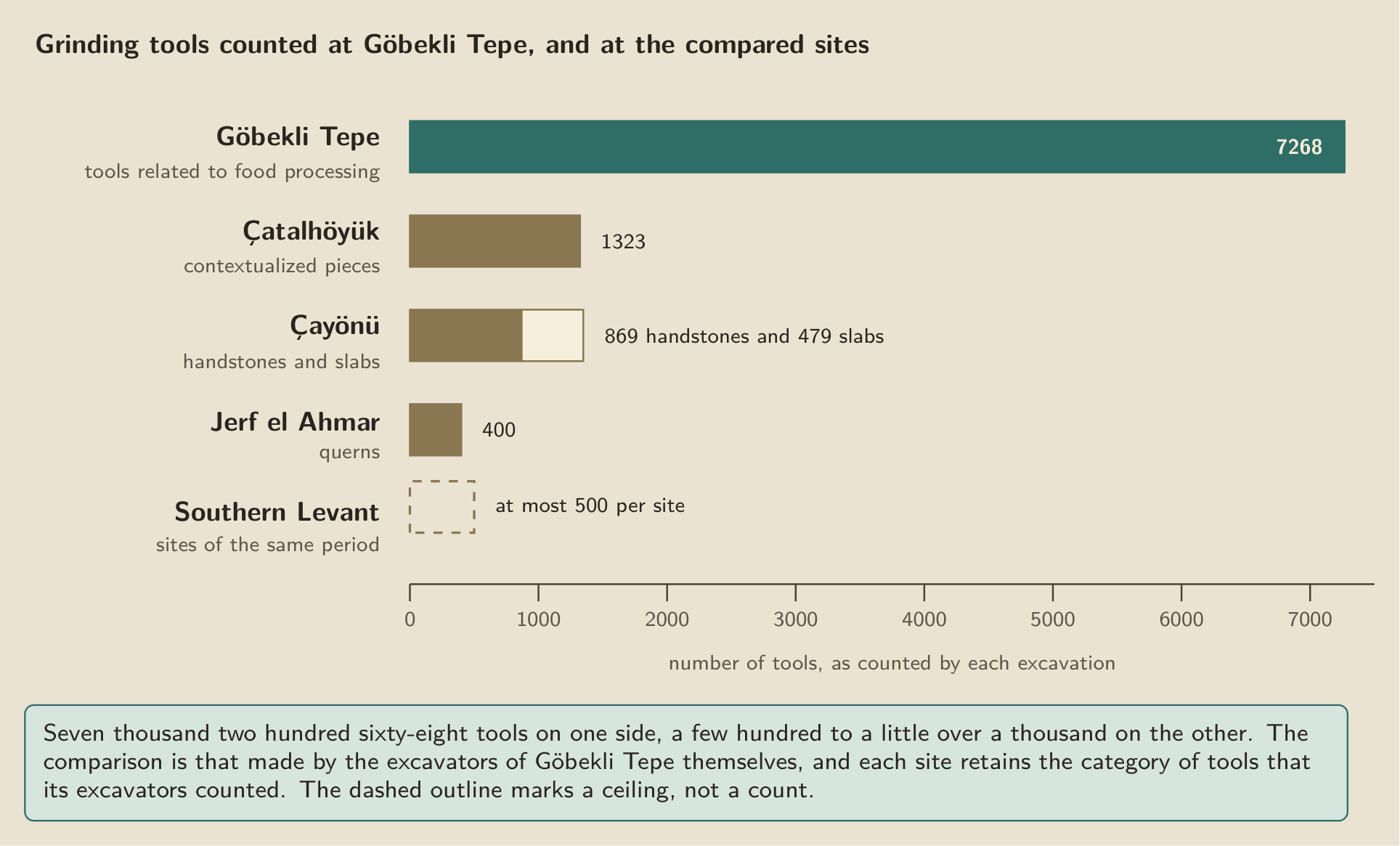
In 2019, the team excavating the site published an inventory of the tools found there (Dietrich et al. 2019) (Dietrich et al. 2019). It counted more than seven thousand tools used for grinding and crushing grain: grinding stones, pestles, and mortars (Dietrich et al. 2019). Sites from the same period yield from a few hundred to just over one thousand (Dietrich et al. 2019).
 Tap to enlarge
Microscopic traces left by plants also show that cereals were widely present on site (Dietrich et al. 2019). The researchers tried it: grinding 500 grams of an ancient cereal took them from forty minutes to one hour (Dietrich et al. 2019).
These tools are found mainly in small rectangular buildings, built around the large enclosures, and on the terraces that surround them (Dietrich et al. 2019) (Dietrich et al. 2019). No large storage area has been found (Dietrich et al. 2019). The team therefore thinks that the food was prepared to be eaten on the spot, during large feasts where people gathered to work together (Dietrich et al. 2019).
A place apart
Even so, the team continues to see the large round enclosures as ritual places (Dietrich et al. 2019; Gresky et al. 2017). No hearth has been found there, either in the small buildings or in the large enclosures (Dietrich et al. 2019). There are almost no bone tools and no clay figurines, whereas villages from the same period yield them (Dietrich et al. 2019).
The site sits on a bare limestone ridge, with no spring, three kilometers from the nearest stream (Dietrich et al. 2019). The villages in the region, by contrast, settle by the water (Dietrich et al. 2019).
Each enclosure has its own animal: snakes dominate in one, foxes in another, wild boars or vultures elsewhere (Dietrich et al. 2019). The excavators see in this the emblem of different groups, each decorating its own enclosure (Dietrich et al. 2019). In their view, Göbekli Tepe was a place where these groups came together for large meals and rituals (Dietrich et al. 2019; Gresky et al. 2017).
Three skulls
In 2017, other researchers described three human skulls found in pieces at the site (Gresky et al. 2017). They bear deliberate incisions, of a type never seen before (Gresky et al. 2017). The researchers suggest seeing in them the trace of a skull cult (Gresky et al. 2017). They also specify that no grave has been found at the site, only scattered bone fragments (Gresky et al. 2017).
Animism, the first belief?
The idea that animism was humanity’s first belief comes from the anthropologist Edward Tylor, who argued for it in 1871 (Peoples et al. 2016). His book was long read as a ladder that all of humanity had supposedly climbed, from animism up to the major religions, and was later rejected for that reason. According to the abstract of a 1999 article (I was unable to read the rest), his critics largely misunderstood him (Stringer 1999).
In 2016, three researchers arranged hunter-gatherer peoples from around the world into a large tree, like a family tree: each branch is a people, and the trunk is their common ancestor (Peoples et al. 2016). By comparing the beliefs of the branches, they estimated which ones that ancestor probably already held (Peoples et al. 2016).
In their calculation, animism was almost certainly present in that common ancestor (Peoples et al. 2016). The authors note that this aligns with Tylor’s idea (Peoples et al. 2016). The great gods who meddle in human affairs, by contrast, do not appear there (Peoples et al. 2016).
For other beliefs, such as life after death or shamans, the calculation comes down to roughly a coin toss, and the authors write that they cannot decide (Peoples et al. 2016). They also point out that most of these beliefs appear and disappear too often from one people to another to be tracked reliably along the branches (Peoples et al. 2016). The ancestor reconstructed by the study is that of the peoples studied, present-day hunter-gatherers, and not that of the first humans.
What do we call a religion?
To know whether the idea of God is older than religions, we would first have to agree on the word “religion”. Yet researchers do not have a single definition of it (Peoples et al. 2016).
If any belief in invisible beings is called a religion, belief in spirits is already part of it. If the word is reserved for organized religions, with priests and texts, it arrives much later. Some researchers propose viewing religions as a family, in which each resembles the others without any single trait being common to all (Saler 2009; McKinnon 2002).
According to other researchers, an idea of a supernatural being is remembered better when it is just strange enough, normal enough to be understood and odd enough to leave an impression (Norenzayan et al. 2006). In 2007, another team showed that this memory advantage depends on context, to the point of sometimes reversing (Norenzayan et al. 2006; Upal et al. 2007; Upal 2010).
A retracted article
In 2019, the scientific journal Nature published a study drawn from a large historical database (Whitehouse et al. 2019, 2021; Beheim et al. 2021). According to it, complex societies appeared before gods who punish moral failings (Whitehouse et al. 2019, 2021; Beheim et al. 2021).
Two years later, another team re-examined the same data (Whitehouse et al. 2019, 2021; Beheim et al. 2021). It discovered that societies whose religion was unknown had been counted as societies without a moralizing god (Whitehouse et al. 2019, 2021; Beheim et al. 2021). The 2019 study was retracted the same month (Whitehouse et al. 2019, 2021; Beheim et al. 2021).
I did not examine the lion-headed statuette: one would need to read the excavation reports from its cave. My sources are also almost all Western, and the word for God in Hebrew or Arabic, languages from another family, would require a separate investigation (Wikipédia s. d.).
References
What has changed
- : The text is rewritten as a narrative, starting from the question the author asked himself about the origin of the word, and takes the title "What does the French word Dieu tell us about the first beliefs?". What prompted it: The article now tells the researchers' discoveries one after another. Its sources are retained, and two are added: one for the Latin origin of the word, the other for the language family of Hebrew and Arabic.