
Do peptides increase the risk of cancer?
The word "peptide" brings together diabetes medications followed in thousands of patients, vials sold "for research," and skincare creams. Researchers have studied their link with cancer, one molecule at a time
Published · Updated
Peptides are an exploding topic right now, particularly as an alternative to doping. They are presented as miracle cures, supposed to heal just about anything, with a peptide for every problem. I wanted to know what risks one takes using them, when we have fairly limited hindsight on them. When I am promised miraculous effects without the slightest drawback, I am wary, because on this earth, there is always a trade-off.
To me, a peptide is a bit like a key in a lock of the body, and I wondered whether it might not also open the door to cancer. Today, I see them mostly as experimental products that should not be left in just anyone’s hands. Especially since people generally inject them with a syringe, in their living room, when that should be done in a medical setting.
A single word, very different molecules
A peptide is a short chain of amino acids, the small building blocks of which proteins are made (Renke and Chinellato 2026) (Wikipédia s. d.a). In a review published in 2026, Guilherme Renke’s team groups under this name semaglutide, a medication approved worldwide for type 2 diabetes and obesity (Renke and Chinellato 2026). It also includes BPC-157, which has received no approval, and GHK-Cu, which is found in skincare creams (Renke and Chinellato 2026).
These molecules do not act on the same receptors, the locks on cells that receive their signal, and the resources devoted to studying them are in no way comparable (Marso, Daniels, et al. 2016; Wilding et al. 2021; Lincoff et al. 2023; Winkelman and Levine 2026; Dominikowski et al. 2026; Renke and Chinellato 2026) (Wikipédia s. d.s). A company, Cellgenic, paid the publication costs for this review, and Guilherme Renke declares receiving clinical research funding from it (Renke and Chinellato 2026).
A lock carried by cancer cells
In 2010, two major American associations, one for diabetes and the other for cancer, published a joint report (Giovannucci et al. 2010). Its authors point out that most cancer cells carry receptors for insulin and for IGF-1, a growth factor related to insulin (Giovannucci et al. 2010) (Wikipédia s. d.j). When these receptors are activated, they can help these cells multiply, survive, invade neighboring tissues, and form tumors elsewhere in the body, metastases (Giovannucci et al. 2010).
Diabetes and obesity medications
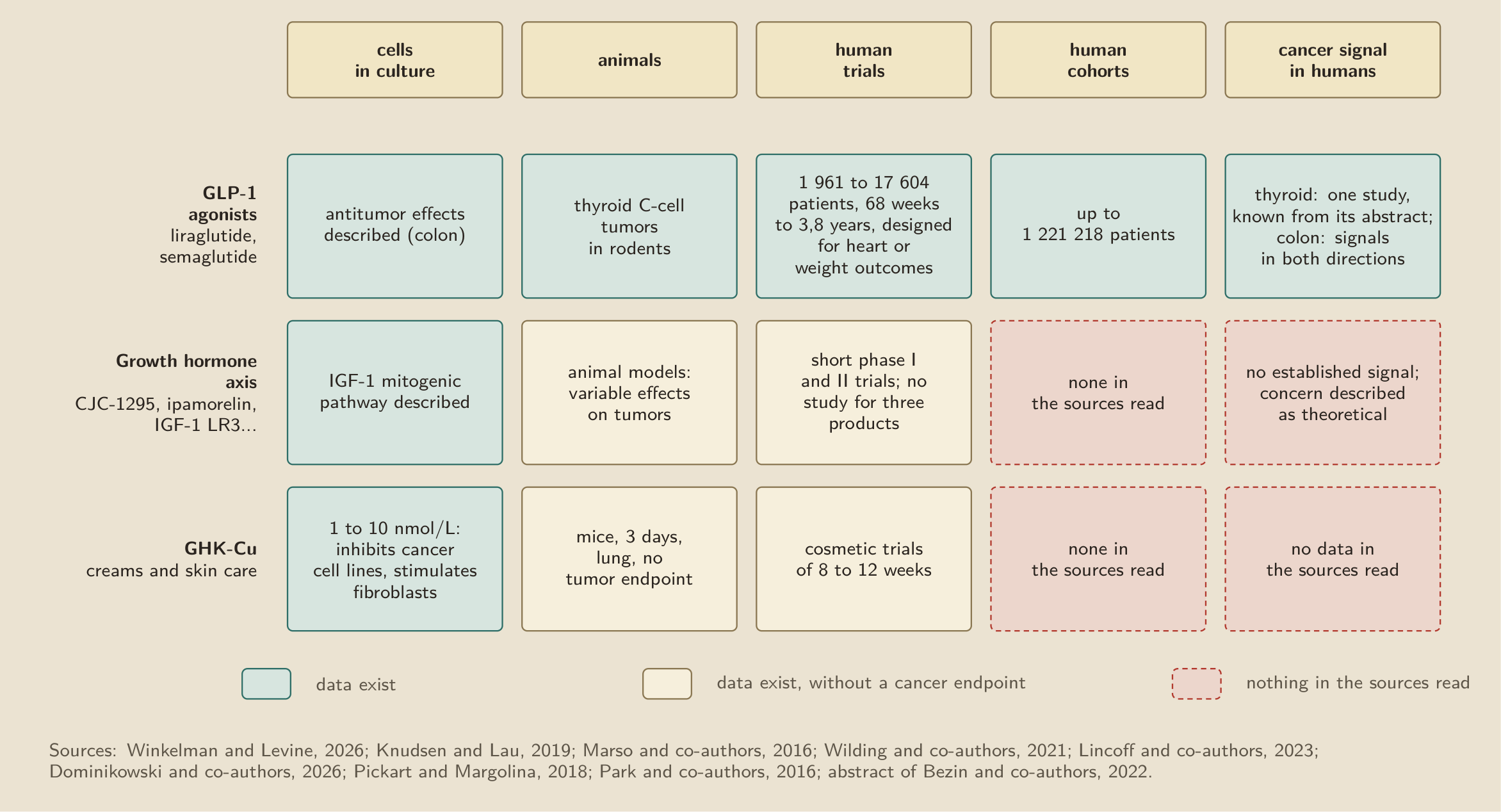
Liraglutide and semaglutide activate the receptor for a hormone called GLP-1, hence their name GLP-1 agonists (Marso, Daniels, et al. 2016; Wilding et al. 2021; Lincoff et al. 2023; Winkelman and Levine 2026; Dominikowski et al. 2026; Renke and Chinellato 2026). Among the peptides of concern, they are by far the most studied in humans: their trials have followed thousands of patients over several years (Marso, Daniels, et al. 2016; Wilding et al. 2021; Lincoff et al. 2023; Winkelman and Levine 2026; Dominikowski et al. 2026; Renke and Chinellato 2026).
These large trials were not designed for cancer (Knudsen and Lau 2019). After a cardiovascular safety issue raised by another family of diabetes medications, authorities required every new treatment to prove that it did not harm the heart (Knudsen and Lau 2019). The American drug agency thus mandated the LEADER trial for liraglutide after it reached the market (Knudsen and Lau 2019). The abstract of the SUSTAIN-6 trial, on semaglutide, notes the same requirement (Marso, Bain, et al. 2016).
Thousands of randomized patients
Published in 2016, LEADER randomly divided more than nine thousand diabetic patients with heart vulnerabilities into two groups (Marso, Daniels, et al. 2016). One group received a daily injection of liraglutide under the skin, the other a placebo, a product without an active substance, and follow-up lasted nearly four years (Marso, Daniels, et al. 2016) (Wikipédia s. d.r). Cancers across all organs affected about six patients out of a hundred in each of the two groups, with no difference that statistics could distinguish from chance (Marso, Daniels, et al. 2016).
The pancreas accounted for thirteen cancers with liraglutide compared to five with placebo, a difference just too small for statistics to attribute it to anything other than chance (Marso, Daniels, et al. 2016). In contrast, the prostate accounted for twenty-six cancers with liraglutide compared to forty-seven with placebo, and leukemia five compared to fourteen (Marso, Daniels, et al. 2016).
Researchers were also monitoring a rare form of thyroid cancer, medullary cancer, because of observations made in rodents (Marso, Daniels, et al. 2016). A single patient developed it, and was on placebo (Marso, Daniels, et al. 2016). The authors write that even a trial of this size lacks power to establish a drug’s effect on cancer, and that they “can therefore neither confirm nor exclude such a possibility” (Marso, Daniels, et al. 2016).
In 2021, the STEP 1 trial followed nearly two thousand overweight or obese adults without diabetes for sixty-eight weeks, on semaglutide once a week or on placebo (Wilding et al. 2021). Cancers affected slightly more than one person out of a hundred, in one group as in the other (Wilding et al. 2021).
Published in 2023, the SELECT trial followed more than seventeen thousand patients on semaglutide or on placebo for a little over three years (Lincoff et al. 2023). Nor does it show any clear difference in the frequency of cancers between the two groups (Lincoff et al. 2023). Yet a cancer can take decades to develop, far longer than these few years of follow-up (Song 2020).
Novo Nordisk, which developed both medications, funded LEADER along with the US National Institutes of Health, and funded STEP 1 alone (Knudsen and Lau 2019) (Marso, Daniels, et al. 2016; Wilding et al. 2021; Marso, Bain, et al. 2016). According to its abstract, SUSTAIN-6 was also funded by Novo Nordisk alone (Marso, Daniels, et al. 2016; Wilding et al. 2021; Marso, Bain, et al. 2016).
A warning from rodents
In rats and mice, the thyroid contains so-called C cells, which produce a hormone, calcitonin, and carry many GLP-1 receptors (Knudsen and Lau 2019; Marso, Daniels, et al. 2016) (Wikipédia s. d.c). In 2019, two researchers described what follows: stimulated by these medications, C cells produce more calcitonin, then multiply, and benign tumors, adenomas, appear more frequently (Knudsen and Lau 2019; Marso, Daniels, et al. 2016) (Wikipédia s. d.b). The authors of LEADER also report more tumors of these cells in rodents treated with liraglutide (Knudsen and Lau 2019; Marso, Daniels, et al. 2016).
In monkeys, these cells are fewer in number and do not react in a measurable way, and the human thyroid carries few of these receptors, sometimes too few to be detected (Knudsen and Lau 2019). The two researchers therefore consider the observations made in rodents much less relevant to humans (Knudsen and Lau 2019). Both are full-time employees and shareholders of Novo Nordisk (Knudsen and Lau 2019).
For humans, they rely on a 2015 study published in the journal Modern Pathology, which measures the presence of these receptors in tissues, and on two analyses of calcitonin published in 2011 and in 2018 (Knudsen and Lau 2019). I was unable to read these three papers (Knudsen and Lau 2019). Nor did I find at what dose tumors appear in rodents, compared to the dose a patient receives.
A French study on the thyroid
Julien Bezin and his colleagues compared more than two thousand five hundred diabetic individuals with thyroid cancer to more than forty-five thousand others without this cancer, of the same age, the same sex, and with diabetes for just as long, identified in French national health data (Bezin et al. 2022). I was able to read only the study abstract (Bezin et al. 2022). The risk of thyroid cancer was approximately one and a half times higher in individuals who had taken a GLP-1 agonist for one to three years, and nearly twice as high for the medullary form (Bezin et al. 2022). This is an observational study: it notes an association between the treatment and cancers, without being able to establish that the treatment caused them.
The colon, results in both directions
According to its abstract, a 2026 review reports the results of meta-analyses, studies that pool the results of numerous randomized trials (Raja and Kandagari 2026; Silverii et al. 2025) (Wikipédia s. d.o). They show no clear decrease in the total number of cancers on these medications, but variable signals depending on the organ, notably the thyroid and the colon (Raja and Kandagari 2026; Silverii et al. 2025). One of these meta-analyses describes the same signals, without any clear overall difference (Raja and Kandagari 2026; Silverii et al. 2025). Cancers were not the primary focus of the trials, and their diagnoses were not always verified by an independent committee (Raja and Kandagari 2026; Silverii et al. 2025).
In 2026, Jeremy Winkelman and a colleague devoted an entire review to the colon, declaring no conflict of interest (Winkelman and Levine 2026). They cite a meta-analysis of ninety trials and more than one hundred twenty thousand participants, in which colorectal cancers are approximately thirteen percent more frequent under treatment, a difference compatible with an absence of effect (Winkelman and Levine 2026). Another meta-analysis, of fifty trials, finds a clear excess, of about one quarter (Winkelman and Levine 2026). This excess is clear only in trials lasting less than two years, where colorectal cancers are more than twice as frequent under treatment, and it ceases to be so in longer trials (Winkelman and Levine 2026).
Its authors consider a detection bias: treated patients undergo more digestive examinations, so that their cancers are detected more often (Winkelman and Levine 2026). A methodological paper published in 2007 describes this trap with an example: if a medication causes stomach pain, patients undergo gastroscopy more often, an examination of the stomach using a camera, and more ulcers are found in them without the medication causing more of them (Vandenbroucke et al. 2007) (Wikipédia s. d.f, s. d.e).
The longest follow-up comes from a Danish registry, which compares these medications to another family of antidiabetic drugs for up to ten years (Winkelman and Levine 2026). Among those taking them for a long time, it finds a modest excess of cancers across all organs, of about one third (Winkelman and Levine 2026). Its authors attribute this to a statistical bias known as survival bias, and the study notes that patient weight can also blur the comparison (Winkelman and Levine 2026).
Large cohorts, studies that follow a very large number of patients in their daily lives, most often find the opposite: fewer colorectal cancers on these medications (Winkelman and Levine 2026) (Wikipédia s. d.g). In one of them, covering more than one million patients, these cancers are almost half as frequent as on insulin (Winkelman and Levine 2026). The 2010 report on diabetes and cancer points out that insulin is more often prescribed when diabetes is long-standing or complicated by other illnesses (Giovannucci et al. 2010). Studies have rarely taken this into account, so that a comparison with insulin can set patients against others who are sicker (Giovannucci et al. 2010).
Winkelman and his colleague consider it unlikely that these medications clearly increase the risk of colorectal cancer, and call for long-term monitoring (Winkelman and Levine 2026).
According to its abstract, a 2026 study compared more than six hundred thousand non-diabetic obese individuals on semaglutide or on tirzepatide to patients who had surgery for obesity and to users of other weight-loss treatments (Bitar et al. 2026). At therapeutic doses, colorectal cancers were approximately one quarter less frequent than among surgery patients, and pancreatic cancers more than one third less frequent (Bitar et al. 2026). When all doses are included, the difference is no longer clear (Bitar et al. 2026).
People kept away
LEADER excluded patients who had, themselves or in their family, a history of medullary thyroid cancer or multiple endocrine neoplasia type 2, a hereditary disease that predisposes to it (Marso, Daniels, et al. 2016) (Wikipédia s. d.p). In 2021, a review authored by Michael Nauck states that individuals exposed to this rare cancer should be kept away from these treatments, and the review by Renke’s team issues the same warning (Nauck et al. 2021; Renke and Chinellato 2026).
Nauck’s review also asserts that the large heart trials have reduced concerns for the pancreas and the thyroid (Nauck et al. 2021). It relies on a meta-analysis from his own group, and its authors declare ties to manufacturers, including Novo Nordisk (Nauck et al. 2021).
Insulin, a century-old peptide
Insulin is itself a peptide, used in medicine since 1922 (Renke and Chinellato 2026). It also activates the insulin and IGF-1 pathway (Giovannucci et al. 2010; Renke and Chinellato 2026). Injected under the skin, it reaches blood levels much higher than those the body produces on its own, but the 2010 report considers it uncertain whether this difference affects cancer cells (Giovannucci et al. 2010).
Glargine, an insulin modified to act longer, binds to the IGF-1 receptor much more strongly than human insulin, and it stimulates cells more to divide (Giovannucci et al. 2010) (Wikipédia s. d.k; Giovannucci et al. 2010). In cancer cells grown in the laboratory, removing this receptor eliminates the proliferation it causes, whereas removing the insulin receptor does not eliminate it (Giovannucci et al. 2010).
In 2009, a German study associated glargine with an increased risk of cancer (Nauck 2009). Michael Nauck replied in a letter (Nauck 2009). In it, he notes that several of its authors work for Germany’s largest health insurance fund or for the institute responsible for assessing drug benefits, two institutions required to contain costs, which he argues could predispose them against more expensive modified insulins (Nauck 2009). He concludes his letter by declaring his own research funding and fees, received from Novo Nordisk, Sanofi-Aventis, and eleven other pharmaceutical companies (Nauck 2009).
A five-year trial compared glargine to another insulin in approximately one thousand randomized patients (Giovannucci et al. 2010). It found no excess of cancers, but the numbers were small: fifty-seven cases on glargine, sixty-two in the other group (Giovannucci et al. 2010). The 2010 report concludes that, for the average patient, cancer risk should weigh little in the choice of a diabetes treatment, and calls for greater attention to patients at very high risk of cancer (Giovannucci et al. 2010).
Vials sold without a prescription
In 2026, Aleksander Dominikowski and his colleagues reviewed eleven products that act on growth hormone (Dominikowski et al. 2026) (Dominikowski et al. 2026). Some prompt the body to release more of this hormone, such as sermorelin, tesamorelin, CJC-1295, or ipamorelin; others mimic IGF-1, such as IGF-1 LR3 (Dominikowski et al. 2026).
The authors classify them according to four levels of evidence (Dominikowski et al. 2026). Only tesamorelin reaches the first, which requires randomized trials in a condition for which the product is approved (Dominikowski et al. 2026). Three products, including IGF-1 LR3, are at the lowest level, without any published human studies (Dominikowski et al. 2026) (Dominikowski et al. 2026). For the others, human studies are mostly early, short trials that measure hormone levels rather than effects on performance or body composition (Dominikowski et al. 2026). For eight of the eleven products, long-term safety data are lacking (Dominikowski et al. 2026).
For ten of the eleven, the authors note a theoretical concern regarding cancer, because growth hormone and IGF-1 prompt cells to divide (Dominikowski et al. 2026). For seven of them, they specify that no cancer signal has been established in patients (Dominikowski et al. 2026). For products that mimic IGF-1, they consider this risk theoretical but clinically relevant, especially in the absence of long-term safety data (Dominikowski et al. 2026). Their caution is supported by studies that link high levels of IGF-1 to several cancers (Dominikowski et al. 2026).
These products are often sold “for research only,” outside ordinary medical supervision (Dominikowski et al. 2026). Their users inject products of uncertain identity and purity, at higher and more variable doses than in trials (Dominikowski et al. 2026). They often combine them with anabolic steroids and take them longer than the durations studied, so that trial results apply poorly to these uses (Dominikowski et al. 2026).
Another team examined six peptides increasingly popular among patients and athletes in 2026, including BPC-157, CJC-1295, ipamorelin, and GHK-Cu (Tewari et al. 2026). Two out of three publications involve animals, and human studies are reduced to a handful, most often without a solid comparison group (Tewari et al. 2026). None of these reviews describes a human study tracking cancer under these products (Dominikowski et al. 2026; Tewari et al. 2026; Renke and Chinellato 2026).
In 2014, Martins Ekor described a similar situation for medicinal plants: classified in some countries as foods or supplements, they can be sold without proof of quality, efficacy, or safety, and their manufacturers’ marketing has fueled their success (Ekor 2014).
GHK-Cu, from cream to laboratory
GHK-Cu was described for the first time by Loren Pickart’s team, in 1973 (Pintea et al. 2025) (Pickart and Margolina 2018). In the blood, its level decreases with age, by more than half between twenty and sixty years of age (Pickart and Margolina 2018). Loren Pickart continued to publish on this peptide as first author in 2008, 2015, 2018, and 2021 (Pickart 2008; Pickart et al. 2015; Pickart and Margolina 2018, 2021). His 2018 article lists the affiliation “R&D Skin Biology,” in Bellevue, Washington State, and its authors declare having no conflict of interest (Pickart and Margolina 2018).
In that article, the authors themselves ask the question: since the peptide stimulates cell growth and tissue remodeling, could it trigger cancer (Pickart and Margolina 2018)? They describe its effects on fibroblasts, the cells that produce the skin’s supporting tissue; on the proliferation of keratinocytes, the cells on its surface; and on the formation of blood vessels when tissues repair themselves (Pickart and Margolina 2018) (Wikipédia s. d.h, s. d.l).
In a database describing how one thousand three hundred nine substances alter the activity of genes in five cancer cell lines maintained in culture, GHK is one of only two to inhibit certain genes linked to colon cancer metastases (Pickart and Margolina 2018). At very low concentrations, it also inhibits the growth of human neuroblastoma cells, a cancer of nerve cells, and lymphoma cells, a cancer of white blood cells, while stimulating that of fibroblasts (Pickart and Margolina 2018) (Wikipédia s. d.q, s. d.n, s. d.m). In these experiments, the investigator chooses the concentration to which the cells are exposed (Pickart and Margolina 2018) (Pickart and Margolina 2018).
The article cites only one animal experiment against cancer, conducted in 1983 on mouse sarcoma with a mixture of GHK-Cu and vitamin C, which remained unpublished until 2014 (Pickart and Margolina 2018). In 2021, Pickart studied how the peptide modifies gene activity in breast and prostate cancer cells, again using a database, while specifying that these data alone are not sufficient to conclude on a future cancer treatment (Pickart and Margolina 2021).
In animals, two studies focus on the lung (Park et al. 2016; Ma et al. 2020). In 2016, a team injected GHK-Cu into the abdomen of mice for three days to protect them from deliberately induced lung inflammation (Park et al. 2016). According to its abstract, another study followed an animal model of pulmonary fibrosis in 2020, a stiffening of lung tissue, with similar injections (Ma et al. 2020) (Wikipédia s. d.i). Both find lung protection, without investigating whether tumors appear (Park et al. 2016; Ma et al. 2020). In humans, data are limited to cosmetic trials of eight to twelve weeks (Pickart and Margolina 2018; Park et al. 2016; Ma et al. 2020; Renke and Chinellato 2026; Pintea et al. 2025; Pickart 2008).
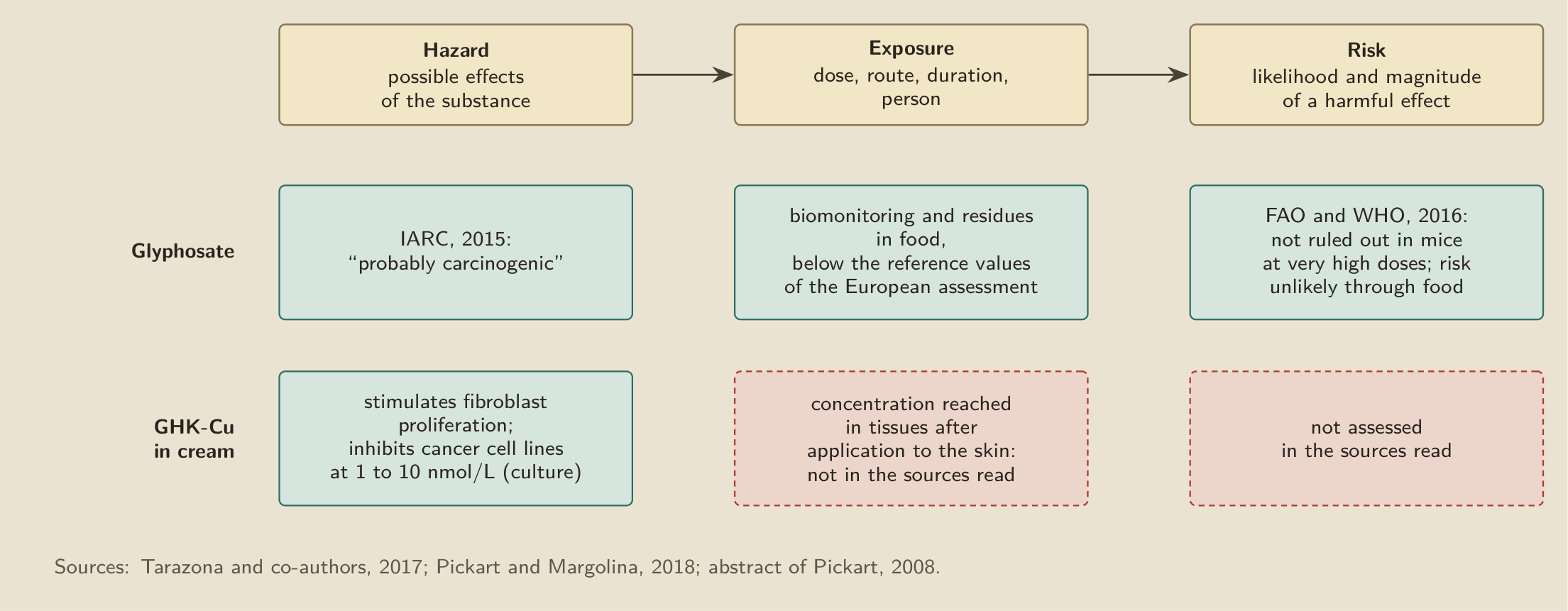
The review by Renke’s team states that GHK-Cu is very safe on the skin, that its systemic use has not entered medical practice, and that animal studies show no notable toxicity (Renke and Chinellato 2026). These three assertions rely on a 2015 article by the team that first described the peptide (Renke and Chinellato 2026). A 2025 review describes its effects on the skin based on Pickart’s 2018 article, an older article he co-authored, and cosmetic trials from other teams, without addressing cancer risk (Pintea et al. 2025; Pickart and Margolina 2018). None of the studies says what quantity of peptide reaches tissues when applied as a cream.
 Tap to enlarge
Hazard and risk
Toxicology, the science of toxic substances, distinguishes hazard, the possible effects of a substance, and risk, the probability that an adverse effect will occur under conditions of use (Tarazona et al. 2017) (Wikipédia s. d.t). Glyphosate, a weedkiller, provides an example: in 2015, the International Agency for Research on Cancer classified it as a probable carcinogen, a conclusion that focuses on hazard (Tarazona et al. 2017). The European assessment concluded that glyphosate was probably not carcinogenic, and a joint meeting of the FAO and WHO judged a cancer risk for humans exposed through their diet to be unlikely (Tarazona et al. 2017) (Tarazona et al. 2017).
 Tap to enlarge
In 1965, Bradford Hill proposed nine criteria to judge whether an association between an exposure and a disease reflects a cause, including the existence of a mechanism that could explain it (Fedak et al. 2015) (Wikipédia s. d.d). A 2015 article points out that these are flexible benchmarks, not a checklist (Fedak et al. 2015). In 2020, Mingyang Song noted regarding sugar that most studies had found no link with cancer, despite a mechanism deemed very plausible, whereas the French NutriNet-Santé cohort found a slightly higher risk among the highest consumers (Song 2020) (Song 2020).
In a study published in 2015, William Goodson and more than one hundred seventy co-authors examined eighty-five chemical substances: most already acted at low doses on cancer mechanisms, and substances with no effect taken individually could have one when combined (Goodson et al. 2015) (Goodson et al. 2015) (Goodson et al. 2015) (Goodson et al. 2015). They do not reach a conclusion on any specific mixture (Goodson et al. 2015). In 2020, Vladimír Bencko and his colleagues wrote that risk assessment and the precautionary principle complement each other, depending on the information available at the time of decision, and that epidemiology often lacks sufficiently large samples to establish a link with cancer (Bencko et al. 2020) (Bencko et al. 2020).
I was unable to read documents from drug agencies or package inserts for these medications, whose terms are known to me only through articles. Nor did I read the World Anti-Doping Agency list or the decisions of the American drug agency on peptides sold without a prescription. My sources describe no large study tracking cancer in people taking these peptides, but such a study may exist elsewhere. The digestive or cardiovascular risks of these products require a separate investigation, and when facing a specific substance, the decision rests with each individual and their physician.
For my part, I do not believe one can say across the board that “peptides” cause cancer, nor that they are without risk, because the word brings together molecules that have almost nothing in common. Diabetes medications have been followed in thousands of patients, whereas the vials people inject at home have almost never been studied in humans, and it is this silence that makes me doubt them most.
References
What has changed
- : The text is rewritten as a narrative, starting from the question the author asked himself about the risks of peptides. Its title does not change. What prompted it: The article now goes through the studies one after another, and the doses reported in the trials no longer appear in it. Its thirty sources are retained, and the medical terms it explains along the way point to their encyclopedia article.