
Why does leaving one's religion hurt so much?
Years after ceasing to believe, certain fears and certain reflexes remain. Psychologists, neuroscientists, and scholars of sacred texts have studied these intuitions that outlive faith
Published · Updated
Leaving one’s religion hurts, especially when one fears losing one’s loved ones by departing. When one has been raised dogmatically, one can no longer really distinguish between dogma, politics, family, and upbringing. It is this mixture that made me want to write, because I find that it bears a strange resemblance to brainwashing.
Leaving a religion can leave behind an experience that one does not always dare to name, even though one has stopped believing. The decision was made calmly, after reflection. Yet the fear of hell returns, a previously forbidden food triggers disgust, the thought of disappointing a parent sets off overwhelming guilt. These sensations are sometimes so strong that they take on the appearance of a message, as if the abandoned religion had been right after all. They are found after leaving Islam, but also strict evangelicalism, Jehovah’s Witnesses, or certain rigorist Catholic currents.
A religious residue
In 2021, Daryl Van Tongeren compared former believers with people who have never believed (Van Tongeren et al. 2021). His samples, which were representative, came from the United States, the Netherlands, New Zealand, and Hong Kong, countries with predominantly Christian traditions, except Hong Kong (Van Tongeren et al. 2021). Among former believers, he found differences in ways of thinking, feeling, and acting, which he calls a “religious residue” (Van Tongeren et al. 2021). Two of his three studies measure only a single moment in the participants’ lives (Van Tongeren et al. 2021).
Leaving, and risking losing one’s own
According to the abstract of his study on immigrant Muslim families in France (I was unable to read the rest), Thomas Soehl notes strong religious continuity between parents and children (Soehl 2017).
In the Netherlands and Great Britain, Maria Vliek collected accounts from people who left Islam (Vliek 2019). One speaks of the shame felt by the family, while others tell of a family that accepted the departure (Vliek 2019). These interviews do not indicate which of the two situations is more frequent (Vliek 2019).
Leaving also means losing the group around which a life was built (Ransom et al. 2020). In 2012, Naomi Eisenberger recalled that exclusion causes significant psychological pain, which partly engages brain circuits close to those for physical pain (Eisenberger 2012; Macdonald and Leary 2005). This connection with physical pain is still debated (Eisenberger 2012; Macdonald and Leary 2005).
According to work by Selina Rudert in 2023, excluding or threatening to exclude pushes group members to conform and maintains group cohesion (Rudert et al. 2023; Eriksson et al. 2021; Ransom et al. 2020). A survey conducted in 2021 across fifty-seven societies also examined how groups enforce their rules (Rudert et al. 2023; Eriksson et al. 2021; Ransom et al. 2020). Several religions have organized this exclusion and given it a name: the “disfellowshipping” of Jehovah’s Witnesses, Jewish herem, Amish Meidung, and the takfir of certain Muslim fringes (Ransom et al. 2020).
In 2020, Heather Ransom and her coauthors surveyed five hundred fifty-four people, the vast majority of whom had left Jehovah’s Witnesses (Rudert et al. 2023; Eriksson et al. 2021; Ransom et al. 2020). Among them, being shunned is frequent, whether the person was disfellowshipped or left voluntarily (Rudert et al. 2023; Eriksson et al. 2021; Ransom et al. 2020). The authors cite other work linking departure to lower self-esteem and lower well-being, and note that their survey measured only a single moment (Rudert et al. 2023; Eriksson et al. 2021; Ransom et al. 2020).
A learned fear does not fade
Thomas Giustino and his coauthor noted in 2015 that a learned fear does not disappear when it is “unlearned” (Giustino and Maren 2015). A new, more fragile learning overlays it, and the initial trace remains (Giustino and Maren 2015) (Giustino and Maren 2015). This fear largely passes through the amygdala, a brain region that reacts quickly and depends relatively little on reasoning (Giustino and Maren 2015; Mavrych et al. 2025) (Wikipédia s. d.a). A review published in 2025 provides its anatomical details (Giustino and Maren 2015; Mavrych et al. 2025). To extinguish it, one must be exposed again to the feared situation, and conviction alone is not sufficient (Giustino and Maren 2015).
A predictive brain
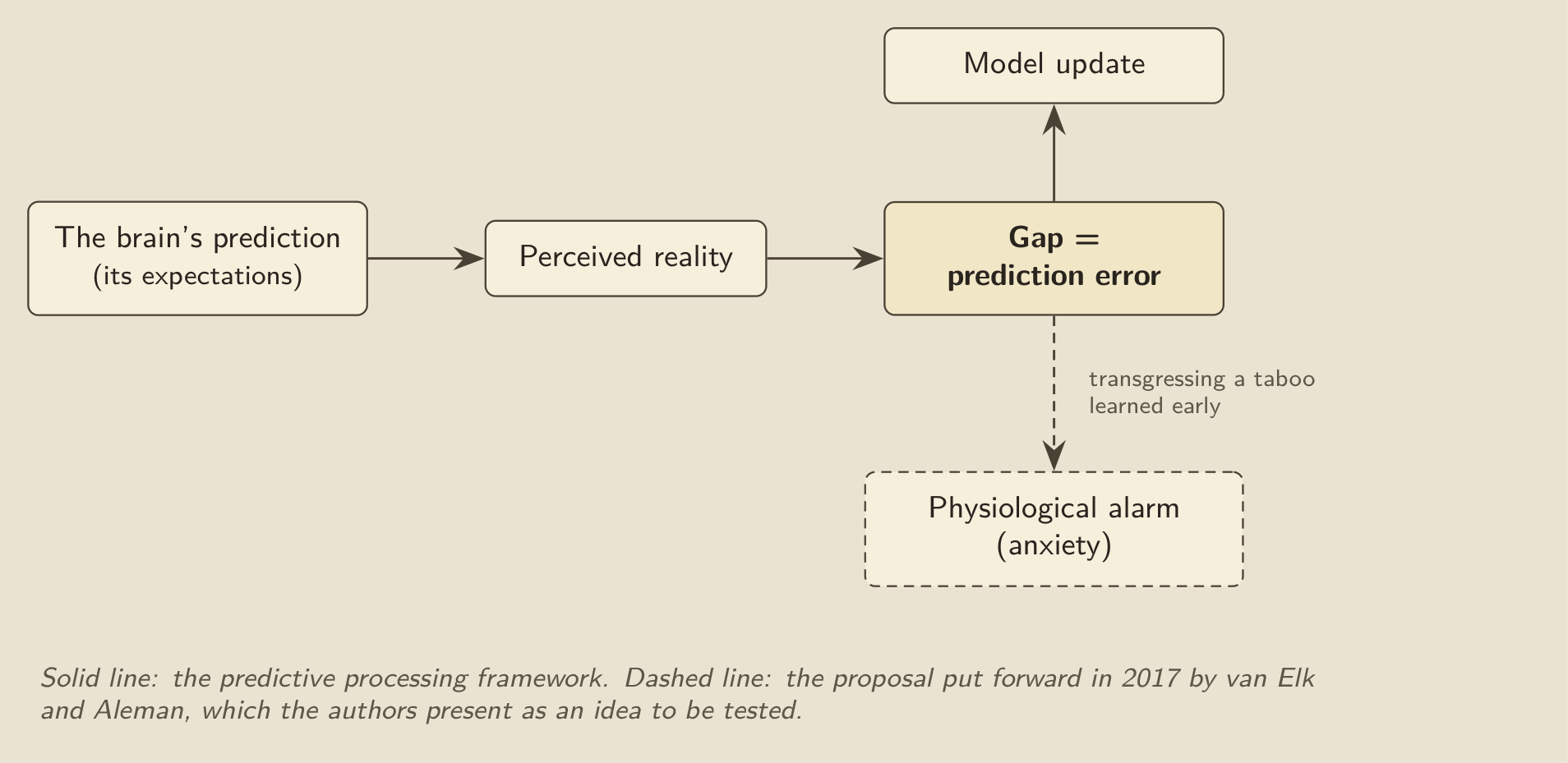
A theory in neuroscience, predictive processing, describes the brain as a machine that anticipates its perceptions and then corrects its predictions based on incoming information (Van Leeuwen and van Elk 2018) (Millidge et al. 2021; Schlicht 2025). It is now a dominant framework in cognitive neuroscience, but it remains a theory (Millidge et al. 2021; Schlicht 2025).
In 2017, Michiel van Elk and a colleague proposed applying it to religion (van Elk and Aleman 2017). In their view, early religious upbringing would establish deep expectations that link doubt or transgression to sin and damnation (van Elk and Aleman 2017). Transgressing would then create a gap with these expectations, experienced as anxiety (van Elk and Aleman 2017). The authors present these ideas as avenues to test, and no measurement has verified them yet (van Elk and Aleman 2017) (van Elk and Aleman 2017).
 Tap to enlarge
In the brain, the dopamine system signals the gap between expected reward and received reward, thus locking in learned associations (Wood and Rünger 2016; Glimcher 2011; Dabney et al. 2020). Paul Glimcher noted this in 2011, and a team detailed it in 2020 in the journal Nature (Glimcher 2011; Dabney et al. 2020). This evidence relates primarily to reward, not to the fear of damnation (Glimcher 2011; Dabney et al. 2020).
Another region, the anterior cingulate cortex, often recurs in these explanations, because it was long viewed as a conflict and error detector (van Elk and Aleman 2017; Botvinick 2007; Burle et al. 2008; Schmidt 2019; Dignath et al. 2020). This idea was still considered standard in 2007, but a team showed as early as 2008 that the error signal does not reflect conflict (van Elk and Aleman 2017; Botvinick 2007; Burle et al. 2008; Schmidt 2019; Dignath et al. 2020). In 2019, James Schmidt concluded that this conflict monitoring is an illusion, and that learning and memory biases in the experiments better explain the observed effects (van Elk and Aleman 2017; Botvinick 2007; Burle et al. 2008; Schmidt 2019; Dignath et al. 2020). In 2020, other researchers proposed an emotional explanation, while considering part of the evidence ambiguous (van Elk and Aleman 2017; Botvinick 2007; Burle et al. 2008; Schmidt 2019; Dignath et al. 2020).
The difficulty of enduring not knowing has a name among psychologists: intolerance of uncertainty (McEvoy et al. 2019; Mathews and Sarawgi 2025) (Mathews and Sarawgi 2025). It is associated with several disorders, including anxiety, obsessive-compulsive disorder, and depression (McEvoy et al. 2019; Mathews and Sarawgi 2025). According to the abstract of a meta-analysis, a study that aggregates results from many others (I was unable to read the rest), the link is clear, without it being known which of the two causes the other (McEvoy et al. 2019; Mathews and Sarawgi 2025) (Wikipédia s. d.f).
When fear becomes debilitating
In some people, the fear of hell, the terror of having been mistaken, and the feeling of having lost everything become debilitating (Singh et al. 2024; Ransom et al. 2020). People sometimes speak of “religious trauma syndrome” (Singh et al. 2024; Ransom et al. 2020). American psychologist Marlene Winell proposed the phrase in 2011, but it does not appear in the DSM-5, the American manual of mental disorders, or in the International Classification of Diseases (Winell 2011; Singh et al. 2024) (Wikipédia s. d.e). Clinicians can diagnose post-traumatic stress of religious origin, without the two designations having been recognized as equivalent (Singh et al. 2024).
Two researchers, including Daniel Koch, constructed a spiritual harm scale, a questionnaire on abusive religious experiences and the accompanying distress (Koch and Edstrom 2022). According to the abstract, they developed it using responses from three thousand two hundred twenty-two people (Koch and Edstrom 2022). It is a tool for assessing suffering, not the diagnosis of a syndrome (Koch and Edstrom 2022).
Scrupulosity
Suffering sometimes takes an obsessive form, called scrupulosity (Greenberg and Huppert 2010; Mathews and Sarawgi 2025). In 2010, David Greenberg and a colleague described it as a form of obsessive-compulsive disorder, or OCD, with obsessions, compulsions, and moral or religious distress (Greenberg and Huppert 2010; Mathews and Sarawgi 2025). The fear of being mistaken or burning for eternity drives checking, ruminating, and endlessly seeking reassurance (Greenberg and Huppert 2010; Mathews and Sarawgi 2025). It can affect former evangelical Christians haunted by damnation, with doctrine providing the disorder’s content (Greenberg and Huppert 2010; Mathews and Sarawgi 2025). Nothing shows that religious upbringing causes OCD (Greenberg and Huppert 2010; Mathews and Sarawgi 2025).
OCD is treated in particular with exposure and response prevention, a standard treatment: one voluntarily and gradually confronts the feared thought without performing the rituals used to reassure oneself (Reid et al. 2021; Song et al. 2022). According to the abstract of a meta-analysis published in 2021, this treatment performs better than a psychological placebo (Reid et al. 2021; Song et al. 2022). It also performs better than the medications compared, though the difference becomes small when these medications are taken at the proper dose, and it does not perform better than other psychotherapies (Reid et al. 2021; Song et al. 2022). Data specific to scrupulosity remain rare (Reid et al. 2021; Song et al. 2022).
In scrupulosity, constantly seeking reassurance can sustain obsessive doubt (Rector et al. 2019; Mathews and Sarawgi 2025). In patients with anxiety or OCD, Neil Rector’s team observed that seeking less reassurance is associated with improvement (Rector et al. 2019; Mathews and Sarawgi 2025). Their study did not test the effect of arguments about the existence of hell (Rector et al. 2019; Mathews and Sarawgi 2025). Another model, known as inhibitory learning, aims instead to teach tolerance of uncertainty, even when the feared religious consequence can never be observed (Weisman and Rodebaugh 2018; Mathews and Sarawgi 2025).
The feeling of being watched
The scene is imaginary: an ancestor hears a rustling in the tall grass of the savanna, without seeing its origin. The wind is blowing, or a predator is approaching. If they wrongly believe in the predator, they get off with a fright (Willard et al. 2025). If they believe in the wind when a predator is approaching, they may lose their life (Willard et al. 2025).
A theory known as error management proposes that such unequal costs favor the less costly error (Haselton and Nettle 2006). In 2006, two researchers applied it to the detection of beings that act: when in doubt, assuming someone is there would cost less than failing to see them (Haselton and Nettle 2006). Researchers who study religion drew from this the idea of a “hyperactive agency detection device”: people would spontaneously attribute invisible intentions to their environment, and religion would build upon this reflex to populate the world with spirits and gods who watch (Willard et al. 2025; Van Leeuwen and van Elk 2018).
In 2025, Aiyana Willard and her colleagues took stock: after nearly thirty years, almost no experiment directly supports the existence of this detector (Willard et al. 2025; Van Leeuwen and van Elk 2018). Other researchers were already raising this objection in 2018 (Willard et al. 2025; Van Leeuwen and van Elk 2018). Anthropologist Pascal Boyer viewed religion in 2003 as a byproduct, which would reuse mental mechanisms that arose for other reasons (Boyer 2003; Sommer et al. 2023). This idea still dominates, but several of the mechanisms on which it rested, including this detector, have lost their solidity (Boyer 2003; Sommer et al. 2023).
Purposes everywhere
In 2009, a study by psychologist Deborah Kelemen showed that people spontaneously assign purposes to the world, as if things existed “for” something (Willard et al. 2025; Van Leeuwen and van Elk 2018; Kelemen and Rosset 2009). This tendency, which psychologists call “promiscuous teleology,” is observed in children and partly persists in adults (Kelemen and Rosset 2009). In their experiments, college students who had taken science courses more readily agreed with a sentence like “the sun radiates to warm living things” when pressed to answer quickly (Kelemen and Rosset 2009).
An invisible presence
When one attributes thoughts and intentions to someone, two brain regions in particular are active: the medial prefrontal cortex and the temporoparietal junction (van Elk and Aleman 2017). This circuit can continue to function even when no one is watching (Van Leeuwen and van Elk 2018). In 2017, Michiel van Elk and his colleague linked the impression of being judged by an invisible presence after losing faith to this circuit (van Elk and Aleman 2017). The anatomy has been measured, but this link to invisible surveillance has not been tested (van Elk and Aleman 2017).
Disgust toward a forbidden food
Someone who has left Islam can view pork as ordinary meat and yet feel physical aversion when near it. The same gap exists, after leaving a strict community, toward a gesture, a piece of clothing, or a word that was once forbidden.
Disgust is primarily a defense against disease: it keeps one away from spoiled food, poisons, and sources of infection (Oaten et al. 2009; Curtis et al. 2011; Cepon-Robins et al. 2021). The psychology of emotions considers this role well established, as Megan Oaten’s 2009 review noted (Oaten et al. 2009; Curtis et al. 2011; Cepon-Robins et al. 2021). In 2021, a team showed that in an environment where infectious diseases are highly prevalent, individuals most sensitive to disgust were infected less often (Oaten et al. 2009; Curtis et al. 2011; Cepon-Robins et al. 2021). This sensitivity develops early: a 2025 study found that young children share part of their mother’s sensitivity to disgust (Kaňková et al. 2025). It focused on disgust toward sources of disease, without any religious prohibitions (Kaňková et al. 2025).
One often reads that physical disgust and moral disgust share the same brain region, and that religions graft their prohibitions onto it to make them indelible (Landy and Goodwin 2015). In 2022, a brain imaging meta-analysis found only partial overlap: disgust toward repulsive food and disgust toward social transgression converge in a region called the anterior insula, and diverge elsewhere (Gan et al. 2022, 2024). Another team had already distinguished the anterior from the posterior insula in 2018, finding a shared basis in some places and different circuits elsewhere (Ying et al. 2018; Gan et al. 2022).
In 2023, Kurt Gray and his coauthors concluded that “purity” is a poorly unified concept that cannot be tied specifically to disgust (Gray et al. 2023). Another idea holds that incidental disgust makes moral judgments more severe (Landy and Goodwin 2015; Gan et al. 2022; Gray et al. 2023). In 2015, Justin Landy and a colleague aggregated studies on the topic and corrected for publication bias, the tendency to publish primarily positive results: the effect becomes so small that it is no longer distinguishable from zero, and even reverses direction (Landy and Goodwin 2015) (Wikipédia s. d.b).
Learned food aversions, for their part, can endure: in 2022, Mark Bouton showed that in the laboratory, they resist extinction (Nakai et al. 2020; Bouton and Michaud 2022). These experiments generally start from nausea, whereas a religious prohibition starts from a rule, and none involved pork among former believers (Nakai et al. 2020; Bouton and Michaud 2022). That a purity code could establish a lasting physical aversion in the body is an unverified hypothesis (Curtis et al. 2011; Gray et al. 2023).
A text that seems perfect
A text can seem so beautiful that one comes to think no human could have written it. In Islam, this idea has a name, i’jaz, the inimitability of the Quran. The same feeling exists before the King James Bible, a Vedic recitation in Sanskrit, or a Miserere that overwhelms whoever listens to it.
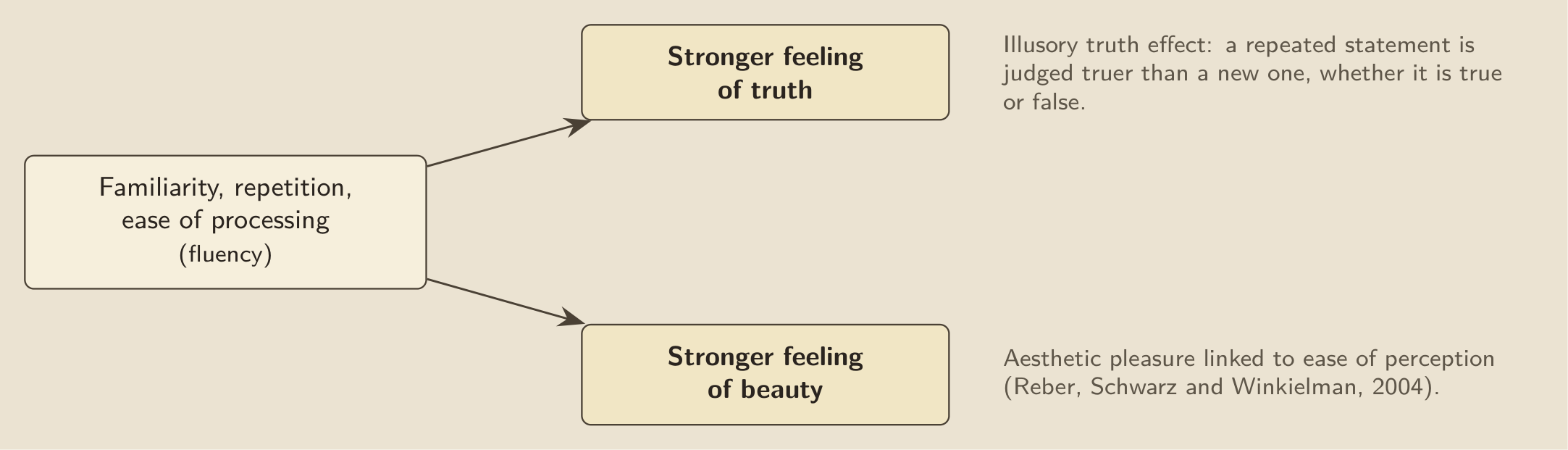
The more easily information is processed, the more true and beautiful it seems, and psychologists call this ease fluency (Hassan and Barber 2021; Unkelbach and Rom 2017) (Reber et al. 2004; Yoo et al. 2024). A repeated sentence is thus judged truer than a new sentence, whether it is true or false: this is the “illusory truth effect” (Hassan and Barber 2021; Unkelbach and Rom 2017). A 2021 study found it again, affecting feelings of truth as well as confidence, and other researchers have proposed since 2017 to explain it instead by familiarity (Hassan and Barber 2021; Unkelbach and Rom 2017). For beauty, Rolf Reber and two colleagues linked aesthetic pleasure as early as 2004 to the ease with which an object is perceived (Reber et al. 2004; Yoo et al. 2024). Beauty would thus depend largely on the observer’s experience (Reber et al. 2004; Yoo et al. 2024).
 Tap to enlarge
Encountering the same thing multiple times can also make one like it more: this is the mere exposure effect (Montoya et al. 2017; Yoo et al. 2024). A 2017 meta-analysis shows that this effect plateaus, then reverses beyond a certain number of encounters (Montoya et al. 2017; Yoo et al. 2024). Certain sacred texts are recited thousands of times from early childhood, in solemn settings.
Knowing in advance that something is valuable also changes the pleasure derived from it (Plassmann et al. 2008; Schmidt et al. 2017). In 2008, Hilke Plassmann led wine tasters to believe that a wine was expensive (Plassmann et al. 2008; Schmidt et al. 2017). They found it better, and an area of their brain linked to pleasure, the orbitofrontal cortex, was more active, even though the wine was the same (Plassmann et al. 2008; Schmidt et al. 2017). Another team found this price effect again in 2017 (Plassmann et al. 2008; Schmidt et al. 2017). The experiment involved wine, not a text regarded as the word of God.
Counting the words of the Quran
The i’jaz also makes testable claims about the text itself: its style, its composition, the unity of its authorship. Stylometry, which studies a text’s style through statistics, can compare writing signatures and estimate whether a corpus of texts comes from a single author (Neal et al. 2017; Eder 2015; Rosa 2025) (Wikipédia s. d.g). It measures neither a text’s beauty nor its origin (Neal et al. 2017; Eder 2015; Rosa 2025). It also requires length: in 2015, Maciej Eder measured that roughly two thousand five hundred to five thousand words were needed, depending on language and genre, with no single threshold valid across all methods (Eder 2015).
One sometimes reads that a computer supposedly detected multiple authors in the Quran. Since the work of Nöldeke, specialists have distinguished Meccan and Medinan layers in the text (Nøldeke et al. 2013; Sadeghi 2011). These layers may correspond to different periods of writing by the same author.
In 2011, in the journal Arabica, Behnam Sadeghi tracked four stylistic markers, from the average length of verses to the frequency of morphemes, the smallest units of meaning in a language (Sadeghi 2011) (Wiktionnaire s. d.a). According to the abstract (I was unable to read the rest), he arranges the text into seven phases, and his markers evolve so steadily from one to the next that he concludes there is a single style and a single author (Sadeghi 2011) (Nøldeke et al. 2013; Sadeghi 2011). His criterion assumes that several independent markers evolving together steadily are better explained by a single author whose style changes (Sidky 2019a, 2019b). In 2019, Hythem Sidky announced a conference talk in which he considers certain objections to this criterion legitimate, cites the early Meccan surahs as a debated case, and stresses that the text is too short for statistical certainty (Sidky 2019a, 2019b) (Sidky 2019a, 2019b). This is the abstract of a conference talk presenting a research program (Sidky 2019a, 2019b).
In 2012, Halim Sayoud compared the Quran to selected texts from al-Bukhari’s hadith collection, accounts reporting the words of the Prophet (Sayoud 2012, 2015) (Wikipédia s. d.c). According to the abstract, his sixteen experiments conclude there are two different authors, but the two corpora also belong to different genres (Sayoud 2012, 2015).
The manuscripts
According to the abstract of his 2020 article, Hythem Sidky reconstructs four ancestor manuscripts from which the regional families of so-called Uthmanic manuscripts he examined descend (Sidky 2020; Putten 2019). Marijn van Putten supports the idea of a single written copy at the origin of these manuscripts, but sets aside the lower text of the Sanaa palimpsest, a parchment erased and then rewritten: in his view, not all known texts descend from a single exemplar (Sidky 2020; Putten 2019) (Wiktionnaire s. d.b).
The Bible
Since Julius Wellhausen in 1883, scholars have recognized different sources and editorial additions in the Pentateuch, the first five books of the Hebrew Bible (Wellhausen 1883; Schmid 2021). A 2021 overview notes that while this principle enjoys consensus, the classic division into four sources no longer does (Wellhausen 1883; Schmid 2021).
Among the letters attributed to Paul, scholars hold seven to be authentic and consider the others disputed (Savoy 2019; Rosa 2025). In 2019, Jacques Savoy distinguished four stylistic groups using stylometry, and attributes the letters to the Colossians and Ephesians and the so-called pastoral letters to hands other than Paul’s (Savoy 2019; Rosa 2025). In 2025, Anthony Rosa noted regarding these same letters that, without reference texts of certain authorship, these methods cannot resolve the question of origin (Rosa 2025).
Five prayers a day
In Islam, ritual prayer, salat, occurs five times a day: at dawn, noon, afternoon, sunset, and evening (Encyclopaedia Britannica 2025). It begins with ablutions, then follows a set order of postures and recitations facing Mecca (Encyclopaedia Britannica 2025). On Friday, the noon prayer gathers the community (Encyclopaedia Britannica 2025).
In 2017, Jonathan Scourfield presented a study of sixty Muslim families in Cardiff, where children learned prayer gradually through the body and practice (Scourfield et al. 2013; Scourfield 2017). They were four to twelve years old, and the age at which they learned salat varied from one family to another (Scourfield et al. 2013; Scourfield 2017). Practiced daily from childhood to adulthood, prayer is repeated tens of thousands of times, at the same hours, in the same places, with the same movements.
In 2016, Wendy Wood and a colleague described habit in this way: an action repeated in a stable context gradually becomes automatic, to the point of being triggered on its own by a cue, a time, a place, or a sound (Wood and Rünger 2016; Lally et al. 2010). In 2010, Phillippa Lally tracked ninety-six volunteers for twelve weeks to see at what rate a new behavior becomes automatic (Wood and Rünger 2016; Lally et al. 2010). Among those whose measurements were usable, it generally took sixty-six days for automaticity to approach its plateau, with variations from eighteen to two hundred fifty-four days depending on the individual (Wood and Rünger 2016; Lally et al. 2010).
Salat has several such cues each day, and some do not depend on the practitioner, such as the path of the sun and the call to prayer that follows it (Wood and Rünger 2016). None of the studies consulted, however, measured the extent to which ritual prayer becomes automatic (Wood and Rünger 2016).
Prayer is also a ritual, and rituals are linked to anxiety in both directions (Lang et al. 2015, 2020, 2022) (Lang et al. 2020; Hobson et al. 2018). In 2015, Martin Lang used motion capture to film movements that became more repetitive and more rigid when participants were made anxious (Lang et al. 2015, 2020, 2022). These predictable sequences appeared to restore a measure of control (Lang et al. 2015, 2020, 2022). In 2020, among Marathi practitioners in Mauritius, his measurements showed conversely that ritual lowers anxiety, real though modest in effect (Lang et al. 2015, 2020, 2022).
Stopping prayer removes five anchors a day, a rhythm, a posture, a means of soothing anxiety, and the Friday gathering, even as the sun continues to set and Friday returns. In 1988, Cindy Ehlers and two colleagues proposed the theory of “social zeitgebers”: disrupting daily routines could contribute to triggering depressive episodes in vulnerable individuals (Ehlers et al. 1988; Grandin et al. 2006). In 2006, a review considered the evidence in its favor limited (Ehlers et al. 1988; Grandin et al. 2006).
Meaning after belief
A theory long presented religions as an answer to a human need for meaning and structure, but it held up poorly when other teams replicated its experiments (3rd et al. 2010).
Among experiences that provide meaning without religion, the most studied is awe (Monroy and Keltner 2023). In 2023, Dacher Keltner defined it as the emotion felt before something so vast, in size or concept, that it compels the mind to expand its mental schemas (Monroy and Keltner 2023). In 2015, Paul Piff and his colleagues observed that it reduces the sense of one’s own importance and makes people more generous, regardless of the participants’ degree of religiosity (Piff et al. 2015). In 2018, Craig Anderson associated it with greater well-being and lower stress among veterans and at-risk youth, though such studies remain few (Monroy and Keltner 2023; Anderson et al. 2018). It is experienced without religion, especially in nature, the best-documented avenue, but also through music or collective movements (Monroy and Keltner 2023; Anderson et al. 2018).
One also reads that it “spectacularly deactivates” the default mode network, a set of brain regions associated with self-referential rumination. In 2019, Michiel van Elk did find a decrease in self-centered activity during awe, but attention absorbed by the scene partly accounts for this, and this study has no known replication (van Elk et al. 2019). A meta-analysis on rumination focused on healthy individuals and distinguished several parts of this network, without measuring general hyperactivity in anxious or depressed individuals (Hamilton et al. 2015; Zhou et al. 2020). “Ego dissolution,” which is also attributed to it, is described primarily under psychedelics and cannot be applied without caution to ordinary awe (Lebedev et al. 2015; Siegel et al. 2024). In supervised clinical trials with severely ill patients, psychedelics reduced anxiety and depression through the mystical experience they induce, and this result applies only within that setting (Griffiths et al. 2016; Ross et al. 2016).
In 2015, Jennifer Stellar linked a disposition toward awe to lower levels of interleukin-6, an inflammatory marker (Stellar et al. 2015) (Wikipédia s. d.d). Available studies, however, do not support an oxytocin release or an effect on the vagus nerve (Stellar et al. 2015).
Astrophysicists have known since 1957 that the carbon, oxygen, and iron in our bodies were forged in the cores of stars, then dispersed by their explosions (Arcones and Thielemann 2022). Rituals without the supernatural mark solstices, births, and mourning, providing belonging and bearings (Hobson et al. 2018). They too can reduce anxiety, with an effect that is real but modest (Lang et al. 2020; Hobson et al. 2018).
In 2013, Michael Tomasello traced the evolutionary roots of cooperation, empathy, and a sense of fairness, which exist without a supernatural foundation (Tomasello and Vaish 2013; Purzycki et al. 2016). A study published in Nature in 2016 gives moralizing, punitive gods a possible role in history: believing in them reportedly extended to large groups of strangers a cooperation that this belief had not created (Purzycki et al. 2016).
A question for philosophers
Philosophers have long wondered whether knowing the origin of a belief says anything about its truth (Kahane 2011; Joyce 2016). In 2011, Guy Kahane gave a standard form to a line of reasoning known as “genealogical debunking”: a belief produced by a mechanism that triggers in the same way whether it is true or false loses its justification, without thereby being proven false (Kahane 2011; Joyce 2016). Philosophers who study it point out that it can “prove too much,” even undermining our ordinary beliefs (Kahane 2011; Joyce 2016). Perception, mathematics, and reasoning escape this because we have other reasons to think they track their object: in a room with no table, one sees no table (Kahane 2011; Joyce 2016).
For my part, I do not see in these fears and reflexes a message from elsewhere, since they would also appear in a world without a god (Kahane 2011; Joyce 2016). Nor do they say that God does not exist (Kahane 2011; Joyce 2016). But their pain is no less real.
References
What has changed
- : The text is rewritten as a narrative of the research on the fears and reflexes that outlive faith, without the test that judged each feeling; the title does not change. What prompted it: The article now tells the researchers' work one study after another, with their own reservations, and leaves the conclusion to the reader. Its scientific sources are retained, and nine dictionary or encyclopedia pages are added for the terms explained along the way.
- : The exemption that spares perception, mathematics and reasoning is stated to be assumed rather than established. What prompted it: This clause bears the entire reasoning of both texts and is neither set out, sourced nor graded there, in a corpus that grades everything else. Two independent reviews identified it as the weakest link in their paper. Refusing to grade it was the only asymmetry that an opposing reader did not have to look for.
- : The passage on the pain of exclusion refers to the paper that establishes it instead of demonstrating it a second time. What prompted it: Two papers independently established the same overlap with physical-pain circuits, using two distinct apparatuses. This is the subject of the paper on fear of rejection, and the duplication was the most visible in the corpus.
- : The savanna scene is described as an illustration of asymmetric costs, not as a reconstruction of ancestral behaviour. What prompted it: Another paper in the corpus explicitly refuses to rely on fossils and explains why. This text made its central mechanism depend on an ancestral setting without any of that apparatus.
- : The reference to “another examination” states that this examination does not yet exist in this journal. What prompted it: The philosophical arguments for God were referred to an examination with no destination, and no text in the corpus addresses them. Stating the debt is better than pointing to a door that opens onto nothing.
- : The opening chapter refers to the paper that provides the tools for recognising invalid reasoning. What prompted it: This text presupposes that tool from its opening without ever saying where it is set out.
- : Conflict monitoring by the anterior cingulate cortex, previously described as firmly established, is presented as a matter of debate. What prompted it: A 2019 review concludes that this monitoring is an illusion, and a 2008 reassessment shows that the error signal does not reflect conflict. These studies had not been considered.10.3758/s13423-018-1520-z10.1162/jocn.2008.20110