Why do we say "society" to name the harms that touch us but that we do not want to answer for?
The word sometimes points to a real collective cause, sometimes it serves to pull one's own hand out of the problem, and we gain by knowing which of the two we are doing
0. Introduction: the word that does two things
A news item shocks you and you say “society is violent”. A public service fails and you sigh “society does nothing”. A child grows up badly, a neighbour goes under, an injustice drags on, and the same subject keeps returning to our lips, convenient, available, never contradicted: “it’s society”. The word arrives at the exact moment when a harm touches us but when we do not want to attach ourselves to it, as if we needed a culprit vast enough that no face, above all not our own, could be recognised in it. It is this usage that must be examined closely, not in order to forbid it, but because it covers two very different gestures that we have an interest in not confusing.
The word “society” does in fact two distinct things that we mix without thinking: it sometimes points to a real causal level, that of harms produced by rules and aggregates that do not reduce to the sum of individual intentions, and it sometimes serves as a screen, a way of diluting one’s own share and suspending action. Knowing which of the two operations one is carrying out, each time one utters the word, is the heart of the problem. The thesis defended here is therefore neither “everything is individual fault”, which would erase the structural level, nor “everything is society”, which would erase agency: it is that the same sentence can name an authentic collective cause or dodge one’s own share, and that we gain by knowing which case we are in.
The march of the text follows a simple logic, dictated by the problem itself. It first lays out the reflex, then shows the real structural level so as to take nothing away from it, then describes the mechanism of the screen, proposes a test to separate the two, and finally points to the concrete way out. This order is not decorative: beginning with the structural avoids reducing every use of “society” too quickly to a personal cowardice, and ending with the test avoids believing that it would be enough to denounce the dodge to have gone beyond it.
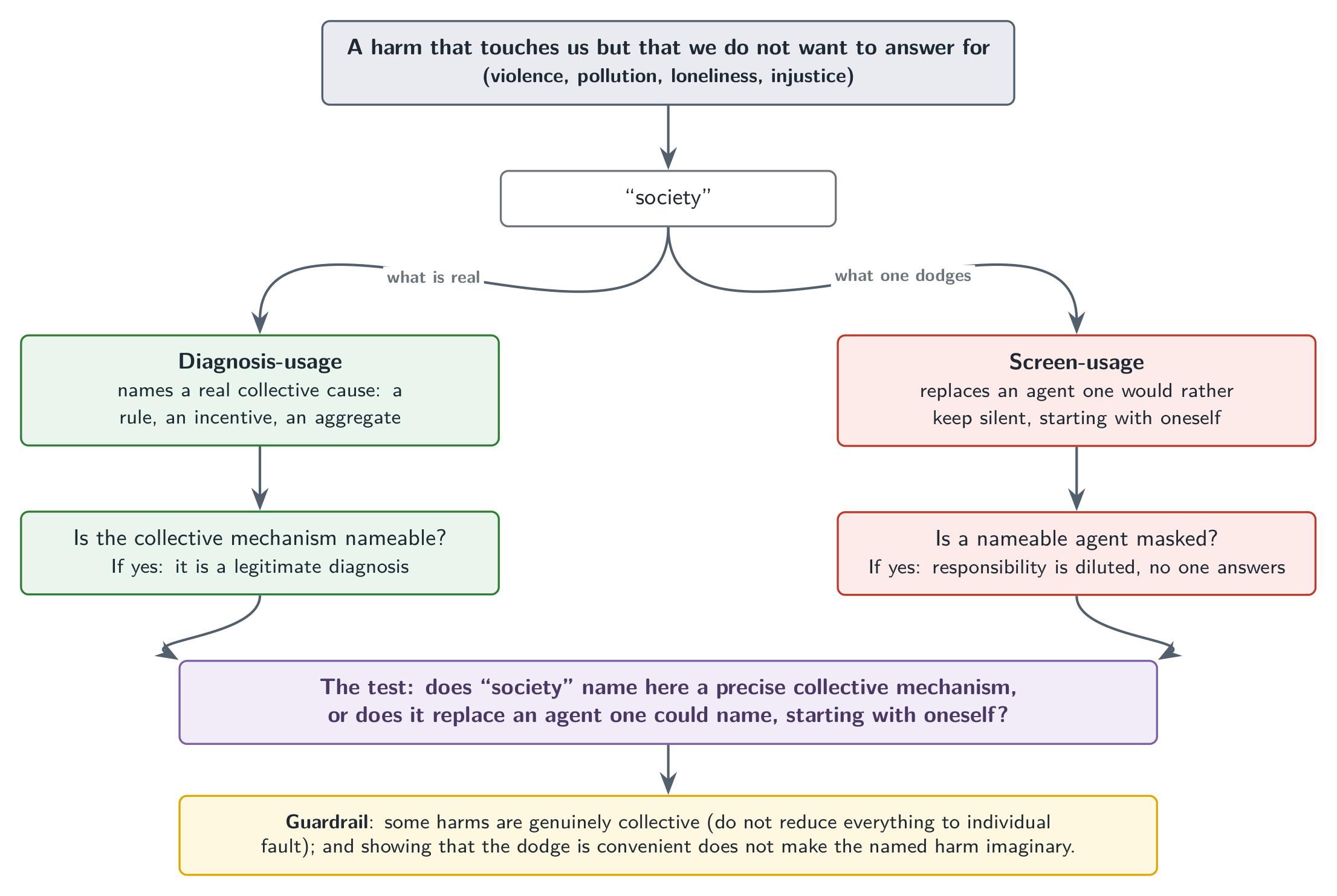
The test that will guide the whole reading comes down to one question. When you catch yourself saying “society”, ask whether the word here replaces a collective mechanism that you could name precisely, a rule, an incentive, an aggregate, or whether it replaces an agent you would rather not name, starting with yourself. If you can point to the mechanism, “society” works as a diagnosis; if the word only masks an identifiable responsible party, it works as a screen.
Two precautions, at the outset, to frame the point. This text treats the rhetorical and psychological slippage by which an abstraction absorbs responsibility; it does not claim to do the general sociology of the notion of society, nor to settle the old metaphysical quarrel between holism and methodological individualism, two debates flagged in passing without being arbitrated here. And it targets a movement observable in everyone’s language, on the right as on the left of the political spectrum, rather than one camp: “society is too permissive” and “society is oppressive” proceed from the same grammatical gesture, and the screen claims every colour.
1. When “society” names something real
Let us begin with what the word rightly points to, for without this the whole sequel would turn to moralism. Sociology very early named a level of reality that escapes individual intentions. A social fact, in the classic sense, denotes ways of acting, thinking and feeling external to the individual and endowed with a power of constraint, which establishes an order of description irreducible to the psychology of each person (Durkheim 1895; Merton 1936). The language you speak, the rules of politeness you follow, the monetary system in which you count are not choices you negotiated: they precede you, impose themselves on you, and yet no individual decreed them alone (Durkheim 1895; Merton 1936). The social fact is therefore a fact, not a figure of speech, and to deny it would amount to claiming that nothing exists above individual heads (Durkheim 1895; Merton 1936).
The social sciences extend this intuition by distinguishing two regimes of causality. There is individual causality, that of intentions and choices, and structural causality, that of rules, institutions and occupied positions, and this distinction grounds the idea that certain harms call for a collective-level explanation (Durkheim 1895; Merton 1936). To explain a rate of unemployment by the supposed laziness of the unemployed, or an epidemic of accidents by the recklessness of drivers alone, amounts to ignoring that structures, a market, a road network, a set of incentives, produce regularities that no particular will commands (Durkheim 1895; Merton 1936). Recognising this level is not shirking: it is describing a part of the world correctly (Durkheim 1895; Merton 1936).
The clearest case is that of collective-action dilemmas. In such a situation, each actor who rationally pursues his interest contributes to an overall result that no one wants, which shows that a harm can be perfectly real without being wanted by any individual in particular (Olson 1965; Ostrom 1998). A traffic jam is desired by no motorist; it nonetheless arises from the sum of their individually sensible journeys (Olson 1965; Ostrom 1998). Here “society” does not serve as a screen: it names the right level of description, that of an interaction whose outcome exceeds each participant (Olson 1965; Ostrom 1998).
The free rider is the economic version of the same trap. The free-rider problem explains the underproduction of collective goods: everyone has an interest in enjoying a common good without contributing to its cost, so that the good risks never being produced, even when everyone wants it (Olson 1965; Ostrom 1998). A dyke, a national defence, breathable air benefit everyone without one being able to exclude those who have not paid, and this incentive structure pushes each person to wait for others to take care of it (Olson 1965; Ostrom 1998). The harm here is not a moral defect: it is lodged in the very form of the interaction (Olson 1965; Ostrom 1998).
The most famous image remains the tragedy of the commons. It describes the degradation of a shared resource when each user draws an individual benefit from it while spreading the cost over the whole, which illustrates a structural harm of aggregation rather than a personal wickedness (Hardin 1968). An open pasture, a water table, a stock of fish are drained when it is rational for each to take a little more, the loss being diluted over everyone (Hardin 1968). No one wants the exhaustion, the exhaustion happens all the same (Hardin 1968).
This tragedy has nothing of a fatality, however, and saying so matters so as not to fall into fatalism. Communities durably govern shared resources by means of local institutions, rules and negotiated sanctions, which shows that the collective level calls for collective solutions rather than individual virtue alone or privatisation alone (Ostrom 1990; Dietz et al. 2003). Irrigation systems, forests and fisheries managed in common sometimes hold for centuries, contradicting the idea that nothing can save a shared good outside the State or the market (Ostrom 1990; Dietz et al. 2003). The lesson is not to accuse individuals: it is that the right answer to a collective problem lies itself at the collective level (Ostrom 1990; Dietz et al. 2003).
Other harms of aggregation confirm the picture. A negative externality, like pollution, is a cost imposed on third parties by a transaction to which they are not a party, a real collective harm that requires the malice of no actor but flows from the aggregation of sensible individual choices (Dietz et al. 2003; Hardin 1968). The factory that releases its fumes, the motorist who drives, seek to wrong no one; the cost nonetheless falls back on residents who signed nothing (Dietz et al. 2003; Hardin 1968). Here again, invoking a level that exceeds intentions faithfully describes what is happening (Dietz et al. 2003; Hardin 1968).
Finally, sociology has made unintended effects an object in their own right. The unintended consequences of purposive action form a classic theme: individual conduct aimed at a goal produces overall effects that no one intended, another face of unwanted structural harm (Merton 1936). A well-intentioned policy can worsen what it meant to solve, a prudent norm can create a new risk, and these reversals can be read only at the level of the aggregate (Merton 1936). In all these cases, “society” is not a dodge: it is the correct name of a phenomenon that exists above persons (Merton 1936).
2. When “society” becomes a screen
The same word, backed by the same real phenomena, can tip into an entirely different usage. This tipping is illuminated by a set of well-documented mechanisms. Moral disengagement denotes a set of cognitive processes by which a person neutralises his own moral censorship and behaves harmfully without distress, notably by displacing or diffusing responsibility (Bandura 2014; Bandura et al. 1996). These processes are not the preserve of a few cynics: they activate in everyone, ordinarily, as soon as it is a matter of reconciling questionable conduct with the image one wants to keep of oneself (Bandura 2014; Bandura et al. 1996).
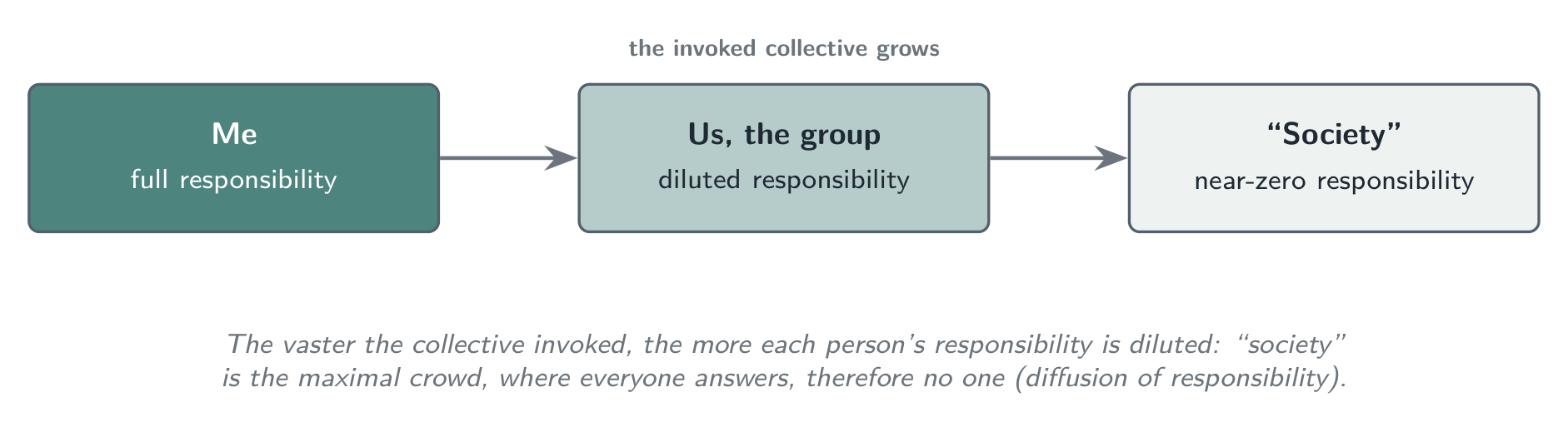
Two of these mechanisms bear exactly on our subject. The displacement and diffusion of responsibility consist in attributing one’s conduct to an authority or a collective, which attenuates the feeling of being the author of one’s own acts (Bandura 2014; Bandura et al. 1996). To say “I was told to” shifts the load toward a superior; to say “everyone does the same” dilutes it into a shapeless whole, and in both cases the agent feels less accountable for what he does (Bandura 2014; Bandura et al. 1996). “Society” offers an ideal receptacle for this transfer, since it has neither office nor face to which responsibility could be returned (Bandura 2014; Bandura et al. 1996).
Social psychology has measured this loosening in a striking situation. In an emergency, the presence of other witnesses reduces the probability that a given individual will intervene, an effect attributed to the diffusion of responsibility among the persons present (Darley and Latane 1968; Fischer et al. 2011). The more spectators presumed concerned there are, the less each feels bound to act, as if the load were shared until it became negligible for all (Darley and Latane 1968; Fischer et al. 2011). The effect has been refined rather than refuted: the meta-analysis confirms it while showing that it attenuates, or even reverses, when the danger is clear and intervention low-risk, which specifies its conditions instead of cancelling it (Fischer et al. 2011; Darley and Latane 1968). Caution is therefore called for in both directions, without denying the effect or inflating it (Fischer et al. 2011; Darley and Latane 1968).
A neighbouring factor reinforces the loosening. Deindividuation, that state of reduced self-awareness in a group or in anonymity, comes with a drop in the feeling of personal responsibility and a loosening of the norms of conduct (Postmes and Spears 1998). Merged into a mass, one feels less oneself, therefore less bound, and the collective absorbs what the individual no longer takes on (Postmes and Spears 1998). The word “society”, by designating the widest possible mass, offers precisely this bath of anonymity where each person’s share becomes untraceable (Postmes and Spears 1998).
From this a point of synthesis. To invoke “society” as responsible for a harm is the limit form of the diffusion of responsibility: the designated culprit is a collective so vast that everyone can count himself in it without ever feeling personally bound to act. Where the bystander effect plays out with a few passers-by, “society” summons a total crowd, that of all the living, so that responsibility, shared to infinity, no longer weighs on anyone. Everyone is responsible, therefore no one is.
The history of the research brings two honest clarifications here. Obedience studies showed that participants inflicted acts they disapproved of by attributing responsibility to the authority that commanded them, an experimental illustration of the displacement of responsibility outside oneself, even if they must be cited with the reservations raised by attempts at replication (Milgram 1963; Burger 2009). The result keeps its value as illustration without being made a mechanical proof of everyone’s behaviour (Milgram 1963; Burger 2009). Likewise, the news item that founded research on the bystander effect was told in exaggerated fashion by the press, and this part of myth has since been documented: flagging it protects the point from sensationalism while keeping the effect, itself, well replicated (Manning et al. 2007). Taking a mechanism seriously does not oblige one to swallow its legend (Manning et al. 2007).
A last spring closes the loop of collective inaction. Pluralistic ignorance reinforces the group’s immobility: each interprets the apparent calm of others as the sign that there is no cause to act, so that the whole freezes through mutual misreading (Prentice and Miller 1993; Darley and Latane 1968). No one moves because no one moves, each taking the wait-and-see of others for a reassuring verdict (Prentice and Miller 1993; Darley and Latane 1968). “Society is not moved by it” then becomes a self-fulfilling prophecy, each authorising himself by the general silence to fall silent in turn (Prentice and Miller 1993; Darley and Latane 1968).
3. The abstraction that anaesthetises
The screen draws part of its efficacy from a very general trait of our sensibility: we react to the concrete, not to the abstract. Research on giving and helping gives a clear measure of this. People show themselves more generous and more mobilised toward a single, identifiable victim than toward a large number of victims described statistically, a gap known as the identifiable-victim effect (Small et al. 2007; Kogut and Ritov 2005). A face, a first name, a singular story open the wallet and the heart where a figure, however dizzying, leaves us cold (Small et al. 2007; Kogut and Ritov 2005). The target that triggers affect is individual, and the collective abstraction makes it disappear (Small et al. 2007; Kogut and Ritov 2005).
The phenomenon worsens as the number grows. Psychic numbing means that compassion does not increase in proportion to the number of victims and can even decrease as that number grows, which makes great abstract harms less mobilising than a concrete case (Slovic 2007; Västfjäll et al. 2014). One person in danger grips us; a thousand people become a statistic, ten thousand a backdrop, and our emotional response dulls instead of following the real magnitude (Slovic 2007; Västfjäll et al. 2014). Great number, far from sharpening urgency, anaesthetises it (Slovic 2007; Västfjäll et al. 2014).
The effect does not trigger only at enormous scales. The loss of compassion is observed from the shift from one to two victims, which indicates that insensitivity to scale is not reserved for very large numbers (Västfjäll et al. 2014). Attention and affect already begin to waver when a second figure comes to share the light with the first, as if the resource of compassion were being divided instead of added (Västfjäll et al. 2014). The tipping from the individual to the collective is enough, on its own, to dent our impulse (Västfjäll et al. 2014).
Valuation studies confirm this insensitivity to number. Scope insensitivity means that the willingness to pay to save a large number of entities barely increases with that number, which shows that moral valuation does not follow the real magnitude of the harm (Kahneman and Knetsch 1992). Saving two thousand birds or two hundred thousand mobilises roughly the same sum in people’s minds, as if one were paying for the image of an oiled bird, not for their count (Kahneman and Knetsch 1992). The scale of the harm and the intensity of our response come uncoupled (Kahneman and Knetsch 1992).
A last bias finishes defusing great harms. The futility effect, the sense of the drop in the ocean, lowers helping when the share of victims one can rescue seems small relative to the total, which paradoxically makes the magnitude of a harm demobilising (Fetherstonhaugh et al. 1998). Learning that one will save only a tiny fraction discourages action, even though that fraction represents very real people (Fetherstonhaugh et al. 1998). The more immense the problem, the more derisory our gesture seems, and the less we act (Fetherstonhaugh et al. 1998).
These mechanisms have a coherent theoretical basis. A distant or abstract target is mentally treated in a more distant way than a near and concrete one, which reduces its emotional weight and the commitment to act, in keeping with construal-level theory (Trope and Liberman 2010). The more a thing is remote in space, time or abstraction, the more the mind treats it in general and cold terms, and the less it calls for a response (Trope and Liberman 2010). “Society” is, by construction, the most abstract and most distant object one can invoke (Trope and Liberman 2010).
Hence the direct application to our word. To say “society suffers” mobilises less than to say “this person suffers”, because the collective abstraction removes the identifiable target that triggers affect and action. The collective formula gives the impression of taking the harm seriously, in its greatest extension, whereas it places it out of reach of what would make us move. The word puts at a distance what a face would bring near, and this distance has a cost in action.
4. The grammar of the dodge
The screen does not hold only to the psychology of great number; it is inscribed in language itself, in the way a sentence can name or erase its author. Psycholinguistic research has measured it. Framing an event in the passive voice or in a non-agentive way, without naming the author, reduces the attribution of responsibility and blame compared with an active framing that names the agent (Fausey and Boroditsky 2010a, 2010b). “The vase broke” exonerates where “he broke the vase” accuses, and this difference of phrasing is enough to shift the judgment (Fausey and Boroditsky 2010a, 2010b). The grammar chosen orients whom one holds responsible (Fausey and Boroditsky 2010a, 2010b).
The effect does not stop at immediate judgment. Non-agentive language also influences the sanction judged appropriate and even the memory of the author, not just the attribution in the moment, which reveals a durable effect of the way an act is named (Fausey and Boroditsky 2010b, 2010a). Describing a fact without its agent leads to demanding a lesser reparation and to remembering less well who committed it, so that the grammatical erasure carries on into memory and into punishment (Fausey and Boroditsky 2010b, 2010a). The way of saying does not only colour the instant: it sediments (Fausey and Boroditsky 2010b, 2010a).
We thus have a genuine grammar of the dodge. “Mistakes were made”, “society failed”, “the system is like that”, “nothing can be done about it”: these collective subjects and passive turns all perform the same suppression of the author. This device is not a mere stylistic ornament. It accomplishes the very operation by which the speaker pulls his hand out of the gesture he describes, by making the agent disappear behind a form with no nameable subject. The sentence stays true in appearance, and yet it has evacuated the responsible party that an active turn would have exposed.
This power of abstract framing has been spotted well beyond the laboratory. Bureaucratic and impersonal language, by substituting neutral turns for agents and concrete acts, has been identified as a factor that distances the moral responsibility of those who carry out orders (Arendt 1963; Bandura 2014). Calling an eviction “handling a file”, a violence “a measure”, a dismissal “a headcount adjustment” allows one to act without feeling the author of an act that, described bluntly, would revolt (Arendt 1963; Bandura 2014). Administrative abstraction works as a moral anaesthetic for the one who uses it (Arendt 1963; Bandura 2014).
Softened vocabulary alters even the judgment passed on the act. Euphemistic language changes the moral appraisal of a behaviour: the same act, described in softened terms, is judged less reprehensible, another lever by which abstraction disengages (Bandura 2014; Bandura et al. 1996). What is called “collateral damage” shocks less than “civilians killed”, although the reality designated is identical, and this gap of words shifts the cursor of perceived gravity (Bandura 2014; Bandura et al. 1996). The choice of terms is therefore not neutral: it manufactures part of the judgment one will later believe to have formed freely (Bandura 2014; Bandura et al. 1996).
5. Why the screen is comfortable, and costly
If this slippage is so tempting, it is because it renders immediate services to the one who uses it. The first holds to self-image. Individuals adjust their judgments and their accounts to maintain a favourable moral image of themselves, which makes attractive any framing that lets one deplore a harm without counting oneself in it (Kunda 1990; Monin and Miller 2001). To say “society is selfish” ranks me among those who deplore it, never among the selfish, and earns me at little cost a place among the lucid and the just (Kunda 1990; Monin and Miller 2001). The screen flatters, since it gives me the fine role of the indignant witness (Kunda 1990; Monin and Miller 2001).
The second service is more insidious, for the verbal gesture can stand in for action. Moral licensing shows that affirming a good intention or deploring a harm can then authorise inaction or less demanding conduct, a hidden cost of the purely declarative gesture (Monin and Miller 2001; Merritt et al. 2010). Having voiced one’s indignation gives the feeling of having already done one’s share, which relaxes the pressure to do anything else (Monin and Miller 2001; Merritt et al. 2010). The moral credit banked by speech is spent as a dispensation from acting (Monin and Miller 2001; Merritt et al. 2010).
The digital world has given this mechanism a recognisable form. A symbolic and low-cost support displayed publicly can reduce subsequent involvement in real help, a phenomenon akin to moral licensing that illuminates the price of the purely declarative gesture (Kristofferson et al. 2014). Signing, sharing, displaying a public intention gives the impression of having contributed, and this impression sometimes discourages the gift or the act that would really cost (Kristofferson et al. 2014). Displayed support can thus settle the account in place of effective help (Kristofferson et al. 2014).
A third benefit, reputational, completes the picture. To deplore a harm in public procures a reputational gain at low cost, which explains the appeal of abstract denunciation independently of any real effect on the harm denounced. To proclaim “society is going badly” signals one’s clear-sightedness and one’s good conscience without committing to anything, and this yield, much prestige for little effort, is enjoyed on both sides of the political spectrum. The disillusioned remark about “the times” or “people” has the elegance of never presenting the bill.
These comforts have a flip side, however, and this is the first cost of the screen. A responsible party that cannot be found is a problem with no handle: reducing a harm to “society” without naming a precise collective cause or an individual share makes it insoluble by construction. If the culprit is everyone and no one, there is neither a lever to lean on, nor an act to change, nor a rule to reform, and the harm is condemned to last for want of an address where to take hold of it. The dodge that relieves today locks the solution for tomorrow.
The second cost is more intimate, for the screen ends up turning against the one who uses it. When it is he who is the victim, “society” answers for nothing, so that the dodge that protected him one day leaves him without recourse the next. The one who repeated “it’s society” so as not to answer for his own wrongs discovers, the day he is wronged, that he has before him no interlocutor from whom to demand reparation. The vast faceless culprit, so convenient for clearing oneself, is just as untraceable when one would want it to render accounts.
6. The heart of the matter: distinguishing the two usages without abolishing one
We reach the delicate point, the one where the whole reasoning could slip to one side or the other. Having shown that “society” often serves as a convenient dodge might tempt one to conclude that every invocation of the collective is a cowardice. That would be a misstep. Showing that invoking “society” often serves as an escape does not make imaginary the harm thus named, and does not establish that nothing is ever collective: the psychological origin of a usage does not disqualify what it designates. That a cognitive mechanism makes the dodge easy is one thing; that the social fact, collective-action dilemmas and externalities exist is another, independent, matter. To confuse the two would be to commit a fallacy, that of judging a claim on the motive of the one who utters it rather than on the facts.
The separation must therefore be done case by case, and the criterion is the one laid down at the start. If one can name the precise collective mechanism, a rule, an incentive, an aggregate, then “society” works as a legitimate diagnosis; if the word only replaces a nameable agent, starting with oneself, it works as a screen. The question does not bear on the right to speak of society. It bears, in this precise case, on what the word covers: a structure one could describe or a hand one could point to. The same statement, according to what it covers, tips from one usage to the other.
This test has a property that must be made explicit so as not to mistake it. It does not undo the notion of society: since the premise, the existence of a real collective cause, can genuinely differ from one case to another, the test shifts the burden toward the examination of facts rather than settling it in advance. Applied to a traffic jam or an overexploited water table, it confirms the diagnosis; applied to “it’s society that made me this way” to excuse a precise wrong, it reveals the screen. The criterion prejudges nothing: it obliges one to look.
One can then draw the map of the two errors to avoid, symmetrical to each other. The first is the screen: reducing to “society” a harm whose cause one shares, so as to dispense oneself from acting. The second is moralism: denying that a harm is collective in order to reduce it to individual failings, as if everything came down to a lack of will. The “just make an effort” is the exact mirror of the “it’s society’s fault”, and both miss the real, one by dissolving the agent, the other by denying the structure. The criterion of the nameable mechanism separates these two faults in a single gesture.
There remains a requirement of intellectual honesty that applies to our own grid. Our criterion must itself be falsifiable: to affirm that a use of “society” is a screen must be capable of being contradicted by the exhibition of a precise and actionable collective cause. Without this handle, the accusation of dodging would become as unfalsifiable, and therefore as vain, as the dodge it targets. The day someone names the rule, the incentive or the aggregate that produces the harm, the charge of screening falls, and that is quite right: an honest grid must be able to lose.
7. The way out: naming one’s share without denying the structural
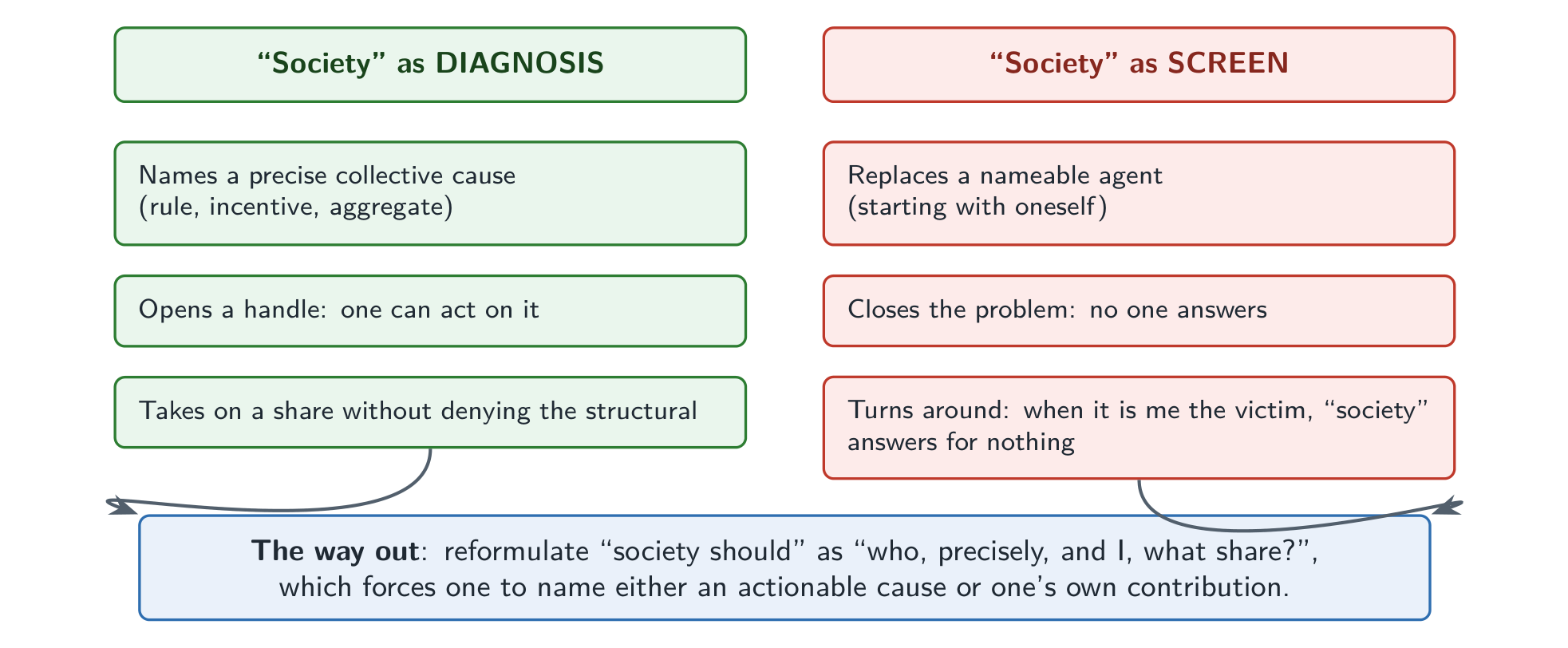
If abstraction removes the handle, the way out consists in restoring it, without tipping into all-individual. The first spring is psychological. The feeling of having a handle on a situation, what research calls agency or perceived self-efficacy, is associated with a greater propensity to act, which illuminates why naming one’s share makes action possible again where abstraction removed it (Bandura 1977). As long as the harm belongs to “society”, there is nothing to do; as soon as one identifies a gesture within reach, the hand returns to the lever (Bandura 1977). Recovering a handle, even a partial one, is what sets the movement going again (Bandura 1977).
Studies of prosocial conduct confirm this link at the scale of behaviours. The ascription of personal responsibility and the activation of personal norms predict the adoption of prosocial and pro-environmental conduct, which empirically supports the idea that counting oneself in the cause favours action (Schwartz 1977). The one who recognises a share of his own in a problem, rather than sending it off to some vast elsewhere, tends more to modify his conduct (Schwartz 1977). Feeling concerned, in the strong sense of accountable, precedes the fact of acting (Schwartz 1977).
At the other end, naming the collective cause can mobilise as much as the individual. Perceived collective efficacy, the feeling that a group can act together on a problem, is associated with increased mobilisation, which shows that designating an actionable collective cause is both honest and mobilising (Sampson et al. 1997). A neighbourhood that believes itself capable of acting on its safety organises itself more than a resigned neighbourhood, and this shared confidence translates into acts (Sampson et al. 1997). The good use of “society”, the one that points to a collective handle, therefore calls for action instead of lulling it to sleep (Sampson et al. 1997).
Here one must guard against the reverse misreading, the one that would turn all this into a trial of the person. Recognising one’s share is not taking on the whole harm: distributed responsibility stays distributed, and taking on an identifiable fraction does not oblige one to declare oneself guilty of the whole structural mass. Reducing your own consumption does not make you the sole party responsible for the derailment of a system, any more than voting makes you accountable on your own for a policy. The structural keeps its full share, and taking on one’s own is recovering a handle, not shouldering everything.
From this a portable tool, simple to handle. It consists in reformulating “society should” as “who, precisely, and I, what share?”, which forces one to name either an actionable collective cause or one’s own contribution. The first question, “who precisely”, flushes out the screen by seeking the agent or the rule; the second, “I, what share”, brings from abstraction back to a concrete gesture within reach. Posing these two questions, each time the word comes, is enough to sort the diagnosis from the dodge and to make the problem graspable again.
8. Conclusion: from “society is like that” to “here is the cause, here is my share”
The whole point comes down to a shift of reading. The word “society” becomes useful again when it designates an identifiable collective cause instead of dissolving responsibility, and we gain by placing each observation on the side of the diagnosis rather than of the screen. It is not a matter of banning the word, which names realities that nothing else names as well, but of ceasing to use it as a curtain drawn over one’s own hand. Moving from “society is violent” to “here is the mechanism that produces this violence, and here is what, in me, contributes to it or can answer it” changes the very nature of the sentence.
The balance sheet therefore comes down to a workable distinction, one that can be carried everywhere. “Society” is a diagnosis when it names a collective cause one can act on, and a screen when it replaces a nameable agent, starting with oneself. Between the two, a single test decides: can one point to the precise mechanism, the rule, the incentive, the aggregate, or does the word only mask a responsible party one would rather keep silent. The same requirement holds on the right as on the left, against fatalism as against moralism, for the screen has never had a side.
There remains a simple, portable rule, valid well beyond the big words we use in order not to answer. When the harm touches you and “society” rises to your lips, look first for the collective cause you could name, then for the share that falls to you, and keep the word only if it designates instead of dissolving. The structural will remain real, your share will remain partial, and the problem, ceasing to be no one’s fault, will become someone’s business again.