
Why do we always miss our twenties?
Nostalgia is the mix of sweetness and longing that comes when we think back to a period of our lives. Psychologists have counted the memories adults keep from each age and measured the effect of nostalgia on mood. Demographers, for their part, have tried to separate what comes from age from what comes from the era
Published · Updated
There is a wave of nostalgia for the 2000s going around on social media at the moment. I hear it elsewhere too, from people of all ages: things were better before, nothing tastes the same anymore. Everyone has their own good old days, and the next generation does not recognize them.
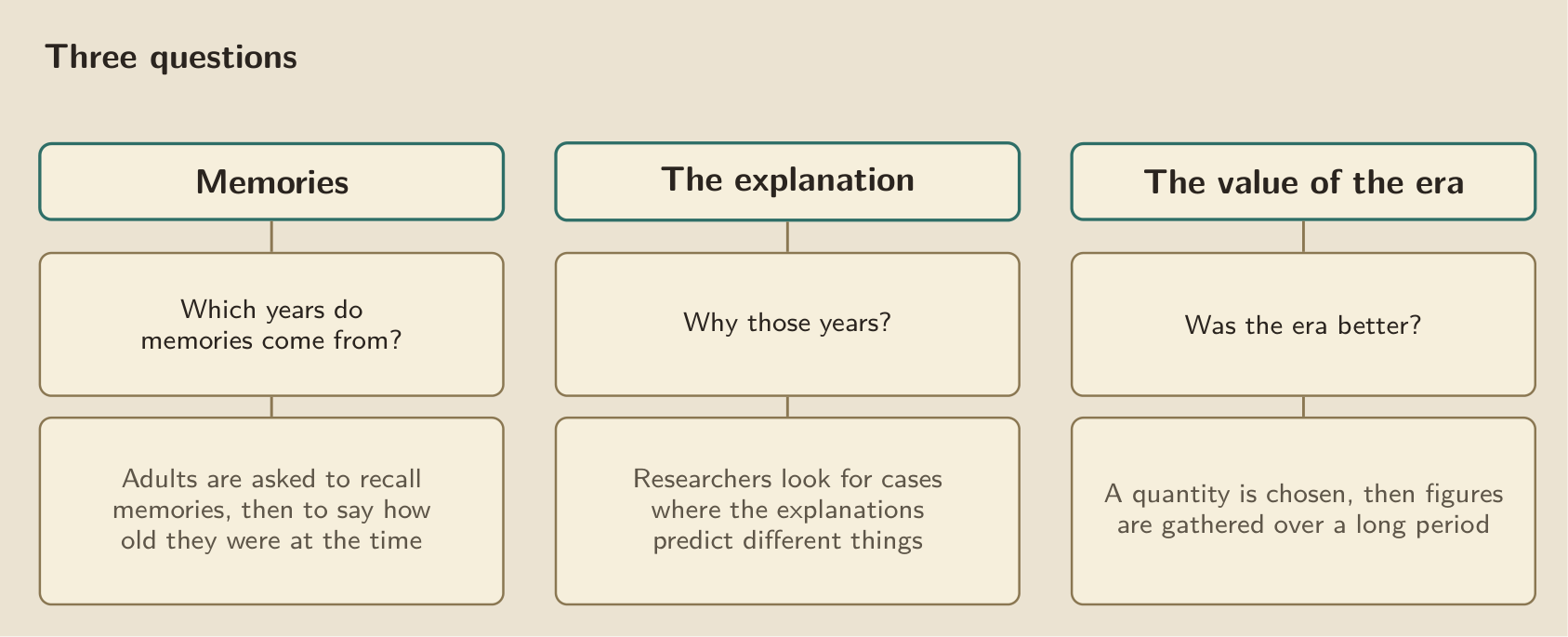
I had no opinion on the value of those years. I wanted to understand how memories that were nothing special at the time come back with so much tenderness, and I suspected memory of cheating a little. So I went to see how researchers know which years our memories come from. They ask adults to recall memories, then to say how old they were when they lived them (Kawasaki et al. 2011; Scherman 2013).
The bump
When adults over forty are asked to tell the story of their lives, their memories are not spread evenly over the years. The very first years leave few, and the most recent leave many (Janssen et al. 2010). Forgetting is enough to explain the second point, since an old memory has had more time to fade. But adolescence and early adulthood leave far more memories than forgetting would allow. On the curve that counts memories by age, these years form a bump. Researchers call it the reminiscence bump, the bump of memories that come back (Scherman 2013).
I expected a fragile result, drawn from one or two studies. It is the opposite. One team studied how memories are spread over the whole lifespan (Janssen et al. 2010). Another brought together, in 2018, the studies published on the bump (Munawar et al. 2018). Both teams find it, as do other teams who questioned other people with other methods (Scherman 2013).
It also exists outside the English-speaking world. It has been found among Dutch people (Janssen et al. 2005; Scherman 2013) and among young and middle-aged Japanese adults (Kawasaki et al. 2011). It does not fall at quite the same age there, partly because the researchers did not ask their questions in the same way (Kawasaki et al. 2011).
A word, or the big moments
The age of the bump also moves with the question. You can give someone an ordinary word and note the first memory that comes to them, or ask them for the most important events of their life. With words, a 2015 study places the bump between roughly 9 and 22 years of age; with the big moments, between 15 and 28 years (Koppel and Berntsen 2015).
People of seventy who were asked for their five most important memories drew almost all of them from the years between twenty and thirty, whereas with words their memories were spread differently (Rubin and Schulkind 1997). One team even interviewed centenarians. When they told the story of their lives, their memories fell in the bump more often than when they were given words, even though the two studies asked different questions of different people (Fromholt et al. 2003). A word brings back an ordinary memory, while the question about big moments calls on the story we tell ourselves about our own life (Kawasaki et al. 2011).
The songs of youth
I started looking for the source of an idea repeated everywhere, that our musical tastes are fixed once and for all at around twenty-four. I must admit I was hoping it was a little true: it would have explained without effort why certain songs still bring a lump to my throat, while others, more recent, slide over me without leaving a trace. It looks solid. Researchers who work on consumption have shown that the styles in fashion during our youth, in music as in film or in cars, stay with us for life (Wildschut et al. 2006).
The figure itself comes from a 1989 study. One hundred and eight people had been recruited from a rugby club, a parish women’s group and a parents’ association. They rated twenty-eight excerpts of thirty seconds taken from the hits of 1932 to 1986, and the curve of their ratings peaked at around twenty-four (Holbrook and Schindler 1989). I could only read the abstract of their article; I know the details of their method from those who repeated it.
That is not many people, and for nearly a quarter of a century no other study gave a precise age. When a German researcher repeated the experiment with 473 people, aged six to eighty-six, the peak fell at seventeen (Hemming 2013). Another team recruited some of its volunteers in retirement homes, and found it at fourteen. Its curve fitted the ratings so poorly that its authors themselves doubt such an age exists (Kopiez et al. 2021). I was disappointed, more than I would have thought.
That left memories, which are not measured like taste. In 2020, a team showed 470 people, aged eighteen to eighty-two, the titles and performers of 111 songs released between 1950 and 2015, and asked them which memories each one called up. Memories pile up on the songs released when they were about fourteen. And the youngest gave better ratings to the music of their parents’ adolescence (Jakubowski et al. 2020).
Seven years earlier, other researchers had played hits from 1955 to 2009 to students of about twenty. These students kept memories attached to the songs of their parents’ youth, and the researchers spoke of “cascading bumps” (Krumhansl and Zupnick 2013). The peak changes depending on whether one asks about taste or about memory, and on the age of the people asked.
If this bump decided nostalgia for an era, it would be enough to know someone’s year of birth to guess the decade they miss: the 1990s for a person born in 1975, the 2000s for a person born in 1985. I looked for a study that had tested this, by measuring nostalgia for a decade according to year of birth, and found none.
Why those years
No one really knows why the bump falls in youth, and several explanations share the field (Scherman 2013). For some, it is the age at which we forge an identity. For others, it is the age of first times, which memory retains better. Others still think that each culture passes on a kind of life calendar, which places studies, meeting a partner and the first child in youth, and that our memories line up along this calendar (Glück and Bluck 2007; Janssen and Murre 2008; Thomsen and Berntsen 2008). The last invoke memory itself, whose capacities mature during those years (Scherman 2013).
In 2008, two researchers checked whether the novelty of events, the emotion they carry, or their happy or sad tone was enough to make the bump, and concluded that it was not (Janssen and Murre 2008). Others defended the role of the story we tell ourselves about our life, or that of the cultural calendar (Glück and Bluck 2007; Thomsen and Berntsen 2008). In 2013, an article that reviewed all these studies still held them to be compatible, while leaning toward the calendar (Scherman 2013).
They have one awkward thing in common: all of them predict a bump in youth. To tell them apart, one has to find cases where they predict different things. When people are asked for sad or painful memories, the bump disappears, a result the same article links to the cultural calendar (Scherman 2013). Another team noted that if the bump comes from maturing memory, it should fall at the same age in every culture, whereas if it comes from identity, it could shift from one culture to another (Kawasaki et al. 2011).
The calendar, for its part, has been measured. People are asked to list the major events that a life usually holds in their culture. Having children comes first: 76% of the 1,172 participants in seven studies mention it, ahead of marriage and starting school (Scherman 2013). But even this calendar, which speaks of expectations shared by a whole group, is used to explain the memories of a single person (Scherman 2013). I found no source that measures how each person’s memory becomes the nostalgia of a whole generation.
A sum
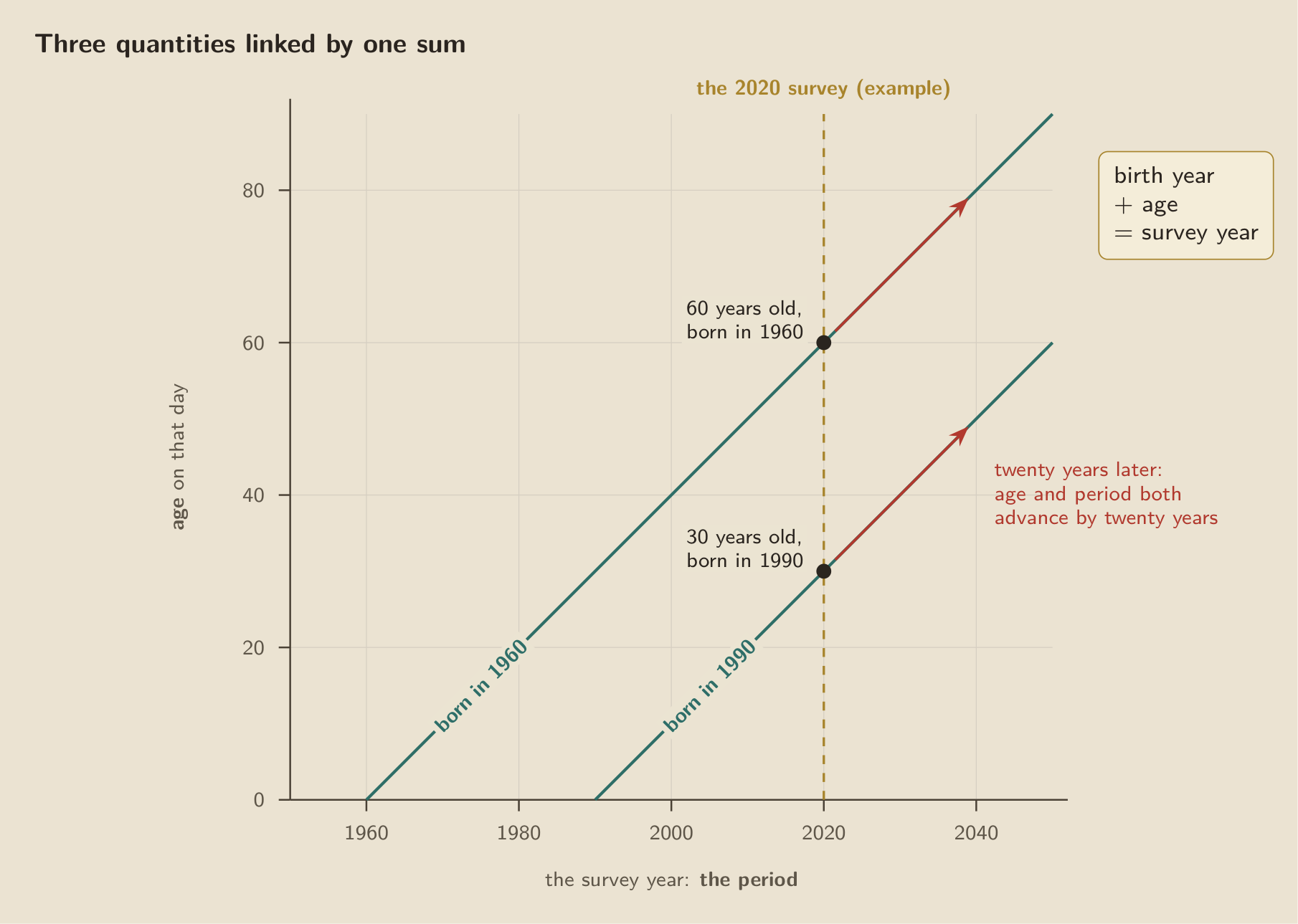
While looking into generations, I came across a problem that demographers, who study populations, know well. A difference between two groups of people can come from their age, from the period in which they are surveyed, or from their year of birth (Bell 2020). Now, year of birth plus age gives the year of the survey. Anyone who knows two of these numbers knows the third, and so they cannot be varied one at a time (Fienberg and Mason 1979; Bell 2020). Perfect data would change nothing, since the problem lies in this sum (Bell 2020).
Take a 2020 survey, invented for the example, which finds that people aged sixty, born in 1960, read more than those aged thirty, born in 1990. The gap may come from aging, from the conditions in which each group grew up, or from a habit specific to each generation. A survey carried out in a single year cannot settle between age and year of birth (Bell 2020). Repeating it twenty years later does not help either, since people have aged twenty years while the period moved on by as much (Fienberg and Mason 1979; Bell 2020). Following the same people for years teaches a great deal about their life course, but the sum stays the same (Bell 2020).
 Tap to enlarge
Methods have been proposed to separate the three effects all the same, but all of them require an assumption that the data do not provide, and their value is debated (Bell 2020). In 2013, one of them was examined in detail, and the journal that published this examination ran replies from several statisticians, including Leonhard Held and Andrea Riebler (Luo 2013; Held and Riebler 2013). Many studies ignore the problem, or keep quiet about the assumption that lets them get around it, even though their results depend on it (Bell 2020). This simple sum took the wind out of my sails.
A bittersweet mix
That left nostalgia itself. In 2006, a team of psychologists described it as a mix of pleasant and painful emotions, in which the pleasant prevails. In one of their studies, 16% of participants said they felt it at least once a day, and 26% three or four times a week. People miss very different things: close others, momentous events, places, periods of life, with close others and events coming first (Wildschut et al. 2006).
The same team, with others, then measured its effects in the laboratory. Some participants are asked to recall a nostalgic memory, the others an ordinary memory, and the two groups are then compared. Nostalgia then strengthens the feeling of having remained the same person over time, and that of being connected to others (Sedikides et al. 2016). In 2023, a team took the figures from twenty-two experiments of this kind and merged them into a single assessment, which remains favorable: nostalgia improves mood, this sense of continuity and the participants’ attitudes (Santini et al. 2023).
Outside the laboratory, the picture blurs. In 2020, a team suggested that part of these benefits came from the way the experiments are set up, and in everyday life its measures linked nostalgia to lower well-being (Newman et al. 2020). Three years later, two of its members followed 151 people who recorded their moments of nostalgia every day, 1,356 entries in all. Pleasant nostalgic moments went with more well-being, painful ones with less (Newman and Sachs 2023). In 2012, another researcher had induced nostalgia in volunteers. Their mood rose at first, then those who worry a lot in ordinary times became more anxious than the people in the comparison group (Verplanken 2012).
While gathering this work, I noticed that out of thirty-eight titles devoted to nostalgia, twenty-one were signed by Sedikides, Wildschut or Routledge, who all three cosign the 2006 and 2016 studies (Wildschut et al. 2006; Sedikides et al. 2016). Newman and Verplanken work in other teams (Newman et al. 2020; Verplanken 2012).
The decline that begins at birth
As early as 2003, a researcher was asking whether people used to be more satisfied with their lives (Hagerty 2003). In 2023, two psychologists, Adam Mastroianni and Daniel Gilbert, studied the impression that morality is being lost. They gathered the questions put to Americans in polls from 1949 to 2019. In 84% of cases, a majority judges that morality is declining, and this figure of 84% does not move from one polling year to the next (Mastroianni and Gilbert 2023). Seventy years of decline announced at the same pace: at first I smiled.
Their work concerns a moral judgment, not every aspect of an era. In one of their studies, they asked people when the decline had begun, and the answer fell roughly on their year of birth. Asked about the twenty or forty years that had preceded it, they saw no decline there (Mastroianni and Gilbert 2023).
The two researchers propose a possible explanation. In our memories, the painful emotion fades on average faster than the pleasant emotion (Mastroianni and Gilbert 2023). A team had measured this as early as 1997; I could only read the abstract of its study (Walker et al. 1997). In 2009, Walker, with Skowronski, summarized this research, his own included. It measures the emotion attached to a memory, not its accuracy, and it shows that the past we remember becomes gentler than the past we lived (Walker and Skowronski 2009).
 Tap to enlarge
The figures of the past
To know how the world has changed, memories are no longer enough. One chooses a quantity to measure, then looks for figures over a long period: saying that housing was more affordable at a given date calls for data on rents and prices.
In 2003, a criminologist gathered the historical series of homicides in Europe, the main indicator available for serious violence between people. Over the long term, homicides decline, with upswings and differences from one region to another, and they do not tell the whole story of violence (Eisner 2003). For life expectancy, a 2019 study describes a continuous rise in the European Union and in the OECD countries, some forty industrialized countries, with a slowdown since 2011 (Raleigh 2019). The same year, two researchers documented, on the contrary, a recent decline in the United States, following mortality from 1959 to 2017 (Woolf and Schoomaker 2019).
I examined neither the value of any particular decade, nor the detail of progress and setbacks in each area, nor the collective memory of societies. The work I read concerns each person’s memory and how to compare generations.
For my part, I was right to suspect memory, but not in the way I thought. It keeps more memories of youth than of other ages, and it softens the painful faster than the pleasant (Scherman 2013; Walker and Skowronski 2009). No one yet knows why those years, nor how each person’s memory becomes everyone’s nostalgia. And the value of an era is read in figures other than our memories, figures that sometimes prove right the person who misses it.
The pleasure of hearing a song from one’s youth again needs no proof. When someone tells me it was better before, I wonder whether they are talking about the era, or about the age they were.
References
What has changed
- : The text is rewritten as the story of an inquiry, with no lesson drawn along the way and no pointers to other articles. Its title does not change. Both figures are redrawn: the one on the three questions shows how each was investigated, and the one on the three quantities no longer draws a conclusion. What prompted it: The reasoning steps that drew a lesson for the reader are removed from the prose and from the supporting material, with their reason. All of the article's sources are retained and every cited fact keeps its marker. The 2020 reading survey is constructed as an example and reports no measurement: the figure now says so.
- : The text is rewritten from the author's own account of a wave of nostalgia on social media and his questions about how memory works. What prompted it: The article now starts from the question that gave rise to it. The links to sources on musical preferences, well-being and the commentary by Held and Riebler are clarified in the supporting material.