Why did we abolish the death penalty, and does the case for its return hold?
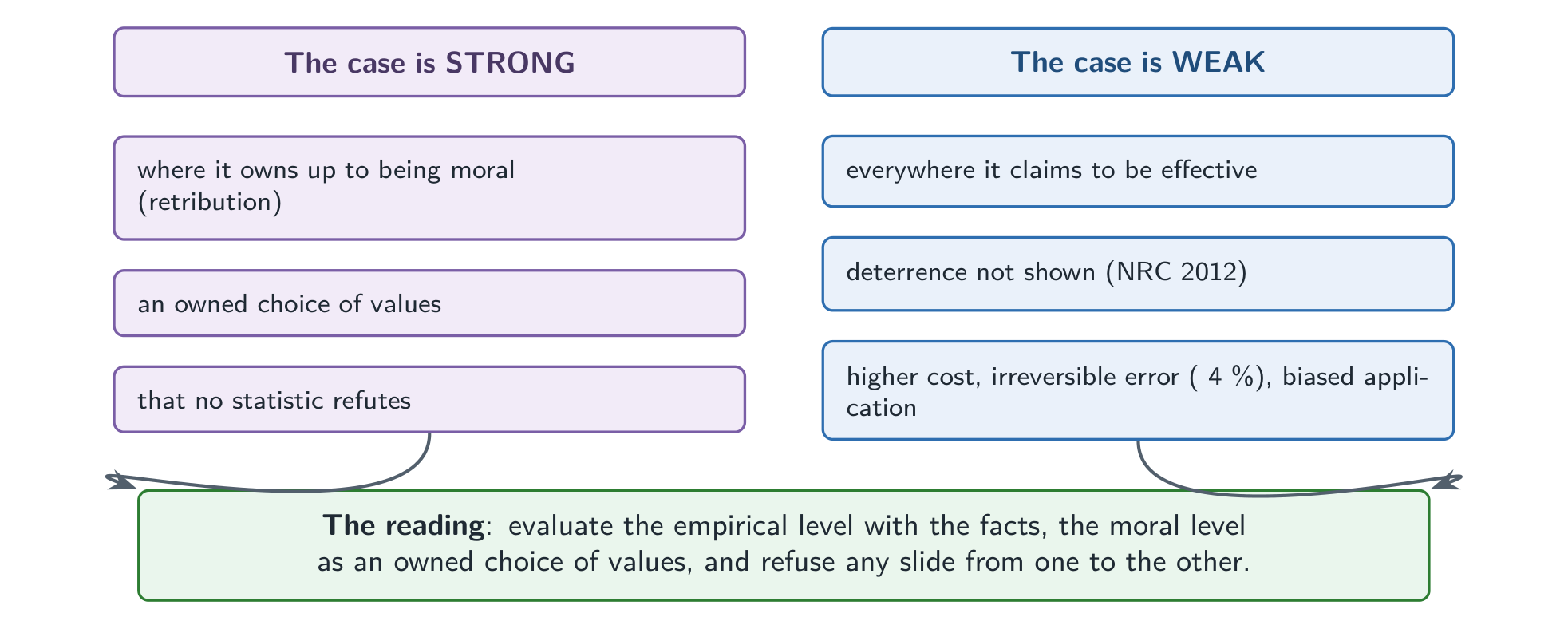
Abolition followed verifiable reasons. The case for its return is strong where it owns up to being moral, weak everywhere it claims to be effective
0. Introduction: two levels we keep confusing
A child is killed, an attack strikes a crowd, a murderer reoffends after release. In the hours that follow, the same sentence comes back in conversations, op-eds and polls: for such acts, death. The demand for reinstatement typically resurfaces after a particularly atrocious crime, at the moment when legitimate emotion is strongest and the separation between the moral response and the assessment of the facts is hardest to hold. It is precisely this moment that must be examined coolly, to see whether the argument that emotion carries holds once set down in black and white. To take the question seriously is neither to wave it away in the name of progress, nor to yield to it in the name of pain: it is to weigh.
The title of this text is deliberately cautious. The common wording, “why should we reinstate it”, already presupposes the conclusion. This paper examines the case for reinstatement in its strongest form and then weighs it, with no conclusion decided in advance: the honest title lies in “does the case hold?” rather than in “should we”. This difference is no ornament. It commits the method: one takes the opposing argument at its best, one formulates it as its most rigorous partisan would, then one looks, piece by piece, at what withstands verification and what collapses.
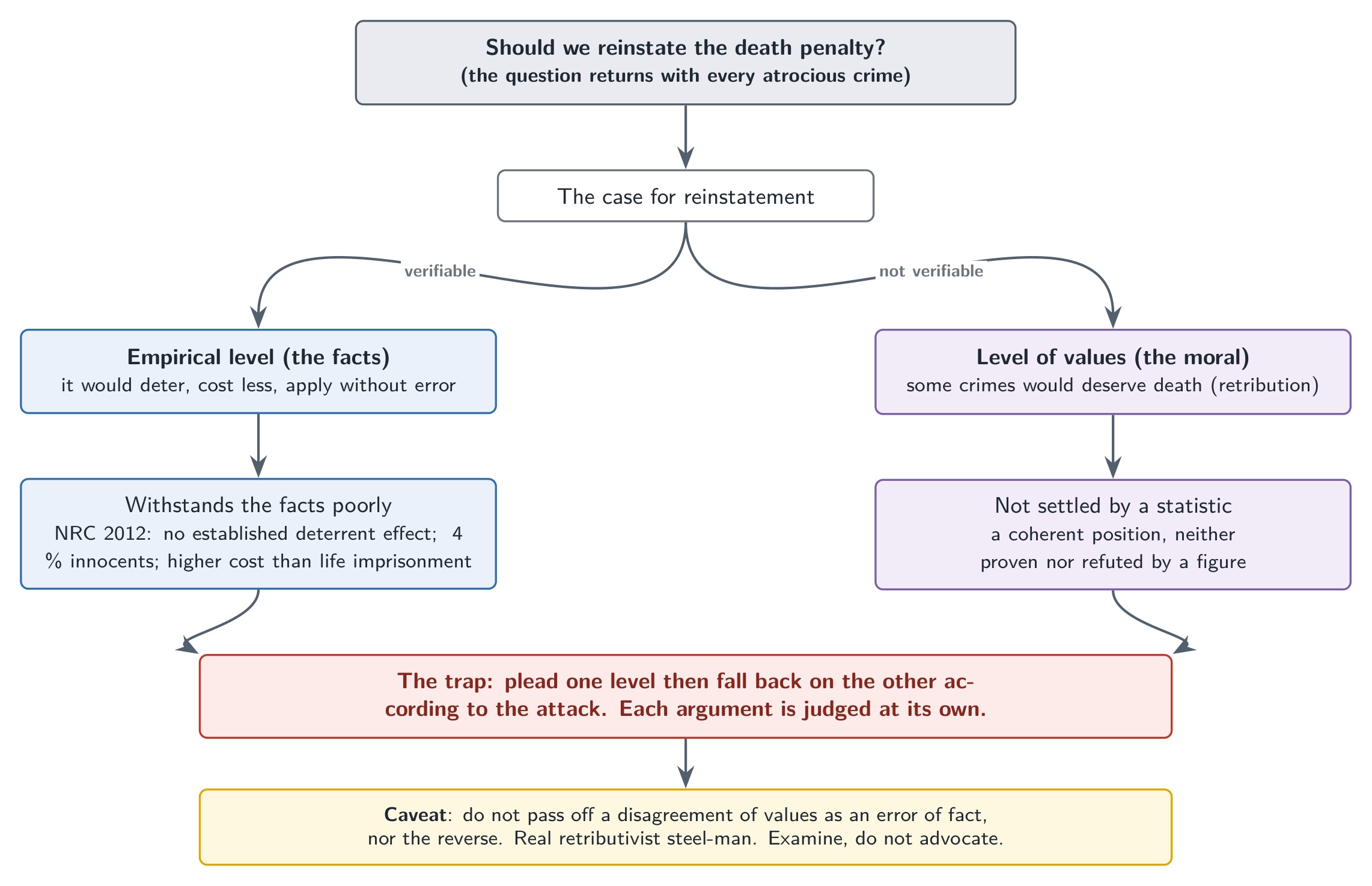
The thesis that organises all the rest fits in one distinction. The case for reinstating the death penalty breaks down into two levels that are constantly confused: an empirical level (it would deter, it would cost less, it could be applied without error) whose every premise withstands verification poorly, and a level of values (some crimes would deserve death) that the data do not settle. These two levels do not obey the same rules. The first belongs to factual questions, settled with figures and studies. The second belongs to a moral disagreement, which no statistic refutes. The main source of confusion in public debate lies in this continual slide from one to the other, each side invoking the level that suits it at the moment the other one hampers it.
Two words on the scope, to be honest about what this text does and does not do. It treats the empirical case and the case of values for reinstatement, drawing on a quantitative corpus mostly American and a European narrative of abolition; it treats neither the full history of the penalty, nor the procedural detail of a reinstatement under French or Swiss law, nor the methods of execution. This choice has a cost better stated up front: the bulk of the quantified data comes from the United States, the only large body studied systematically, and one will refrain from mechanically transposing these figures to a hypothetical French apparatus. The march of the text follows the fairest plan one can hold: first why abolition happened, then the argument for return laid out without caricaturing it, then the weighing of its empirical level, and finally its level of values and how not to mix them.
1. Why abolition happened: a reasoning, not a softening of hearts
Abolition is often told as a victory of sensitivity over severity, one softening of manners among others. This account is too short. Abolition followed a bundle of verifiable reasons (revelation of miscarriages of justice, doubt over deterrence, arbitrariness of application) rather than a mere softening of manners, which makes it the conclusion of a reasoning. Each of these reasons can be examined on its own, and it is their convergence that eventually carried the decision in one country after another. Sentiment has its place, no one denies it. It was not the only engine.
The clearest chronological landmark, on the French side, is a law. France abolished the death penalty by the law of 9 October 1981, championed by Robert Badinter, after decades of decline in its effective use (République française 1981; Neumayer 2007). This point deserves emphasis: by the time the law passed, the guillotine was already running only in slow motion, executions could be counted on one hand and reprieves were multiplying. Legal abolition ratified a groundswell rather than triggering it. The same logic is seen at the scale of the continent. The Council of Europe made abolition a de facto condition of membership through Protocol 6 (1983, in peacetime) then Protocol 13 (2002, in all circumstances) to the European Convention on Human Rights (Conseil de l’Europe 2002; Neumayer 2007). Renouncing capital punishment thus became, for a whole family of democracies, a piece of the common contract and not a national whim.
This movement reaches beyond Europe. A majority of countries has abolished the death penalty in law or in practice, which places abolition within a long-term worldwide trend and not in an isolated exception (Amnesty International 2023; Neumayer 2007). The picture must at once be corrected, on pain of manufacturing a false obviousness. The effective use of the death penalty remains concentrated in a small number of countries, so that the worldwide trend toward withdrawal is not matched by a widely shared retention (Amnesty International 2023; Neumayer 2007). In other words, the world did not vote unanimously against capital punishment: it split between a large majority of states that abandoned it and a handful that practise it intensively. One last trait completes the tableau: reintroductions of the death penalty after abolition are rare on a world scale, which indicates that once the bundle of reasons for abolition is acknowledged, going back is infrequent (Amnesty International 2023; Neumayer 2007). One should note this as a trend, not a law: rare does not mean impossible, and the rarity of a return says nothing, by itself, of its legitimacy.
American history, often cited as the counter-example of a retentionist country, in fact sheds light on the same mechanism. In the United States itself, moratoriums and suspensions were decided after errors came to light, for example the Illinois moratorium in 2000, showing that doubt over reliability weighed in the withdrawal, not only moral sensitivity (Garrett 2011; Neumayer 2007). A governor suspends executions not out of tenderness for the condemned: he acts because his own state has just discovered that it nearly killed innocents. The spring here is factual: the system revealed itself fallible, and that fallibility was enough to stop the machine. Finally, the question is never definitively closed in public opinion. Support for the death penalty has clearly receded over the long term in several Western countries, which shows that its retention or its return is a live political question rather than one settled by a stable consensus (Gallup 2023; Neumayer 2007). The debate can therefore return, and this is precisely why the question of reinstatement still arises: not as a provocation, but as a periodic demand that is worth weighing each time.
2. The steel-man of reinstatement: the argument at its best
To weigh an argument, one must first lay it out in its most solid form, the one its most serious partisan would defend. The caricature of the death-penalty supporter, thirsty for vengeance and deaf to reason, does no one any service: it hands out an easy and false victory. The strongest argument in favour of reinstatement is retributive: some crimes would break the social pact to such a degree that only death would be a proportionate response, independently of any deterrent effect. This is not a cry, it is a thesis. It holds that a just penalty answers the desert of the act, and that for the most monstrous crimes, no penalty lower than death would match what was committed. One may reject this thesis; one cannot pretend it does not exist or that it would be foolish.
Around this core, the case for reinstatement musters other supports. It also invokes the deterrent intuition (the ultimate threat should weigh the most), closure for the victims’ loved ones and the definitive incapacitation of the condemned. Each of these supports has its intuitive force. The threat of death seems bound to frighten more than any other; executing the guilty seems bound to soothe the families; a dead man never reoffends. These intuitions are respectable, and it would be dishonest to dismiss them before having looked at them. The rest of the text will look at them one by one.
A point of method, here, decides everything else. In its strongest form, the case for reinstatement does not depend on deterrence: a retributivist can accept that the penalty does not deter and want it all the same, which forces one to assess the empirical level and the moral level separately. This is the direct consequence of the two-level structure. If the best pro-penalty argument is moral, then the facts on deterrence, cost or error do not touch it head-on: they touch only the empirical supports, which are secondary for the consistent retributivist. This is why one must weigh the two levels apart, without believing that in refuting one, one would have refuted the other.
Two of the empirical supports of the case can moreover be examined right now, for they can be settled without much statistical apparatus. The definitive incapacitation targeted by execution is also obtained, as regards the risk to society, by real life imprisonment without release, so that the incapacitation argument does not clearly settle between the two penalties. If the aim is to prevent the condemned from harming again, a life sentence without adjustment achieves it, without the irreversible character of death. As for soothing the families, the support proves more fragile than it appears. The closure argument for the victims’ loved ones is empirically fragile: work suggests that capital proceedings, long and uncertain, may prolong the families’ suffering rather than soothe it (Vollum and Longmire 2007). The years of appeals, the repeated hearings, the wait for an execution endlessly postponed reopen the wound instead of closing it. One does not claim here that capital punishment never soothes anyone; one observes that the promise of closure is not self-evident, and that it sometimes turns against those it claims to relieve.
3. Empirical level (1): deterrence cannot be established
Here is the premise most often advanced and the easiest to believe: death would push crime back more than any other penalty. This is a testable claim, and it has been tested abundantly. The reference assessment of the US National Academy of Sciences concludes that the existing studies do not allow one to determine whether capital punishment has an effect on homicide rates, in either direction (National Research Council 2012; Donohue and Wolfers 2006). This synthesis report, published by the National Research Council in 2012, does not say that the penalty deters, nor that it does not deter: it establishes that the available data do not allow the matter to be settled, and recommends not basing public policy on these works. This is the most cautious and most authoritative conclusion in the field, and it is the one to keep rather than an isolated study concluding one way or the other.
Why this verdict of indecision? Because the results proved unstable. The estimates of a deterrent effect proved highly sensitive to the choices of statistical specification, to the point that small variations of method make the effect appear or disappear, which deprives these estimates of robustness (Donohue and Wolfers 2006; National Research Council 2012). A result that flips according to the control variables retained, the period studied or the form of the model is not a result to build on. This diagnosis of fragility, laid out notably by Donohue and Wolfers in 2005, holds for both sides: it disqualifies the studies that find a strong deterrent effect as much as those that find the opposite. The most famous historical case illustrates this fate. Ehrlich’s study (1975), which asserted a strong deterrent effect, played a historical role but was heavily criticised on methodological grounds, so that it does not establish what it claimed (Ehrlich 1973). Long cited by supporters of the penalty, it was taken apart for its dependence on the period retained and on its econometric assumptions. It remains a milestone of the debate, not a proof.
To these econometric works are added more direct observations. Comparable jurisdictions with and without the death penalty show no systematic difference in homicide rates, and American states without capital punishment do not have higher rates, which contradicts the simple deterrent expectation (National Research Council 2012; Radelet and Lacock 2009). If the threat of death weighed heavily, one would expect to see the abolitionist states pay for their leniency with more murders. The series do not show this excess. The specialists’ view goes in the same direction. A large majority of expert criminologists judge, in professional surveys, that the death penalty adds no measurable deterrent effect to life imprisonment, which reflects the state of the field more than an isolated opinion (Radelet and Lacock 2009; National Research Council 2012). Systematically surveyed, those who study crime for a living overwhelmingly estimate that capital punishment brings no additional deterrence compared with life detention.
Deterrence theory, taken seriously, moreover explains why the expected effect slips away. Research on deterrence establishes that it is the certainty of the sanction, far more than its severity, that influences behaviour, which weakens the idea that raising the penalty to death would add deterrence (Nagin 2013; National Research Council 2012). What a potential offender fears is being caught, not the nuance between life imprisonment and execution at the end of a fifteen-year chain of appeals. To this is added the very nature of many homicides. A significant share of homicides is committed under the sway of emotion, alcohol or drugs, or without anticipation of the consequences, contexts where a cost-benefit calculation assumed by the deterrent argument applies poorly (Nagin 2013). An act committed in rage or drunkenness is not preceded by a serene weighing of the penalty scale. The model of the rational criminal, who compares sanctions before acting, describes a minority of cases.
Two precautions close this weighing, out of concern for symmetry. The first concerns a result in the opposite direction. Some studies advance a brutalisation hypothesis according to which executions would be followed by a slight rise in homicides, a result contrary to deterrence but itself also fragile and contested, to be cited with the same caution (Cochran and Chamlin 2000). One will not lean on this hypothesis to assert that capital punishment increases crime: that would be committing the symmetric error of those one criticises. The second precaution is the most important of the chapter. Not shown is not shown null: the absence of robust proof of a deterrent effect does not establish that no effect exists, it only deprives the deterrent argument of any solid empirical support. The honest conclusion is therefore not “the penalty does not deter”, it is “nothing allows one to assert that it deters”. A supporter of the penalty here loses the right to lean on deterrence as on an established fact; he is not met with proof of the opposite. Still, one must compare what is comparable. The concrete alternative to the death penalty is real life imprisonment, not impunity, so that the relevant comparison for deterrence and incapacitation is death penalty against life imprisonment, not death penalty against absence of penalty. The whole question is whether death adds anything to life detention, and it is precisely this surplus that the data fail to bring to light.
4. Empirical level (2): the irreversible error
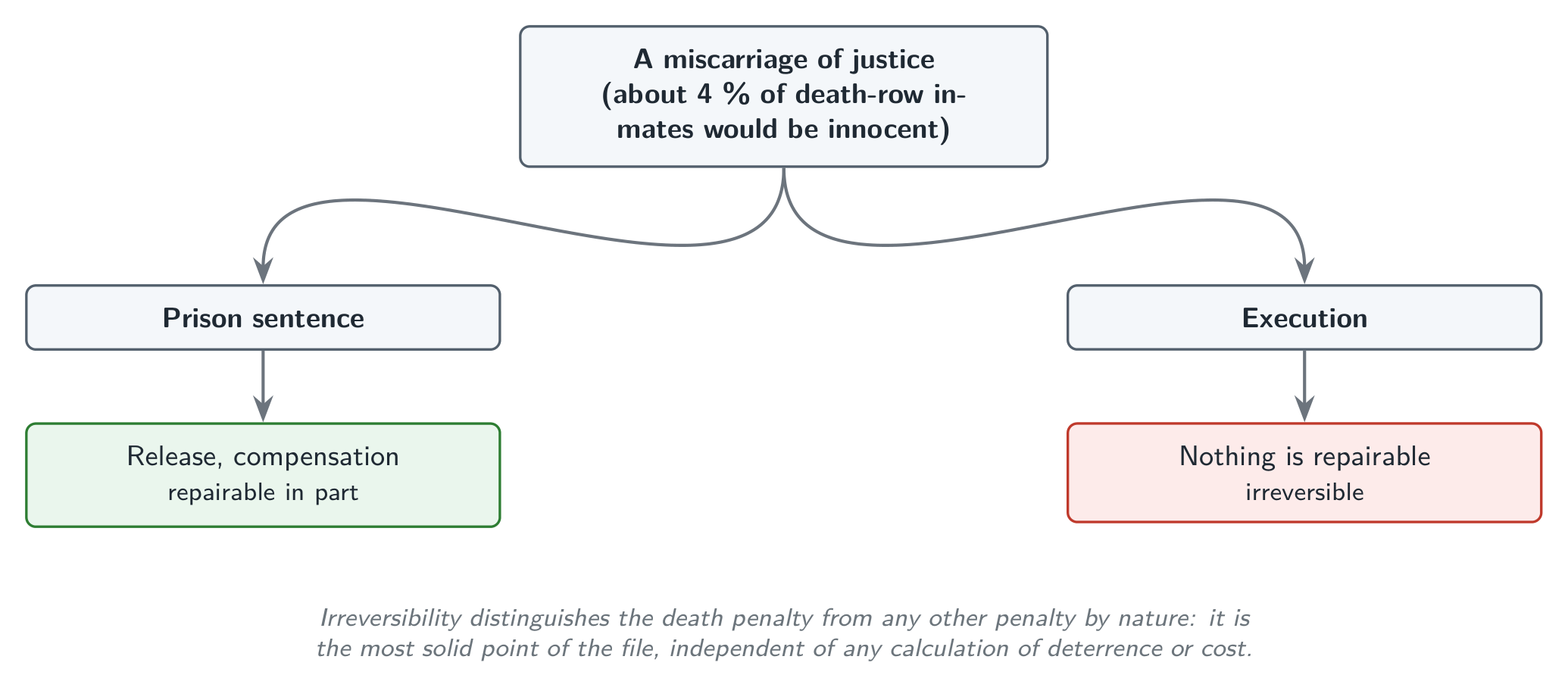
Here lies the most solid point of the file, the one that rests on established facts rather than on a fragile econometric model. A published estimate puts at about 4% the proportion of people sentenced to death in the United States who would in fact be innocent, a non-negligible rate given the irreversibility of the penalty (Gross et al. 2014; National Registry of Exonerations 2024). This figure, drawn from work by Gross and his colleagues published in 2014 in the proceedings of the US National Academy, is an estimate with its interval of uncertainty, not an exact counter. Its reach remains considerable: if roughly one capital conviction in twenty-five targets an innocent, then the system, applied on a large scale, sentences innocents to death on a regular basis. This figure calls for the same symmetric caution as deterrence: the 4% is a statistical estimate with an interval, dependent on a definition of innocence and on an extrapolation from re-examined cases, not an exhaustive count (Gross et al. 2014; National Registry of Exonerations 2024). The best pro-penalty objection concedes it then bounds it: reinforced procedural guarantees and the generalisation of DNA evidence can reduce the future error rate below that of the past corpus (Gross et al. 2014; National Registry of Exonerations 2024). Irreversibility holds all the same, for reducing this rate does not cancel it, and a single execution of an innocent remains beyond repair (Gross et al. 2014; National Registry of Exonerations 2024).
That this risk is real, and not theoretical, is verified by the cases themselves. Dozens of death-row inmates have been cleared and released after conviction, several thanks to DNA evidence, which documents capital miscarriage of justice as an attested and not a theoretical fact (National Registry of Exonerations 2024; Gross et al. 2014). These exonerations are recorded, named, dated: these are men who were awaiting execution and whom new evidence pulled off death row. Genetic evidence, in particular, reopened cases thought closed and overturned verdicts thought certain. These cases are not isolated anomalies, they trace a pattern. The risk of miscarriage of justice is not spread at random: underfunded defence, coerced confessions and eyewitness errors concentrate the risk, which makes “error-free” application all the less plausible (Garrett 2011; Kassin et al. 2010). The same causes recur: an overwhelmed court-appointed lawyer, an interrogation that wrests a false confession, a sincere witness who mistakes a face. These causes are known, documented, and they strike above all the most destitute defendants.
Time adds its own harshness. The average delay between the death sentence and the exoneration is counted in years, often more than a decade, which means that the innocent spends a major part of his life under a capital sentence before being cleared, when he is (National Registry of Exonerations 2024; Gross et al. 2014). Justice, when it corrects itself, corrects itself slowly: the innocent has already lost ten or twenty years, sometimes more, awaiting a scheduled death. And nothing guarantees that the correction arrives in time. Documented cases make the execution of innocent people probable, which turns the risk of irreversible error from an abstract hypothesis into a concrete danger, even if post-mortem proof remains by nature difficult to establish (National Registry of Exonerations 2024). One must stay cautious: proving the innocence of a dead man is almost impossible, and one will not claim here to hold a certain accounting of the innocents executed. Several cases, re-examined after the execution, nevertheless leave little reasonable doubt, and that is enough to make the danger a reality and not a figment of the mind.
From these facts flows the argument hardest to dismiss. Irreversibility distinguishes the death penalty from any other penalty by nature: an error on a prison sentence is repaired in part by release and compensation, an execution is not repaired. This is a difference of nature, not of degree. All human justice errs, that is admitted; the other penalties leave a margin for recovery, imperfect but real. Death leaves none. An innocent imprisoned can be released and compensated; an innocent executed can no longer be, his rehabilitation arriving only after his death. This argument assumes neither a contested statistical model nor a particular value: it assumes only that one admit the system errs sometimes, which the exonerations establish, and that death is without return, which goes without saying. This is why it constitutes the most robust piece of the whole file against reinstatement, the one an honest partisan must confront head-on.
5. Empirical level (3): cost and application
There remains the last empirical premise of the case: capital punishment would be both economical and applicable in a just way. Both claims run up against the data. On the available American data, a capital case costs the system more than a sentence to life imprisonment, owing notably to the reinforced appeal procedures, which contradicts the argument “it costs less to execute” (Death Penalty Information Center 2023; Cook 2009). The intuition that an execution would come cheaper than a life sentence collides with reality: the capital trial is longer, the defence heavier, the appeals mandatory and multiple. One will treat these figures with caution, for the literature on costs is sometimes grey and politically charged; their convergence, state after state, nonetheless makes the economy argument very hard to defend. This overcost is moreover not an arbitrary waste. The high cost of capital cases stems in part from the procedural guarantees meant to limit error, so that reducing this cost would amount to trimming these guarantees, which would increase the risk of executing an innocent. One cannot make the death penalty cheap without making it more dangerous: the costly appeals are precisely what catches part of the errors. The tension is internal to the case itself.
Application, next, does not keep the promise of equity. The application of capital punishment in the United States shows a disparity according to the victim’s race: murders of white victims are more often punished by death, a bias documented by reference studies (Radelet and Pierce 1985; U.S. General Accounting Office 1990). The work of Baldus and his colleagues, at the heart of the McCleskey case, and the official syntheses that followed establish this troubling pattern: for a comparable crime, killing a white person exposes one more to capital punishment than killing a black person. The bias bears not only on the colour of the accused, it bears on that of the victim, so that the criminal protection granted varies according to the victim’s origin. This disparity is part of an older difficulty. The application of capital punishment was judged arbitrary to the point of being suspended then re-framed in the United States (Furman v. Georgia, 1972), a sign of a structural difficulty in applying it coherently (Cour suprême des États-Unis 1972; Radelet and Pierce 1985). The Supreme Court had then found that the penalty fell so capriciously that it became cruel and unusual, before reinstating it under conditions a few years later. The problem of arbitrariness was never fully resolved.
Two factors finish undermining the premise of an equal justice. The probability of a death sentence depends strongly on the county and the jurisdiction where the crime is tried, a geographical variability that reflects an arbitrariness of application hard to justify for an irreversible penalty (Death Penalty Information Center 2023; Cook 2009). A handful of counties hands down most of the country’s capital sentences: the same crime, committed a few kilometres away, would not have warranted death. The fate of the condemned thus depends on geography as much as on the act. To this is added the weight of the defence. The quality of the defence bears heavily on the capital outcome: an underfunded representation is associated with an increased probability of a death sentence, a factor that undermines the premise of an equitable application (Garrett 2011; Kassin et al. 2010). A defendant who cannot afford a solid defence risks the death penalty more, not because his crime would be worse, but because his lawyer has less time and fewer resources. The level of the defence’s resources thus bears on the capital outcome as much as the gravity of the act.
From this accumulation one draws a synthesis. The premise “applied equitably and without error” of the case for reinstatement does not hold empirically, since documented error, higher cost and application bias are all supported by the available corpus. One can sum up the empirical level in one sentence: each of its three promises, to deter, to cost less, to apply without fault, slips away under examination. A supporter of the penalty may still want it; he can no longer want it in the name of its effectiveness or its practical justice, because those grounds do not support him.
6. The level of values: what the figures do not settle
Suppose now the whole empirical level conceded to the critique: no established deterrence, higher cost, irreversible errors, biased application. Does the case for reinstatement collapse for all that? No, and this is the point a hasty abolitionist often forgets. The retributive position, defended by serious philosophers, holds that deserved justice can require capital punishment independently of its effects, which makes it non-refutable by a statistic of deterrence or cost (Kant 1797; Haag 1986). Kant, in his Doctrine of Right, holds that the penalty must answer the crime on principle, and not for its social consequences; van den Haag, in his 1986 plea, defends capital punishment as the expression of a justice that takes the gravity of murder seriously. For these thinkers, executing the murderer is not a calculation of utility, it is giving the act its just measure. No figure of deterrence can refute this position, because it rests on no figure of deterrence.
This position is not, however, unassailable from within. The retributive position has its internal limits, discussed by its own proponents: requirement of proportionality, dignity, and above all the fallibility of the judge, the last bringing the level of values back to a concern with factual error. Proportionality, pushed to its limit, is embarrassing: should one torture the torturer, rape the rapist? The serious retributivist recoils before this consequence, which shows that desert does not mechanically command the mirror penalty. Above all, the fallibility of the judge reopens a door that value thought closed: even the one who holds death to be deserved must take care not to deserve it upon the wrong person. The level of values, by this route, finds itself caught up by the empirical level of error: one cannot want the death of the guilty without a concern for the risk of killing the innocent.
Facing this, a tradition just as old opposes its own values. The abolitionist tradition of principle, from Beccaria (1764) to today, opposes to retributivism arguments themselves of values (dignity, limits of the state’s right over life), which places the disagreement at the moral level, not the factual one (Beccaria 1764). Beccaria, as early as the eighteenth century, contests that the state holds from anyone the right to deal death, and makes dignity a bound that the penalty cannot cross. This principle must nonetheless answer for its own coherence: the state does take lives in self-defence or in a war deemed just, so that an absolute right over life risks proving too much, unless one distinguishes the execution of an already-subdued man from these cases (Beccaria 1764). The underlying disagreement can then be mapped clearly. It opposes a retributivist reading (the penalty answers the desert of the crime) and a consequentialist or deontological abolitionist reading (the penalty is justified by its effects, or the state’s right over life has a limit): two frameworks of values, not a dispute of facts. One no more proves the superiority of one framework than one proves that of a fundamental moral preference: one assumes it and answers for it.
This finding governs how one applies our usual test of symmetry. The symmetry test does not “undo” the level of values: since the disagreement bears on moral criteria and not on a factual premise that could differ, symmetry returns each side to owning its criterion rather than proving it. When two camps clash over a fact, one can hope to settle between them by a better measure. When they clash over an ultimate value, no measure settles it: the role of reasoning is confined to making each position coherent with itself and to laying bare its price. The only notable evolution, on this terrain, came from law. The jurisprudence of fundamental rights has increasingly tied abolition to human dignity and to the prohibition of cruel penalties, shifting the argument from the terrain of effectiveness toward that of principles (Cour suprême des États-Unis 1972). The courts stopped asking whether the penalty was useful to ask whether it was compatible with dignity, which amounts to recognising that the heart of the debate is moral. The shift is illuminating: it admits, by implication, that the facts will never suffice to close the question.
7. The heart of it: not confusing the two levels
The whole difficulty of the public debate lies in a movement, almost always unnoticed, between the two levels. The death-penalty debate often works as a motte-and-bailey: one pleads retribution (impregnable because moral) then falls back on “and besides, it deters and costs less” (empirically weak), or the reverse, switching levels according to the attack. This name designates a tactic where one advances a thesis hard to defend (the exposed position, the bailey) and, as soon as it is attacked, one falls back on a safe thesis (the fortified position, the motte), to bring out the first again once the danger has passed. On the death penalty, the back-and-forth plays out between the moral and the factual: called on to justify the errors and the costs, one invokes deserved justice, which no statistic reaches; called on to justify the pure value, one invokes deterrence and economy, which reassure. At each attack, one moves to the level the assault does not reach.
Getting out of this game requires assigning each argument to its level and holding it there. Honesty consists in placing each argument at its level: whoever wants the death penalty wants it for deserved justice, not for its effects; whoever refuses it does so above all for the irreversible error, not to prove that retribution would be “false”. Put this way, the disagreement becomes clear and honourable. The sincere supporter of capital punishment wants it because he holds certain crimes to deserve death, and he should say so without hiding behind an effectiveness the data do not grant him. The sincere opponent refuses it first because no fallible system should hold a power without return over lives, and he has no need to declare retribution “refuted” to hold this line. Each gains by pleading his true motive rather than a borrowed one.
This reading must be exposed to its own risk. Our own analysis is falsifiable: the thesis “the empirical supports of reinstatement are weak” would be contradicted by a robust synthesis assessment establishing a clear deterrent effect, a cost lower than life imprisonment and an application without significant bias or error. One therefore indicates what would make us change our mind. Let a new reference assessment, of the level of rigour of the 2012 report, bring to light a clear deterrence, let a solid accounting reverse the verdict on costs, let a reform bring the biases and errors down to a negligible level, and the diagnosis on the empirical level should be revised. This diagnosis holds only as long as the current facts hold, and it will correct itself if the facts change. The level of values, for its part, does not fall under this falsification by the data, and that is precisely what distinguishes it.
8. Conclusion: placing each disagreement at the right level
At the end of this weighing, the starting question receives a two-part answer, in the image of its object. The case for reinstatement is strong exactly where it owns up to being a choice of values (retribution), and weak everywhere it claims to be effective (deterrence, cost, error-free application); separating the two levels lets the reader place his disagreement in the right spot. This empirical weakness calls for a nuance of scope: the error rate and the costs remain indexed to the American corpus, and a French apparatus could show other figures, whereas the irreversibility of the penalty, for its part, depends on no country and holds everywhere. The partisan who wants the death penalty for deserved justice occupies a coherent moral position, defended by real philosophers, that no statistic overturns. The same partisan, as soon as he promises a drop in crime, a saving of public funds or a justice without fault, advances onto ground that does not carry him. It is this asymmetry, and not a ready-made verdict, that emerges from the examination.
There remains to draw from it a directive, portable and simple, that holds well beyond this file. The assessment fits in one rule of reading: evaluate the empirical level with the facts (and they are weak for reinstatement), evaluate the moral level as an owned choice of values, and refuse any slide from one to the other. One does not refute a value with a figure, and one does not defend a policy by a value when it is its effects that one invokes. Applied to capital punishment, this rule does not tell the reader what he must conclude. It hands him the two levels separated, so that he knows exactly where he disagrees: on the facts, where the case for return is weak, or on the value, where it remains a moral choice that each owns and for which each answers. It is the most honest service a text can render on a subject where emotion, however legitimate, ceaselessly pushes one to confuse what one feels with what one knows.