
What does the decline in testosterone prove?
Testosterone is reputed to be the hormone of male strength and dominance. Researchers have measured its link with aggression, competition and submission, and have tracked men's levels for decades
Published · Updated
In gyms, you come across people who take anabolic steroids, and you always hear the same oversimplifications about testosterone. It is said to be the male hormone par excellence, the one that lets us become a lion on the savanna, the king of the animals, and build muscle mass. In short, it is supposed to be the sacrosanct hormone of the alpha male.
I wanted to find out what effect testosterone really has on men, and whether all these received ideas were true, or whether they were merely claims from the red pill movement, which uses this hormone to argue for its views.
You read almost everywhere that testosterone makes men aggressive, ambitious, domineering and willing to take risks, and that its decline leaves them soft and tired. A more political version adds that levels have been falling for decades and are making men more docile, to the benefit of those who govern.
A hormone that sells
Treatments that raise testosterone levels are advertised (Layton et al. 2017). From 2009 to 2013, Layton and coauthors tracked the seventy-five largest television markets in the United States (Layton et al. 2017). Each time a household saw one of these ads, testosterone testing and new treatments increased, including among men with no recent test (Layton et al. 2017).
On YouTube, Warren and coauthors examined the first eighty videos returned by four searches on the subject (Warren et al. 2021). Together they had thirty-eight million views (Warren et al. 2021). Most were unreliable, and the most watched were those in which no physician spoke (Warren et al. 2021).
The hormone of aggression?
Tiny associations
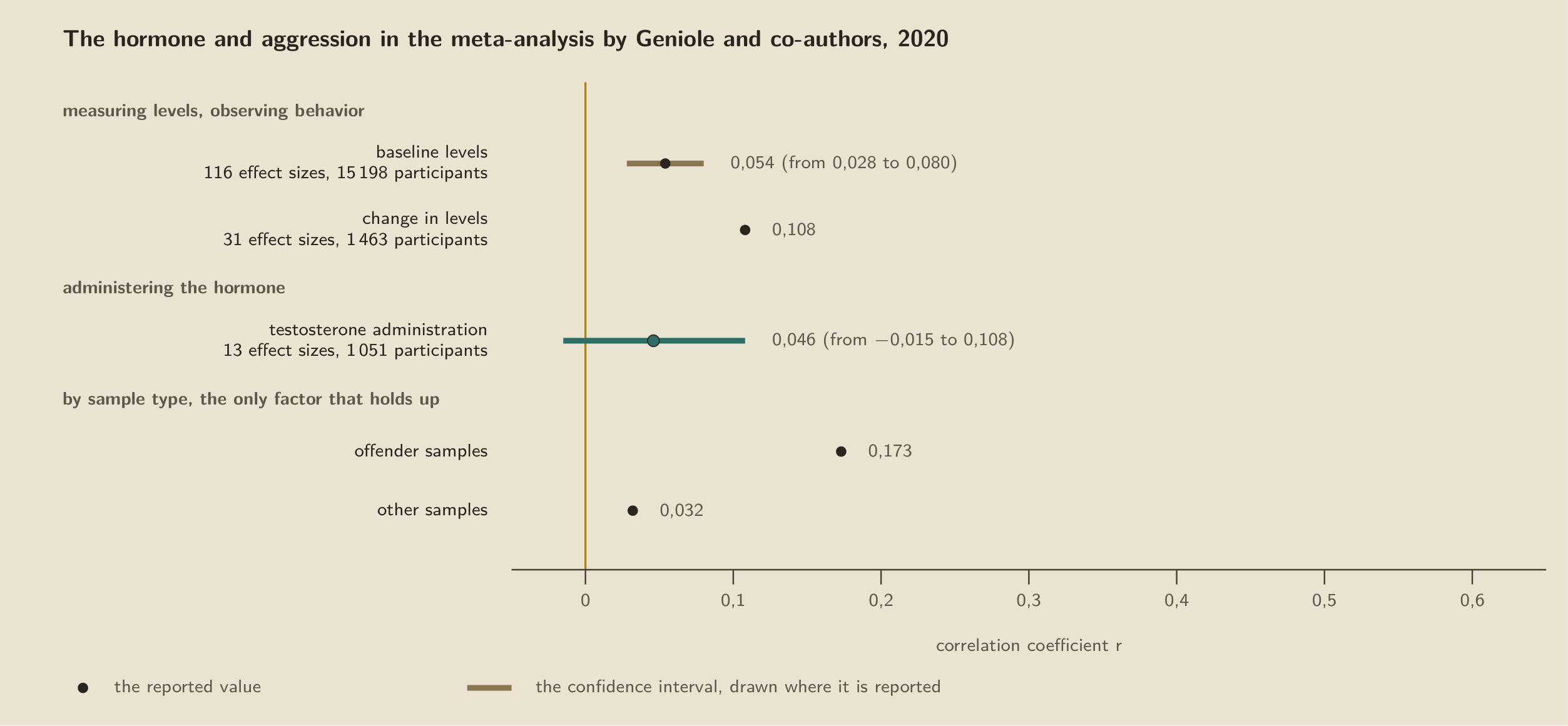
In 2020, Geniole and coauthors published a meta-analysis, a study that pools the results of many others (Geniole et al. 2020) (Wikipédia s. d.b). In it, they separate three things: a person’s testosterone level at rest, changes in that level, and the effect of the hormone when it is given to volunteers (Geniole et al. 2020).
For resting levels, across more than fifteen thousand participants, the link with aggression is very weak (Geniole et al. 2020). In men, it exists but remains very small, and in women, it cannot be distinguished from zero (Geniole et al. 2020).
A link this weak can only be detected with very large samples (Geniole et al. 2020). Even with the most favorable estimate, the authors calculate that about six hundred men would be needed to detect it four times out of five, whereas the pooled studies included on average a little over one hundred (Geniole et al. 2020; Carré and Archer 2018).
Changes in level are somewhat more closely linked to aggression (Geniole et al. 2020). In men, the link appears stronger, but the way the results are distributed suggests that studies with clear-cut results were published more often than the others (Geniole et al. 2020). Once this bias is corrected, the link falls back, and the difference from resting levels may be due to chance (Geniole et al. 2020) (Geniole et al. 2020).
Giving the hormone
Measuring a level and a behavior at the same time does not tell us which one acts on the other (Geniole et al. 2020). To find out, researchers give testosterone to volunteers and observe what follows (Geniole et al. 2020). Across a little over one thousand participants, the administered hormone has no effect on aggression that can be distinguished from chance (Geniole et al. 2020; Carré and Archer 2018).
In 2021, another team, led by Chegeni and with no author in common with the first, pooled twelve trials in which one group received the hormone and the other a placebo, a substance with no active ingredient (Chegeni et al. 2021). They covered five hundred sixty-two healthy men (Chegeni et al. 2021). Once one trial with aberrant results was set aside, the treated men reported slightly more aggression themselves (Chegeni et al. 2021). Outside observers, however, saw no increase, and high, prolonged doses showed none either (Chegeni et al. 2021).
Mostly among offenders
Among the factors that Geniole and coauthors tested together, only one really matters: the presence of offenders in the sample (Geniole et al. 2020; Carré and Archer 2018). The link between resting level and aggression is markedly stronger in these samples, and very weak in the others (Geniole et al. 2020; Carré and Archer 2018).
 Tap to enlarge
The authors themselves set out the limits of their work (Geniole et al. 2020). They counted results rather than distinct studies, and included no unpublished work, at the risk of overestimating the links (Geniole et al. 2020; Carré and Archer 2018). Aggression in their analysis covers very different measures, from a questionnaire filled in by the participant to a criminal record, and they acknowledge that this very broad definition limits how the whole body of work can be read (Geniole et al. 2020; Carré and Archer 2018).
The same substance, two opposite effects
In 2018, a review coauthored by Carré gathered experiments in which the hormone’s effect depends on the situation (Carré and Archer 2018). In one of them, one hundred twenty-one young men received testosterone or a placebo (Carré and Archer 2018; Eisenegger et al. 2011). Aggression measured in the laboratory increased only in some of them, those who described themselves as dominant or as having little self-control (Carré and Archer 2018; Eisenegger et al. 2011). In a bargaining game, the hormone made participants quicker to punish unfair offers, but also to reward fair ones (Carré and Archer 2018; Eisenegger et al. 2011).
Losecaat Vermeer and coauthors gave a single dose of testosterone gel, or a placebo, to one hundred sixty-eight young men, with neither the men nor the experimenters knowing who received what (Losecaat Vermeer et al. 2019). These men then competed against one another in a laboratory hierarchy, which the researchers made either stable or unstable (Losecaat Vermeer et al. 2019).
When the hierarchy was unstable, the men placed at the bottom chose to compete far more often on testosterone: nearly nine in ten, compared with six in ten on placebo (Losecaat Vermeer et al. 2019). When it was stable, men of the same rank, by contrast, competed less often after the hormone (Losecaat Vermeer et al. 2019). The substance, the dose and the rank were the same (Losecaat Vermeer et al. 2019). Only the possibility of moving up changed (Losecaat Vermeer et al. 2019).
Saliva measurements show that the treated men had much higher levels than those in the placebo group, and levels that varied widely from one man to another (Losecaat Vermeer et al. 2019). The authors themselves urge caution, because their comparisons involve groups of about twenty men (Losecaat Vermeer et al. 2019).
Winning raises the level
The link also runs the other way: behavior and position in a group cause the level to vary (Eisenegger et al. 2011). As early as 1998, Allan Mazur and a colleague described a level that rises as a challenge approaches, then increases in winners and falls in losers (Mazur and Booth 1998).
In 2011, Eisenegger and two colleagues brought this work together in a review on the social role of testosterone (Eisenegger et al. 2011). They see it as a hormone of seeking and maintaining social status, rather than a hormone of aggression (Eisenegger et al. 2011) (Eisenegger et al. 2011). In macaques, a high level goes with staring and threats rather than with fights (Eisenegger et al. 2011). In humans, the level rises within minutes before a competition, whether physical or not, and after a soccer match, the winners’ levels diverge from those of the losers (Eisenegger et al. 2011).
According to the abstract of their 2010 article, Carré and a colleague observed in elite hockey players a rise in level of more than forty percent when they rewatched one of their victories (Carré and Putnam 2010). Rewatching a defeat or a neutral video produced no clear rise (Carré and Putnam 2010).
In rigged competitions, where the experimenter decides who wins, victory can raise the level (Eisenegger et al. 2011). Not all winners react in the same way, however. In 2005, according to the abstract of their study, Schultheiss and coauthors found that in men, the winners’ rise depends on their power motivation (Schultheiss et al. 2005). In 2006, Mehta and a colleague had sixty-four men compete one on one (Mehta and Josephs 2006). The winners’ levels did not rise more than the losers’, and among the losers, the change in level predicted the decision to play again (Mehta and Josephs 2006).
Eisenegger’s review judges the human evidence on aggression to be relatively weak, with contradictory results (Eisenegger et al. 2011). The administrations of the hormone that it examines, whether prolonged or one-off, produced no effect on aggression (Eisenegger et al. 2011).
Are levels falling from one generation to the next?
Levels decline with age, as Feldman and colleagues have described (Feldman et al. 2002; Mazur et al. 2013). Finding out whether they also decline from one generation to the next requires something else: comparing men of the same age at different periods.
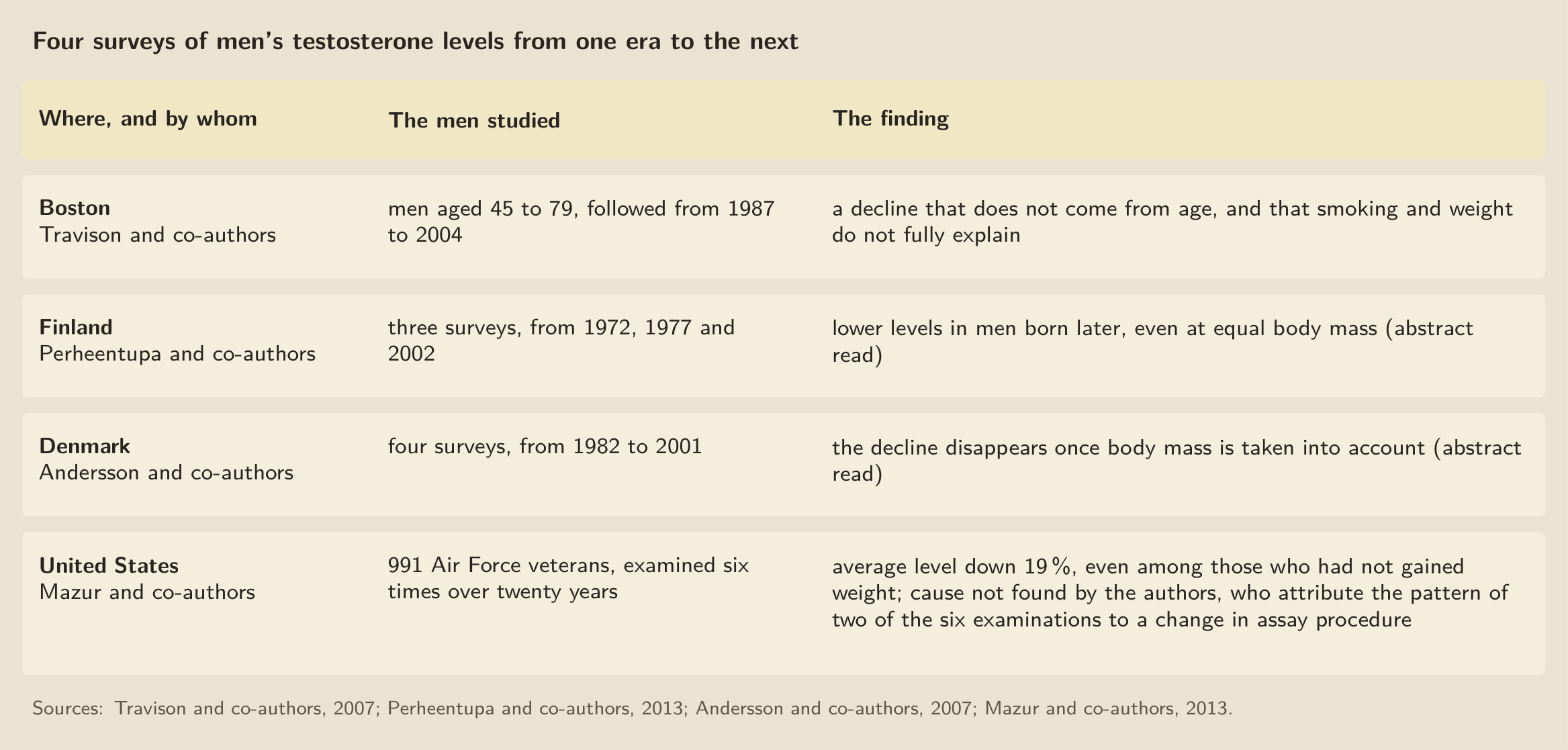
In Boston, Travison and coauthors followed men aged forty-five to seventy-nine from 1987 to 2004 (Travison et al. 2007). They find a decline that is not due to age, and that smoking and weight do not fully explain (Travison et al. 2007).
In Finland, Perheentupa and coauthors compared three surveys, from 1972, 1977 and 2002 (Perheentupa et al. 2013). Men born later had lower levels, even at the same body size (Perheentupa et al. 2013).
In Denmark, Andersson and coauthors find something different in four surveys conducted from 1982 to 2001 (Andersson et al. 2007). The decline disappears once body size is taken into account, and no age-independent trend appears for free testosterone, the fraction of the hormone that is not bound to a blood protein (Andersson et al. 2007) (Wikipédia s. d.f). For these two surveys, I read only the abstracts (Perheentupa et al. 2013) (Andersson et al. 2007).
In the United States, Mazur and two colleagues followed nine hundred ninety-one Air Force veterans, examined six times over twenty years (Mazur et al. 2013). Their mean level fell by nineteen percent, even among those who had not gained weight (Mazur et al. 2013). The authors were unable to find the cause of this decline (Mazur et al. 2013).
 Tap to enlarge
Instruments that do not measure alike
Testosterone is not measured with the same technique everywhere (Wu et al. 2010). Immunoassays, laboratory tests based on antibodies, are known to give variable and imprecise results (Wu et al. 2010). Mass spectrometry is a more accurate laboratory method, and the authors who use it ask that their thresholds be adjusted before being applied elsewhere (Wu et al. 2010) (Wikipédia s. d.e).
In 2004, Wang and coauthors compared two analyzers with mass spectrometry on the same samples (Wang et al. 2004). One gave lower values, the other higher ones (Wang et al. 2004).
In 2017, Travison and coauthors had some of the samples from four American and European cohorts reassayed by the reference laboratory of the Centers for Disease Control, the public health agency of the United States (Travison et al. 2017) (Wikipédia s. d.a). A large share of the differences between these cohorts came from differences in assay (Travison et al. 2017).
In Baltimore, Harman and coauthors found an effect of the sampling date, which their investigation suggests is an artifact, an effect produced by the way the measurement was made (Harman et al. 2001) (Wiktionnaire s. d.a). Of these two studies, I read only the abstracts (Wang et al. 2004) (Harman et al. 2001). Mazur and colleagues likewise attribute the unusual pattern of two of their six examinations to a change in assay procedure (Mazur et al. 2013).
Sleep, weight, chemicals
In 2011, a study by Leproult restricted the sleep of ten young men to five hours a night for one week (Leproult and Van Cauter 2011). Their daytime level fell by ten to fifteen percent (Leproult and Van Cauter 2011).
According to the abstracts of their studies, Camacho and colleagues associate weight gain with a proportional fall in level, and weight loss with a rise, while MacDonald and colleagues link greater body size to lower levels (Camacho et al. 2013; MacDonald et al. 2009; Mazur et al. 2013).
In 2009, the Endocrine Society, which brings together hormone specialists, published a position statement on endocrine disruptors, substances that interfere with the way hormones work (Diamanti-Kandarakis et al. 2009) (Wikipedia s. d.a) (Wikipédia s. d.c). It gathers results obtained mostly in animals and after early exposure (Diamanti-Kandarakis et al. 2009). Its passage on reduced testosterone production refers to a study of rat fetuses at the stage when their sex differentiates (Diamanti-Kandarakis et al. 2009). Its authors describe the human evidence as limited, with results that are sometimes inconsistent from one study to another (Diamanti-Kandarakis et al. 2009).
In Seveso, in northern Italy, the explosion of a chemical plant heavily contaminated the surrounding area in 1976 (Diamanti-Kandarakis et al. 2009). Twenty-two years later, Mocarelli and coauthors studied one hundred thirty-five men exposed that day, grouped by their age at the time of the accident (Diamanti-Kandarakis et al. 2009) (Mocarelli et al. 2008). Those who were then between one and nine years old had poorer-quality sperm (Diamanti-Kandarakis et al. 2009). Between ten and seventeen, the association was reversed, and the authors describe it as stimulatory (Diamanti-Kandarakis et al. 2009). Among those who were already adults, aged eighteen to twenty-six, no association appeared (Diamanti-Kandarakis et al. 2009) (Diamanti-Kandarakis et al. 2009). In no group did the exposure affect the testosterone level itself (Mocarelli et al. 2008).
In 2018, Radke and coauthors reviewed the human studies on phthalates, a family of chemical substances (Radke et al. 2018) (Wikipédia s. d.d). Across thirteen studies of adult men, they rate as moderate the evidence of a link between three of these substances and a lower testosterone level (Radke et al. 2018). All of these studies measure exposure and level at the same time, so it is not known which of the two comes first (Radke et al. 2018).
Low levels: what symptoms?
A large European study examined three thousand two hundred nineteen men aged forty to seventy-nine, in eight centers (Wu et al. 2010). The researchers tested thirty-two candidate symptoms (Wu et al. 2010). Only nine were linked to the level, and the three used to define testosterone deficiency are sexual (Wu et al. 2010).
Psychological symptoms, including fatigue and loss of energy, tracked the level little or not at all (Wu et al. 2010). Sadness and fatigue were the exception when free testosterone was low, and the authors note that they overlap largely with the nonspecific complaints of aging (Wu et al. 2010) (Wu et al. 2010).
Even for the three sexual symptoms, the link with a low level ceased to be clear once age, weight and other illnesses were taken into account (Wu et al. 2010). The authors explain that obesity and general health contribute both to low levels and to the symptoms (Wu et al. 2010).
Earlier work on the same men classified nearly a quarter of them as hypogonadal, that is, testosterone-deficient, on the basis of their blood test alone (Wu et al. 2010) (Wiktionnaire s. d.b; Wikipedia s. d.b). By also requiring symptoms, this study finds only two in a hundred, about eleven times fewer (Wu et al. 2010). The authors insist on symptoms in order to avoid diagnosing a deficiency in men who do not have one (Wu et al. 2010). A level judged to be low occurs without the expected symptoms, and the most characteristic symptoms remain common in men with normal levels (Wu et al. 2010).
In a man who has symptoms, the authors write, a low level is not necessarily the cause, nor the main one, and a general assessment is needed to look for other explanations (Wu et al. 2010). They specify that their data do not establish criteria for treatment (Wu et al. 2010).
What about submission?
I found no study that measures the link between testosterone and obedience to authority, and in this search I screened only titles.
In 2007, a study had twenty-six doctoral students play a money-sharing game, in which one player proposes a split and the other accepts or rejects it (Burnham 2007). Rejecting a low offer meant giving up money in order not to accept a split judged unfair (Burnham 2007). The men who rejected had on average a higher level than the others (Burnham 2007). Forty-five percent of the men above the mean level rejected, compared with seven percent of those below it (Burnham 2007).
The author himself points out the limits of his sample (Burnham 2007). Only six men rejected, all doctoral students at the same university and trained in game theory (Burnham 2007). The level was measured without administering the hormone, so the study does not tell us which of the two acts on the other (Burnham 2007). The trials in which the hormone was given, listed in the review coauthored by Carré, do not find that it increases rejections in this game (Carré and Archer 2018).
Inoue and coauthors studied a real hierarchy, that of seventy rugby players at Aoyama Gakuin University in Japan, where younger players traditionally defer to older ones (Inoue et al. 2017). In a sharing game, each player knew nothing about their partner except their year (Inoue et al. 2017). Among the older players, a high level went with fewer concessions, and among lower-ranked players, with more (Inoue et al. 2017). The study covers a single group, without administration of the hormone (Inoue et al. 2017).
Wright and coauthors gave testosterone on one day and a placebo on another, in an order drawn at random, to women working in pairs (Wright et al. 2012). On testosterone, each woman gave more weight to her own judgment than to her partner’s (Wright et al. 2012). None of these three studies measures a man’s obedience to authority.
For my part, I see a hormone that matters, but far less than people claim: its measured effects are small, they depend on the situation, and they often run from behavior and status to the level rather than the other way around. It seems to me tied to the pursuit of status far more than to an aggressive drive (Eisenegger et al. 2011). And the link between a low level and docility is, in my view, the least supported part of this whole story.
References
What has changed
- : The text is rewritten as a narrative, starting from the common beliefs about testosterone that the author heard around him. The title does not change. What prompted it: The article now tells the studies one after another. Its scientific sources are retained, and dictionary and encyclopedia entries are added for the terms explained along the way.