The proofs that aren't
Why a good argument for one religion would prove another
0. Introduction: convincing is not valid
There is something we easily forget when someone lays out for us, with fervour and in good faith, why their religion is the true one. An argument can be deeply convincing and a complete failure. The force of conviction it carries says nothing about its soundness; what does is its logical validity and the truth of its premises. The aim of this text is not to win a debate, but to learn to separate two things: what wins our assent, and what establishes the truth.
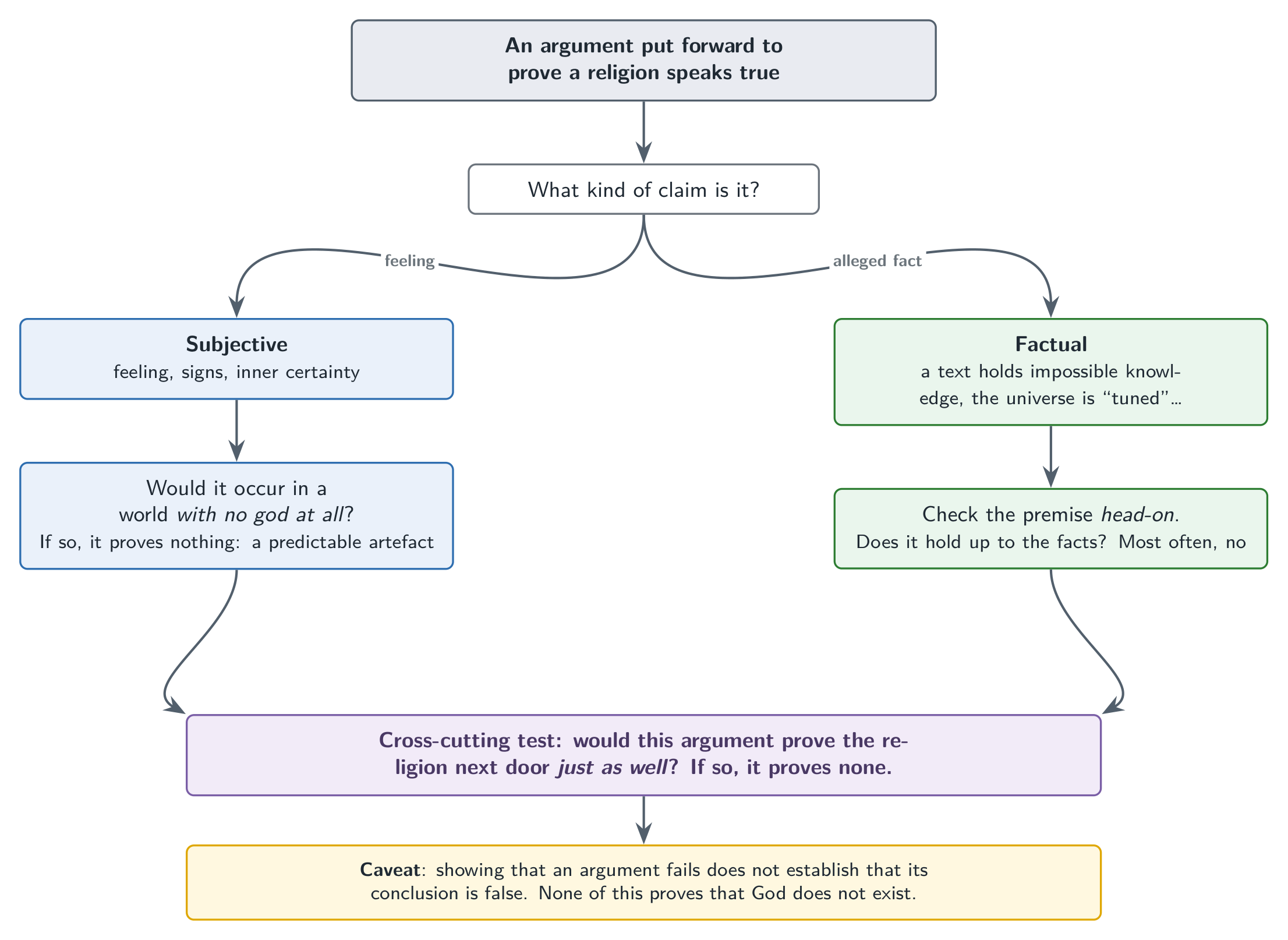
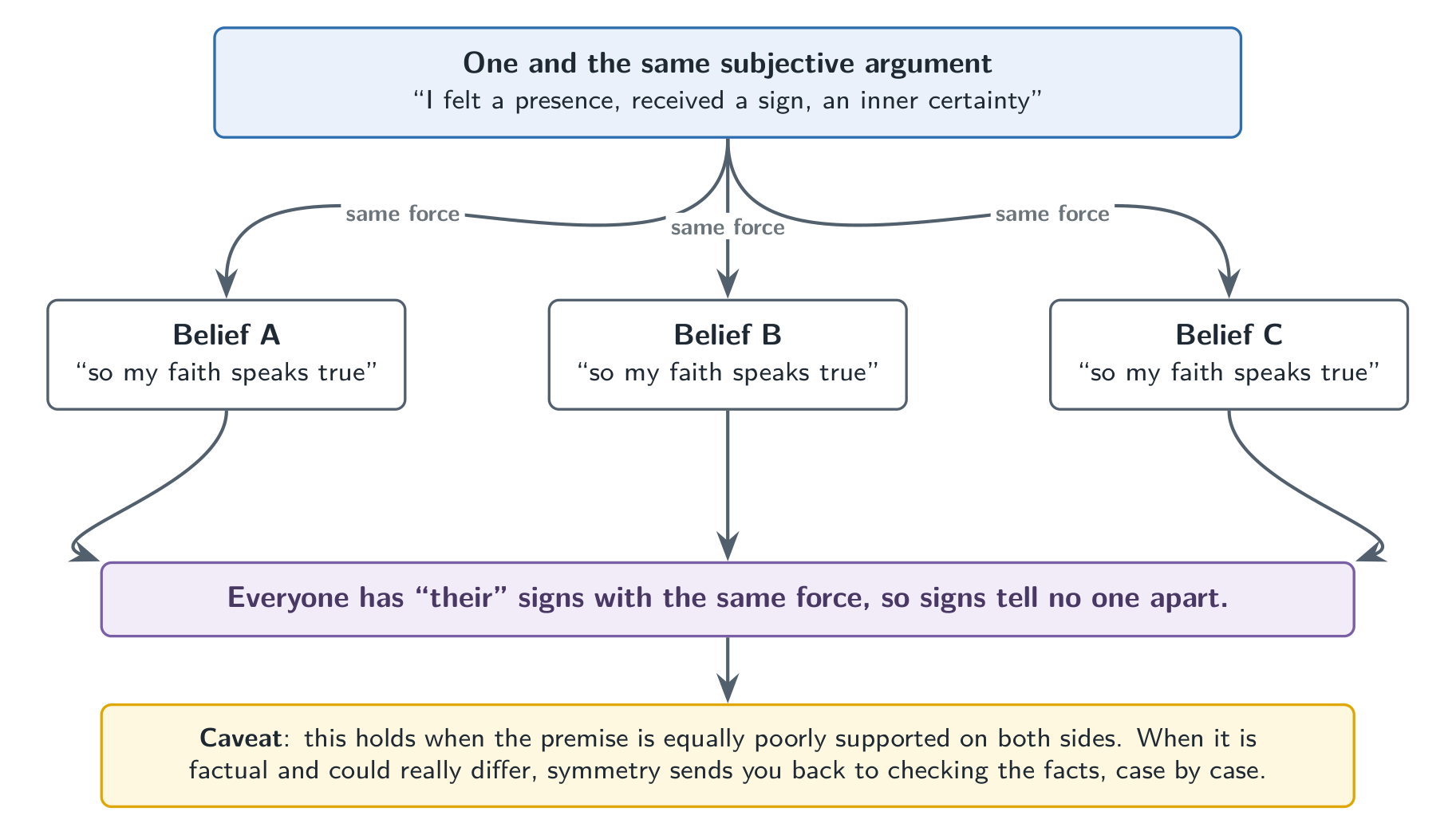
We will look at the arguments most often put forward to establish that a religion speaks true. Islam will serve as a thread, because the material comes from a real discussion about it. But Islam is only an example here. At every step, the same argument turns up, almost word for word, in the mouths of believers of other traditions, and that is exactly what provides the most useful test to keep in mind: this argument, if it were valid, would it prove the religion next door just as well, the one my interlocutor himself rejects? An argument that would prove Islam, Christianity and Hinduism equally well proves none of the three. This tool has its limits, which must be stated so as not to overuse it. Symmetry defeats the inference when the premise is just as poorly supported from one tradition to the next, like the private signs each person reports. But when the premise is factual and could genuinely differ from one case to another, symmetry does not settle it: it sends us back to the examination of the facts, case by case, which we then carry out.
One distinction governs everything that follows. Arguments fall into two families, and we do not treat them the same way. Some are subjective: they rest on a feeling, a certainty, personal signs. For those, the right question is whether the feeling would be there anyway, within any belief. The others make a factual claim: they assert something objective about the world or about a text, for instance that a book contains knowledge impossible for its time. Those we cannot dismiss with a sidestep by saying “it would be there without a god”, because the claim is about a content, not about a feeling. We have to check the premise head-on, and see whether it holds. It is this checking, not a magic formula, that occupies the heart of this text.
One clarification, finally, because the confusion is lying in wait. Showing that an argument fails does not prove that its conclusion is false. Refuting a bad proof of God’s existence does not establish that God does not exist, and this text nowhere claims it does. It aims at something more modest, but more solid: to strip these arguments of the probative force we lend them. The metaphysical question remains entirely open.
A last word on what this text does not do, so as not to suggest it empties the subject. It examines the arguments one hears in a conversation, not the learned natural theology, those far more demanding philosophical constructions that are the cosmological argument, the argument from contingency or the moral argument. Those call for their own examination, and their absence here is not a verdict against them.
1. “I’ve had signs, I’m a hundred per cent sure”
The first argument is not really one, but it is the most sincere and the most widespread: a total inner certainty, fed by signs received throughout a life. It must be taken seriously, because it is experienced as self-evident, and no one gives up self-evidence on command.
In its most demanding form, this argument is not naive, and philosophers have defended it seriously. According to Richard Swinburne’s principle of credulity, what seems to us to be the case is a reason to believe it is, as long as no contrary reason opposes it; and William Alston argued that an experience of God could function as a perception, yielding a presumption of reality (Alston 1991; Swinburne 2004). Properly put, the argument therefore does not say “I feel it, so it is true”, but “an experience counts as a presumption as long as no defeater undoes it”. The whole question is then whether the defeaters are lacking. They are not.
Certainty and signs are predictable products of our mental architecture, and not proofs, and the reason for it is precise. The mechanism that produces them would fire whether the belief is true or false; being insensitive to what it asserts, it follows the state of our brain, not the state of the world. This reasoning does not turn against every faculty: perception, mathematics and logic escape it, because we have independent reasons to think they track their object. And it does not establish that intuition is false; it shifts the burden of proof. A single mechanism is already enough to understand why the signs seem so numerous. Confirmation bias is that tendency, one of the best established in psychology, to notice and retain what confirms our beliefs, and to neglect or reinterpret what contradicts them (Elston 2020; Nickerson 1998). Over a whole lifetime, thousands of small events occur; those that fall at the right moment become signs and are engraved, the others fade without leaving a trace. The final count is not kept honestly, because the mind does not count, it selects.
Above all, this argument fails the symmetry test in the clearest possible way. A large survey conducted in five very different countries, from the United States to Ghana, from Thailand to China and Vanuatu, shows that the sense of a supernatural presence, the voices, the signs, are reported in all these cultures, and that they are shaped by the local religious framework rather than by one true religion in particular (Luhrmann et al. 2021; Gutierrez et al. 2018). A Muslim receives Muslim signs, a Christian Christian signs, a Hindu Hindu signs, and each sees in them the confirmation of his own faith with the same intensity. Here is the defeater the strong form was waiting for: if certainty and signs pointed to a true religion, they would not point with the same force to all of them at once. Since they do, they cannot tell any of them apart.
2. Fine-tuning: “if the sun were shifted by a centimetre”
Here is an argument of a quite different seriousness. In its popular version, it is said that if the Sun were shifted by a centimetre, or the Earth by a hair, life would be impossible: the universe would be tuned with a precision that betrays an intention.
Put this way, the argument falls at once, because its numerical premise is false. The zone around a star where liquid water is possible, the so-called habitable zone, is not measured in centimetres but in fractions of an astronomical unit. For the Sun, it stretches from about 0.95 to 1.7 times the Earth-Sun distance, a width of the order of a hundred million kilometres (Kasting et al. 1993; Kopparapu et al. 2013). The “centimetre” is wrong by about thirteen orders of magnitude. The Earth could be moved several million kilometres without losing its liquid water; the margin is nothing like a razor’s edge.
But it would be dishonest to stop there, because this popular image is only a caricature of a real and difficult argument. In its learned version, fine-tuning is not about the position of a planet, but about the fundamental constants of physics. Several of them appear to have to fall within narrow ranges for complex chemistry to exist: the cosmological constant, which governs the expansion of the universe and whose observed value is minuscule compared with what naive theory would predict; the strength of the strong nuclear interaction, which conditions the formation of nuclei; the ratio between the electromagnetic and gravitational forces (Barnes 2012). Presented by its best defenders, this is a troubling fact that deserves reflection, not a joke.
The inference towards a designer runs, however, into three objections. First, a selection effect. We could in any case only observe a universe compatible with the existence of observers; noting after the fact “well, it is compatible” is therefore no surprise, this is the weak anthropic principle (Carr and Rees 1979). This effect, however, bites only when set against a multitude of universes to fall into; faced with a single case, it loses its reach (Carr and Rees 1979). The philosopher Douglas Adams gave an image of this, as an illustration and not a proof: a puddle that marvels that the hollow it rests in fits its shape so well, before believing it was shaped for it; the image, however, already assumes settled what is in question (Carr and Rees 1979). Next, to speak of “improbable” presupposes a probability distribution over the possible values of the constants, a distribution we do not possess; without it, the word has no precise mathematical meaning, and one cannot compute a rarity from a single observed case (McGrew et al. 2001). Finally, the degree of tuning is often exaggerated: detailed analyses show that stars, and therefore complex chemistry, would remain possible over a far wider range of parameters than is claimed (Adams 2019; Barnes 2012). There are besides competing explanations, such as the hypothesis of a multitude of universes; it is debated and in no way established, but it is enough for it to be serious to show that a designer is not the only option on the table (Carr 2007).
The point is not that fine-tuning is an illusion or a piece of nonsense. It is that a false numerical premise, an ill-defined notion of improbability, an overstated degree, and one explanation among several do not, together, make a proof.
Box. What the science says: fine-tuning
- The scale: the Sun’s habitable zone stretches from about 0.95 to 1.7 astronomical units, nearly 100 million km wide (Kasting et al. 1993; Kopparapu et al. 2013).
- The best version: the serious argument is about constants (the cosmological constant, the strong interaction), not the position of a planet (Barnes 2012).
- Selection: an observer can only find a universe that allows observers (the weak anthropic principle) (Carr and Rees 1979).
- Probability: to say “improbable” presupposes a distribution of the constants that we do not have (McGrew et al. 2001).
- The degree: star formation remains possible over a wide range of parameters; the tuning is often overstated (Adams 2019; Barnes 2012).
- The multiverse: a serious but unestablished competing explanation, not to be presented as a fact (Carr 2007).
3. “Scientists are believers, they can’t prove we exist”
The argument assumes that scientists, unable to demonstrate everything, would end up believing, and that their authority would then back up the faith. The premise is false, and even if it were true, it would prove nothing.
On the facts, it is rather the opposite. Surveys show that scientists, especially elite ones and in a Western context, are markedly less believing than the general population (Ecklund and Scheitle 2007; Ecklund et al. 2016; Larson and Witham 1998). Among the members of the United States National Academy of Sciences, one of the most prestigious scientific bodies in the world, belief in a personal God did not exceed the order of seven per cent at the end of the 1990s, the overwhelming majority declaring themselves unbelieving or agnostic (Larson and Witham 1998). We must nonetheless stay accurate: this finding varies from country to country, many scientists remain believers, especially outside the West, and so we will not claim that “scientists are atheists” (Ecklund and Scheitle 2007; Ecklund et al. 2016; Larson and Witham 1998). The assertion “scientists are believers” is simply false as a generality, and that is all the argument needed.
On the logic, it goes deeper still. Whether experts believe or not does not establish the truth of a proposition; this is an appeal to authority, and authority, outside its field of competence, has no probative value. A great biologist is no authority on the existence of God, which is not a question of biology. And the argument turns round at once: if the number of believers among scholars proved a religion, then their scepticism, where it dominates, should refute it. One cannot brandish the count only when it suits.
4. “The Quran predicted scientific facts we didn’t know”
Here is the argument many hold to be the strongest, and it deserves an inquiry, not a dodge. People cite embryology, the expansion of the universe, iron “come from space”, supposedly unknowable in the seventh century. Let us first state it in its strongest form: if an ancient text really contained knowledge impossible for its time, stated unambiguously before science discovered it, that would be genuinely troubling, and no sidestep would suffice to dismiss it.
The first thing to see is that this is not an isolated example but a whole genre, the i’jaz ilmi, or “scientific inimitability”, which ranges across all of science, from cosmology to geology, from oceanography to anatomy (Bigliardi 2017; Akhtar et al. 2025). This genre is analysed, by the specialists who have studied it, as retrospective concordism: one first identifies a modern discovery, then looks for a verse vague enough to be read into it, after the fact (Bigliardi 2017). The variable adjusted is never the text, it is the interpretation. No one, before science found these things, derived them from the Quran. Rather than asserting this, let us examine three cases, among the most cited.
The embryo. The reference passage (sura 23, verses 12 to 14) describes man formed from a drop, then an alaqah, then a lump of flesh (mudgha), then bones that are afterwards clothed with flesh. Defenders of the i’jaz read alaqah as “clinging embryo”, echoing the implantation of the egg. Yet the primary meaning of the word, attested by lexicography and by classical exegesis, is that of a clot of blood, a leech, a thing that hangs and clings; the whole “miracle” rests on this choice of translation (Kueny 2013; Bigliardi 2017). More telling still is the order announced: first the bones, then the flesh that clothes them. This is the sequence found in the embryology of Galen, the Greek physician of the second century, whose writings circulated in the Near East well before the seventh; and that sequence is inaccurate, bones and muscles differentiating together (Kueny 2013; Chung 2019). The detail is strongly suggestive: if the text came from foreknowledge, one would expect it to correct Galen rather than take up his mistaken order. This is a scholarly reading, defended but debated, and not a closed fact; it weighs as a serious clue, not as a demonstration. More broadly, the embryological knowledge said to be inaccessible was in reality available, inherited from the Greek medicine of Aristotle and Galen (Chung 2019; Kueny 2013).
The expansion. The verse “and the heaven, We built it with power, and We are mūsiʿūn” (sura 51, verse 47) is presented as the announcement of the expansion of the universe discovered by Hubble in 1929. But the classical commentators, centuries before Hubble, rendered mūsiʿūn as “holders of a vast power” or “We dispense provisions amply”, without the slightest idea of a cosmos that dilates (Bigliardi 2017; Coran 2004). The cosmological reading appears only after the discovery it claims to have anticipated.
The iron. The verse “We sent down iron, in which there is fearsome strength” (sura 57, verse 25) is read as the stellar or spatial origin of iron. But the verb “to send down” (anzala) is used throughout the Quran in the sense of granting or providing: it “sends down” cattle (sura 39, verse 6) and clothing (sura 7, verse 26), which do not fall from the sky (Bigliardi 2017; Coran 2004). To read an astrophysics thesis here is to lay a modern technical meaning over an ordinary turn of phrase.
These three cases are not isolated. The scientific readings of the text are unstable and produce errors, something acknowledged even by authors favourable to the i’jaz (Akhtar et al. 2025; Bigliardi 2017). And the reading is selective: one keeps the verses that can be twisted towards science, and reinterprets or passes over those that contradict it, whether the mountains presented as pegs stabilising the earth against earthquakes (sura 78), the sun one finds setting in a muddy spring (sura 18, verse 86), a motif inherited from the cosmology of late antiquity, or the meteors hurled at the demons who try to eavesdrop on the sky (sura 37) (Tesei 2021; Bigliardi 2017).
A word on the famous endorsements by scientists. The most cited, in embryology, attributed to the anatomist Keith Moore, was produced in a special edition of his textbook made with the Commission on Scientific Signs founded by the preacher al-Zindani, and not at the end of an independent peer review (Golden 2002). This is not a scientific validation; it is a promotional operation, documented by the press.
There remains the logical lock. The argument is unfalsifiable: when a verse is shown to be false, it becomes a metaphor at once, so that no observation can ever contradict it. And it fails the symmetry test like all the others: the same concordist method has been applied to the Bible and to other sacred corpora, where the Big Bang, relativity or embryology have been “found” after the fact (Bigliardi 2017). The same method produces miracles in any corpus.
Let us be fair to finish. The Quran contains accurate observations, such as the development of the embryo in stages or the imperfect mixing of fresh and salt waters. The point is not that it is wrong everywhere, which would be as unfair as it is absurd. It is that a banal observation, or vague language reread after the fact, does not amount to knowledge impossible without God; and that as soon as a statement becomes testable and precise, one of two things happens: either it matches a science already known at the time, or it is wrong.
Box. Three worked cases: the “scientific miracles”
- The embryo: the sequence “bones then flesh” (23:14) follows Galen’s mistaken order, Greek knowledge already available; hardly foreknowledge (a scholarly reading, defended but debated) (Kueny 2013; Chung 2019).
- The expansion: mūsiʿūn (51:47) was rendered “vast power” by the classical commentators, before Hubble (Bigliardi 2017; Coran 2004).
- The iron: anzala (“to send down”, 57:25) is also used for cattle and clothing; the astrophysical reading is anachronistic (Bigliardi 2017; Coran 2004).
- The structure: retrospective concordism, selective, unfalsifiable, and symmetrical (the same method “works” on any text) (Bigliardi 2017).
5. “No one has ever been able to imitate the Quran”
The argument from the challenge is old and elegant. The text itself challenges anyone who doubts to produce “a sura like it” (sura 2, verse 23; sura 10, verse 38); yet, it is said, for fourteen centuries no one has managed it. The inimitable perfection of the text would therefore mark its divine origin.
The problem is that there is no objective criterion of literary inimitability. The doctrine of i’jaz, the inimitability of the Quran, occupied the greatest scholars of classical Islam, and it rests in the last analysis on an aesthetic judgment: beauty, arrangement (nazm), the effect produced (Vasalou 2002; Esmail 2023). But who judges? Readers already convinced, for whom an imitation cannot measure up, by definition. The reasoning goes in a circle: the text is inimitable because no imitation is judged worthy, and no imitation is judged worthy because the text is held to be inimitable.
In fact, the challenge is self-sealing. Contemporaries and successors did indeed compose imitations, from the rival “prophet” Musaylima to the deliberately Quranic pages of the great sceptical poet al-Ma’arri; all were declared, out of hand, not equivalent, for want of a shared criterion that would allow them to be judged otherwise (Vasalou 2002). A test whose result is fixed in advance tests nothing.
Finally, the feeling of inimitability is explained without a miracle. The perceived beauty of a text owes a great deal to processing fluency, that ease brought by familiarity, memorisation, repeated liturgical recitation. And other traditions say exactly the same of their own Scripture, held to be of a perfection none could equal. The argument, here again, would prove just as well the perfection of the text across the way.
6. “The text has never changed, and it’s the others who corrupted the Scriptures”
Two historical claims stand here, and textual history can examine both. The first holds that the Quran has remained rigorously identical since the beginning; the second, that the earlier traditions corrupted their own texts.
The transmission of the Quran is, in fact, remarkably stable in the dominant tradition. But “never changed” is a theological simplification of a real history, and one better known than is thought. The Sanaa palimpsest, found in Yemen, offers the material proof: beneath the standard text, its erased lower writing preserves another state of the Quran, with variants in word order, synonyms, segments present or absent, a textual type distinct from the official vulgate (Sadeghi and Goudarzi 2012). There were therefore indeed several versions in circulation in the early centuries, alongside the variant readings (qira’at) recognised by the tradition itself (Déroche 2022; Hilali 2017).
If the text is so stable today, it is because it was stabilised. The Muslim tradition itself reports it: the caliph Uthman had a reference copy made and ordered the other manuscripts burned, including the collections of notable companions such as Ibn Mas’ud’s (an account preserved in Sahih al-Bukhari, hadith 4987) (Sadeghi and Goudarzi 2012; Déroche 2022). The standardisation kept one recension and made the divergent ones disappear, something acknowledged even by the studies most attached to the text’s authenticity (Déroche 2022; Sadeghi and Goudarzi 2012). The stability is real, but it is the product of a decision, not the proof of a supernatural preservation.
As for the accusation that the others corrupted their Scriptures, it has a name, tahrif, and it works in a circle. One asserts that the earlier revelation was altered, which serves precisely to legitimise the new one as the pure and final version (Thomas 1996). The device is convenient, but it proves nothing, because it applies just as well to the next link: the revelation that follows will be able to say in turn that this one was altered. Textual criticism, for that matter, documents variants in all three corpora, Jewish, Christian and Muslim; none fell from the sky intact (Déroche 2022; Hilali 2017).
7. “The Quran foretold future events”
A factual variant of the scientific argument: the text is said to have predicted historical events before they happened. The most cited example is the announcement, at the opening of sura 30, that “the Romans, defeated in the nearest land, will in turn be victorious within a few years” (verses 2 to 4), which is said to have come true when Byzantium beat Persia.
Taken seriously, the case turns out to be elastic. The expression translated “within a few years” (biḍʿi sinīn) denotes an indeterminate number of years, traditionally understood as between three and nine, which leaves a comfortable window. More striking, the very vocalisation of the verb is disputed: depending on whether one reads sa-yaghlibūn or sa-yughlabūn, the verse announces that the Romans will conquer or that they will be conquered, since early Arabic did not mark short vowels (Coran 2004). A prediction whose delay and meaning can both be adjusted after the fact is not a risky prediction.
Now a prophecy counts as proof only under strict conditions: that it be precise, clearly prior to the event, and unable to be reinterpreted to fit the facts. The “fulfilled prophecies” put forward are most often vague, sometimes re-dateable, and only the hits are kept, never the disappointed expectations. Above all, it is a universal genre: the Bible (the coming of Cyrus, the seventy weeks of Daniel), the quatrains of Nostradamus and many other corpora claim fulfilled predictions in just the same way, often reconstructed after the fact to fit the event (Miller 2016). This type of proof is found identically in every tradition.
8. “Islam is the last religion, therefore the true one”
The argument seems elegant: each revelation would fulfil and correct the previous one, and the last would therefore be the culmination, the seal. It has a real narrative force, that of a story that closes neatly.
But this is exactly the structure that every tradition adopts. The motif of presenting oneself as the fulfilment that surpasses and replaces the earlier tradition, supersessionism, is intrinsic to Judaism and Christianity before Islam takes it up in its turn through tahrif (Svartvik 2022; Soulen 2005; Thomas 1996). Christianity calls itself the fulfilment of Judaism; Islam, of both; the Baha’i faith, of Islam; and the chain does not stop there. Each link experiences itself as the last and the true one, and takes the next for a straying.
Hence the logical flaw: “last, therefore true” is a non sequitur. Posteriority in time is not a criterion of truth, otherwise one would have to grant, in consistency, the same privilege to the revelation that will come after, and side today with the latest preacher to date. Chronology indicates only who has spoken last so far.
9. “Look at its success: so many faithful, such rapid expansion, lives transformed”
Two arguments of the same family often come together, and both confuse success with truth. Yet the number of the faithful, the speed of an expansion or the strength of a testimony are not criteria of truth: this is an appeal to numbers and to consequences, a reasoning that would have a thing be true because it succeeds or because it does good. An error shared by millions remains an error.
The expansion. Islam spread across a vast empire in less than a century, and people see in it a divine favour. But rapid diffusion is nothing unique: early Christianity grew at a sustained pace for three centuries, Mormonism long figured among the fastest-growing religions, and still other movements spread at great speed (Bulliet 1979; Stark 1996). Above all, conquest must be distinguished from conversion. The political expansion of the empire was indeed dazzling, but the islamisation of populations was gradual: the conversion curves established by the historian Richard Bulliet show that it took several centuries for a majority of the population of the conquered lands to become Muslim (Bulliet 1979; Stark 1996). The military success of an elite says nothing about the truth of what it professes, and the same argument would prove Christianity just as well, which uses it in exactly the same way.
Lives transformed. People cite upended lives: an addiction overcome, a life calmed, a meaning recovered after conversion. These transformations are real and deserve respect. But they follow conversion in every tradition, and also in entirely secular settings, from mutual-aid groups to group therapy: this is an effect of community, of meaning and of commitment, not the proof of a particular doctrine (Gutierrez et al. 2018). These stories of transformation are found, as far as one can judge, in every tradition as among non-believers, without any having exclusive claim to them (Gutierrez et al. 2018). To this is added a survivorship bias: we see and recount the transformed converts, far less those who relapsed or left, so that the overall picture is distorted before it is even interpreted.
10. “There is no compulsion, you’re free to leave”
The last argument means to be reassuring: Islam would force no one, the Quran proclaiming that “there is no compulsion in religion” (sura 2, verse 256), and whoever leaves should be accepted without friction. The verse is cited in good faith.
The problem is not the stated principle, it is its gap with reality, on two levels. On the social level first, leaving a religion with strong transmission has a documented cost, made of ostracism and the breaking of ties. On the doctrinal level next, the principle coexists with a legal tradition of punishing apostasy, riddah. This tradition rests on a hadith stating “whoever changes his religion, kill him” (Sahih al-Bukhari, hadith 3017), and the four great Sunni schools of law have historically prescribed death for the apostate, with notable variations, such as imprisonment rather than death for a woman among the Hanafis (Peters and De Vries 1976; Saeed 2017).
Honesty calls for two clarifications. On the one hand, this tradition is today vigorously contested by many reformist scholars, who hold that the penalty originally targeted political treason and not the mere change of belief (Saeed 2017; Kamali 2019). On the other, the laws vary greatly from one country to another. It remains that in 2019, twenty-two states, most of them in the Middle East and North Africa, still criminalised apostasy, sometimes with heavy penalties (Pew Research Center 2022). The tension therefore remains entire: a system that proclaims the freedom to leave while surrounding the departure with a social and, in places, legal cost tells us about its means of holding on, not about the truth of what it teaches.
11. Conclusion: judge the argument, not the fervour
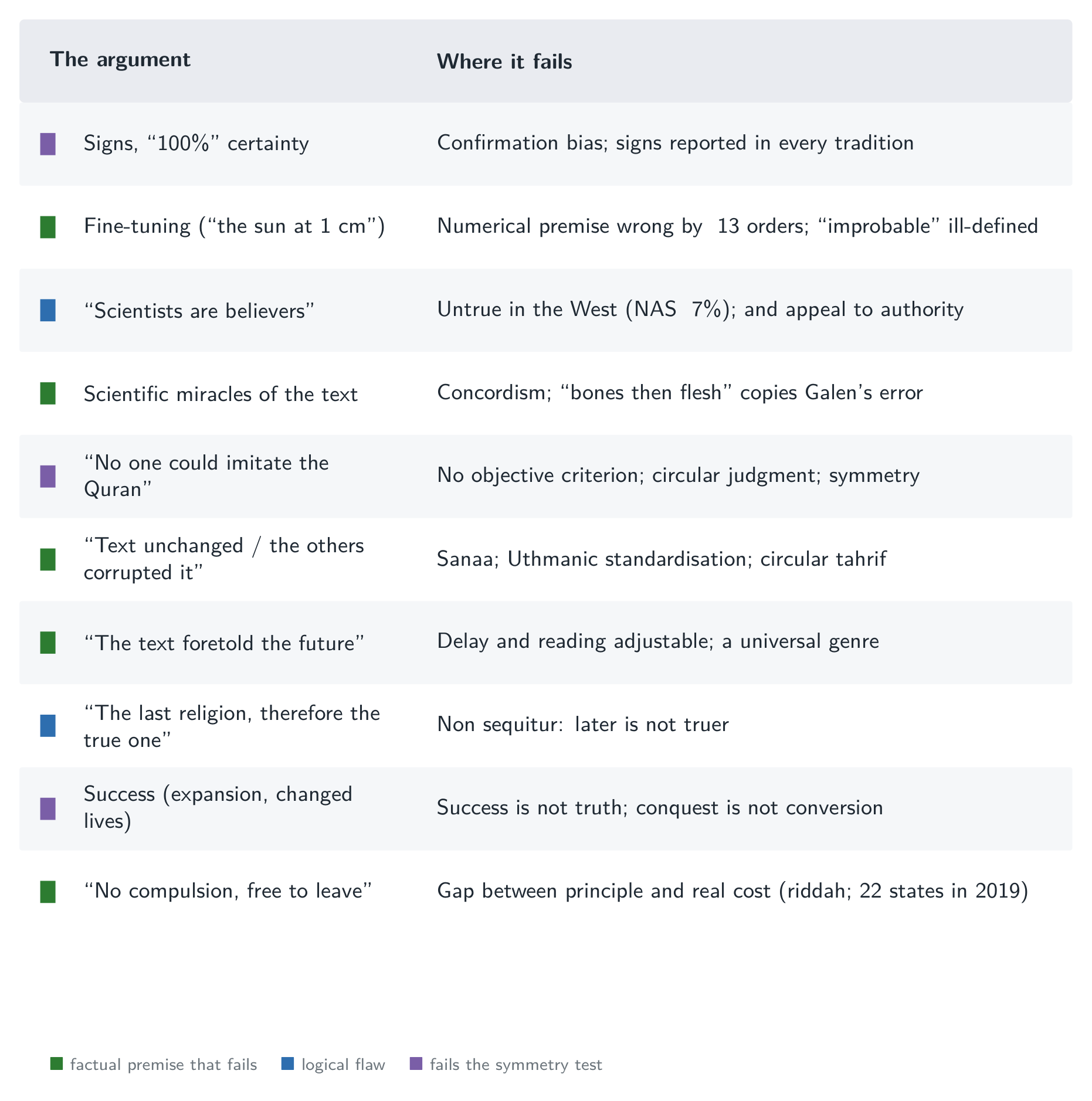
Reviewed, these arguments fail in two ways, according to their nature. Some rest on a feeling that would be there in any religion: certainty, signs, the beauty of the text, the transformed life. The others assert a fact that, checked closely, does not hold: a false astronomical scale, an ill-defined improbability, a retrospective concordism that copies even Galen’s errors, a textual history stabilised by a human decision, an elastic prophecy, a chronology set up as proof. And almost all of them stumble on the same test, the simplest one: the examination of their premise, whether it rests on a feeling present in any belief or on a fact that yields to verification. Symmetry with the religion across the way gives the most visible case of it, decisive when the premise is a matter of feeling.
None of this says that God does not exist, and this text will not say it. It says only that an argument is judged not by the fervour it inspires, but by its validity and the truth of its premises. It is a habit that is acquired and that carries everywhere: identify the nature of the argument, check its premise head-on when it has one, and ask whether it would prove something else just as well. At the next argument heard, from whatever mouth it comes, the reader can apply it himself.