
Does Encrypted Mean Private?
Apps promise that our messages and our files are encrypted, and others reply that everything ends up with the tech giants or the state anyway. Cryptographers, computer scientists who have tried to find people in so-called anonymous files, judges, and the companies themselves, in their own documentation, have written down how far these promises reach, and where they stop
Published · Updated
The conversation stalls almost every time. There is always someone to show the little padlock in their messaging app, and someone else to shrug: they all lie. Since Edward Snowden’s revelations in 2013, that second answer has passed for the more clear-sighted one. I have given it myself, without ever having read a line from the companies about their own services.
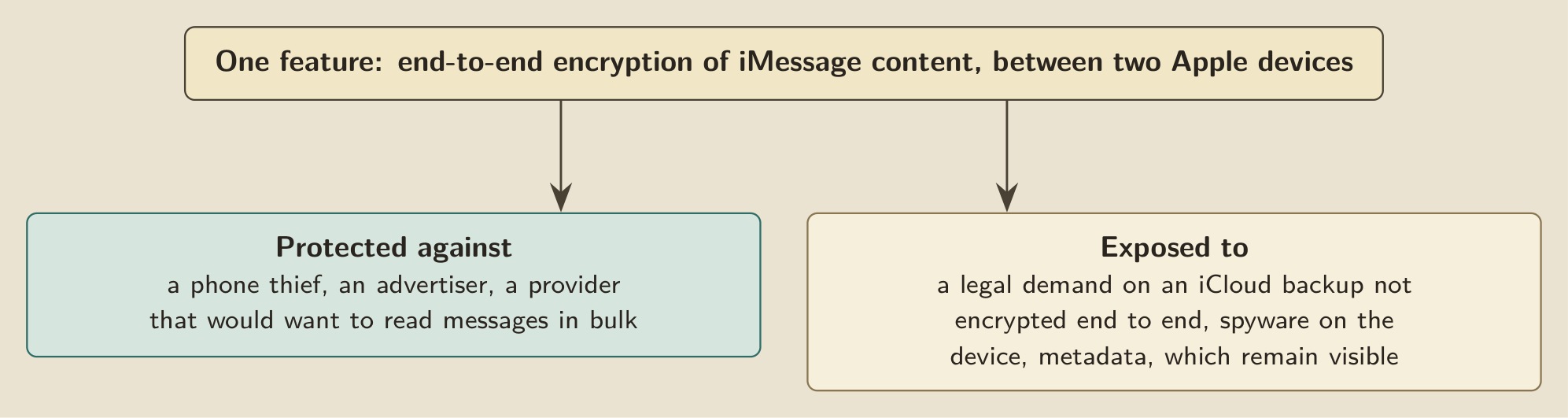
So I wanted to know whether our data is sold, reused, or on the contrary encrypted and anonymized, at Apple and Meta first, then at Telegram, Microsoft, and Google. To do that, security specialists taught me to start by listing those you want to protect yourself from, a list they call a threat model. On that list are the advertiser, the company itself, the thief who picks up a phone, the state of which you are a citizen, a foreign state, an intelligence service armed with a warrant. Because their means and their rights differ, a lock that stops the phone thief can give way before a legal demand.
 Tap to enlarge
Two businesses
The first document I opened had nothing technical about it. Their annual reports for 2024 say it plainly: Apple mainly sells devices and makes privacy a selling point, whereas Meta lives off targeted advertising (Apple ; Meta 2024). That does not make Apple an angel, since it is building its own advertising business and takes a commission on the App Store (Apple ; Meta 2024). So I chose to look at their incentives rather than their intentions. Three economists, who reviewed the research on the economics of privacy, place Facebook among the intermediaries that sell space to advertisers, and point out that the value of a piece of information depends on the other data it is cross-referenced with (Acquisti, Taylor, et al. 2015).
These incentives have left traces in court. As early as 2011, the Federal Trade Commission, the American consumer protection authority, was going after Facebook, and in 2019 it obtained a fine of five billion dollars against it. In May 2023, the agency was again accusing Facebook of having extended developers’ access to its users’ private data after promising to limit that access (Federal Trade Commission (FTC) 2023). I read the dates twice: three actions in twelve years, against the same company, over the same kind of promise.
The word “sell” called for more care, though. It blends three acts: handing data over, passing it on to a third party, and reusing it. As for the GDPR, the 2016 European regulation, it even counts merely consulting data as processing (Parlement européen et Conseil de l’Union européenne 2016). At Meta, the same group encrypts the content of WhatsApp messages end to end (WhatsApp 2023).
The content of messages
End-to-end encryption was my first relief. When it is genuinely active, only the sender and the recipient can read a message, and the service carrying it sees nothing but an unreadable string (Abelson et al. 2015). This can be proven, provided that the protocol, the mathematical recipe for the encryption, is published and that others can hunt for flaws in it.
WhatsApp, for instance, uses the Signal protocol, which was already serving more than a billion people when five cryptographers put it under the microscope in 2017. Its keys change with every message sent. The team showed that its properties follow from assumptions written out in black and white, without declaring the system perfect, and that caution reassured me more than a promise would have (Cohn-Gordon et al. 2017).
At Apple, iMessage also encrypts end to end, but only between two of the brand’s devices. Sent to a phone of another brand, the message leaves iMessage, and that encryption goes with it (Apple 2024b).
The real surprise was waiting for me in the iCloud settings. Under the factory settings, fifteen categories of data are end-to-end encrypted. With Advanced Data Protection, that rises to twenty-five, backups and photos included, and Apple can no longer hand over that content, even under a legal demand. This protection has to be turned on by hand, and someone who loses access to their account can no longer count on Apple, only on the passcode of one of their devices, a recovery contact or a recovery key (Apple 2024a). I saw in this an honest reason not to impose it, and a convenient one too.
Telegram had in store for me the sharpest gap between image and documentation. Its ordinary chats and its groups are encrypted up to its servers, and only “secret chats”, an option the two people have to open, go end to end (Telegram 2024b). As of October 27, 2026, Telegram says it keeps ordinary messages on its servers and splits their keys among data centers located in several countries (Telegram 2026). In its FAQ, the company asks itself why it does not make all chats secret. It answers that recovering your history on a new phone has no elegant solution in that model, and takes the opportunity to fault WhatsApp for its decryptable backups, with a nerve that made me smile (Telegram 2024b).
Its in-house protocol, MTProto, has drawn researchers. In 2021, two computer scientists reported a possible attack on it at the moment the keys are renewed; I only read their abstract (Miculan and Vitacolonna 2021).
The same year, a London team showed that an attacker sitting on the network could change the order of messages. Their example made me laugh: “I say yes to”, “all the pizzas”, “I say no to”, “all the crimes”, and swapping two pieces is enough. After their warning in April 2021, Telegram fixed its apps and paid them a bounty (Albrecht et al. 2021). In 2022, the same team proved the security of a fixed variant of the channel between the app and the servers, under unusual assumptions, and here again I only read the abstract (Albrecht et al. 2022). Even proven, this channel stops at Telegram’s servers, and this work says nothing about the 2026 apps.
For its remote artificial intelligence computations, Apple described in 2024 a system, Private Cloud Compute, in which no personal data would be accessible to it. It promises to publish the software so that researchers can inspect it, and beyond whatever can be inspected, all that remains is its word (Apple 2024d).
The envelope
Encryption protects the content, and that is already a lot. It leaves out the metadata, the envelope of the letter: who writes to whom, when, for how long (Mayer et al. 2016).
Snowden’s very first revelation, on June 6, 2013, was precisely about envelopes. That day, the public learned that a secret order required the carrier Verizon to hand over to the FBI and the NSA the call metadata of millions of Americans. A year later, a researcher who studies surveillance was already noting that it was running up against demands for better encryption (Lyon 2014). I had been citing Snowden as if nothing had changed since, and I promised myself to date every fact.
I still had to find out how much an envelope really tells. To measure it, three researchers released an Android app that collected the call and SMS history of the people who installed it. In this way they gathered, from 823 volunteers, 251,788 calls and more than a million text messages, without a word of their content (Mayer et al. 2016).
I read what followed with growing unease. In these records, a participant makes a long call to her sister early one morning. Then, two days later, she calls a family planning clinic several times, and calls it again two weeks and a month later (Mayer et al. 2016). One participant often calls a gun dealer specializing in a semi-automatic rifle. Another receives a long call from a cardiology department, then calls the line for a device that monitors heart rhythm disorders. For these two participants, the researchers confirmed the heart condition and the rifle with public sources, and they also guessed who was living with a partner (Mayer et al. 2016).
Their volunteers, they warn, are not representative of the population, and for a subscriber picked at random these inferences would not always be possible (Mayer et al. 2016). Yet encrypted messaging apps see an envelope too: the number, sometimes the address book, the network address (Telegram 2026). At WhatsApp, the white paper describes the encryption of the content in detail, and it stops at the content (WhatsApp 2023).
In 2021, Amnesty International gave the Citizen Lab, a laboratory that studies digital surveillance, the backups of a few iPhones, with no other context about the devices or the investigation. The lab confirmed four infections by the Pegasus spyware in them. Its own research described iPhones infected through iMessage without a single click from their owner, and four backups do not tell how many phones are affected (Citizen Lab 2021).
The so-called anonymous files
Services readily promise to anonymize these envelopes, and I was ready to bet that the promise never held. Anonymization protects something other than encryption does, since it is meant to prevent a piece of data from being linked to a person, not to decide who can read it.
For a competition, Netflix had published the movie ratings of 500,000 subscribers, without their names. In 2008, two computer scientists showed that eight of a subscriber’s ratings, even with two errors and approximate dates, are enough to find their record in 99% of cases (Narayanan and Shmatikov 2008). They then tried it on about fifty users of IMDb, a site where people rate movies in public. One of the records they found hinted at political and religious views, through ratings of Fahrenheit 9/11 and of two films about Jesus. They see it only as proof that the attack works (Narayanan and Shmatikov 2008).
In 2013, another team studied fifteen months of mobile phone traces left by one and a half million people in a small European country. For each of them, the carrier recorded hour by hour the antenna that picked up their phone. In these records, four points picked at random were enough to tell 95% of the people apart from everyone else. Telling a trace apart is not the same as putting a name to it, though, and the attacker first has to know those four points (Montjoye et al. 2013).
I was about to collect on my bet when a 2011 review cooled it. Its four authors gathered fourteen published re-identification attacks. In the most famous one, the hospital discharge record of the governor of Massachusetts had been found using a voter list bought for twenty dollars (El Emam et al. 2011). Like the record, that list gave his date of birth, his ZIP code, and his sex. Of the fourteen, only two targeted data anonymized according to standards, and the one on health had re-identified only 0.013% of the records. These cases, the authors judge, are too few to draw a conclusion, and their data stop in 2010 (El Emam et al. 2011).
In 2015, a correction adds that the first author founded the company Privacy Analytics, on top of the anonymization consulting already declared (El Emam et al. 2015). That does not refute the review, but I would have liked to know it before reading it.
In 2012, three computer scientists looked for a sounder method, in a paper of which I only read the abstract. According to them, a randomly drawn sample, in which each record resembles a few others, can guarantee under certain conditions that an analysis barely changes with or without any given person (Li et al. 2012).
European law also separates two things. In its eyes, replacing names with codes, while keeping the lookup table under lock and key, is pseudonymization: the data can still be attributed to someone (Parlement européen et Conseil de l’Union européenne 2016). Since 2020, the French data protection authority, the CNIL, has asked that one check it is no longer possible to single out a person, link their records, or infer something about them with near certainty (CNIL 2020).
The factory setting
Default settings took up more room in my inquiry than I had expected. In 2015, three researchers pointed out that people keep them because it is convenient, and readily take them for recommendations. Their example struck a chord with me: after a change in the default setting, the share of Facebook profiles showing their high school publicly roughly doubled between 2009 and 2010 (Acquisti, Brandimarte, et al. 2015).
The cost of the default setting shows most clearly in backups. Without Advanced Data Protection, Apple holds the keys to iCloud backups and can hand over their content, messages included, in response to a valid legal demand (Apple 2024b, 2024c). In that case, an iMessage encrypted on its journey becomes readable again as soon as it sleeps in an ordinary backup. According to the EFF, an American digital rights organization, the police have known about this gap for a long time (Electronic Frontier Foundation ; Apple 2025).
WhatsApp had the same weak spot, since its backups went to Google Drive or iCloud without end-to-end encryption. In 2021, two Meta engineers described the option that encrypts them. Their key stays with the user, or in a hardware vault that locks for good after too many failed attempts (Krassovsky and Cadden 2021).
For files stored online, the word “encrypted” does not say who holds the keys. As of October 27, 2026, Microsoft encrypts each OneDrive file with its own key, but keeps the master keys (Microsoft 2026c). Its Personal Vault adds an identity check to open a folder in OneDrive, without saying anything about those keys (Microsoft 2026g). At Google, Drive content is processed for search and security, and only four business and education editions leave the keys with the organization (Google 2026b, 2026a).
As for uses, Microsoft indexes OneDrive content, excludes it from targeted advertising, and shares data within its group, which is not a sale. It also promises that individual users’ files do not train the models of its Copilot assistant, which does not prevent them from being read to answer. Since August 2026, however, its FAQ refers the new app to other rules, in which I ended up getting lost (Microsoft 2026e, 2026a, 2026f, 2026d).
The state
Cryptography alone does not keep this adversary away. In 2014, an American oversight board described how the PRISM program obtained data from the major providers (Privacy and Civil Liberties Oversight Board (PCLOB) 2014). Its legal basis, a section of law that targets foreigners outside the United States, was reauthorized by Congress in 2024 (Congres des Etats-Unis 2024). Since 2018, the CLOUD Act has also made it possible to demand from a provider data stored abroad (Congres des Etats-Unis 2018). Finally, with its National Security Letters, the FBI obtains certain subscriber data without a judge, often with a ban on talking about it (Electronic Frontier Foundation 2023).
One case shows these laws at work. In December 2013, federal agents who suspected drug trafficking obtained a warrant for the emails of a Microsoft customer, stored in Dublin. The case went all the way to the Supreme Court, which closed it in April 2018 after the CLOUD Act was passed, without saying whether the emails were handed over (Supreme Court of the United States 2018).
End-to-end encryption limits the demands a state can make, since a company does not hand over content it cannot read. Some governments therefore call for a backdoor, an access reserved for the authorities. In 2015, fifteen cryptographers answered them in a paper titled Keys Under Doormats. They recall that in 1992, an FBI unit predicted that no more than 40% of wiretaps would still be intelligible three years later, whereas the police today can carry out surveillance far better (Abelson et al. 2015). I wondered how many predictions of that kind I had taken at their word. In their view, a weakness does not choose who walks through it. So the key meant for the police can be stolen, or demanded tomorrow by another government, and encryption weakened for criminals is weakened for journalists and dissidents too (Abelson et al. 2015).
The United Kingdom put the argument to the test. In January 2025, a secret order demanded that Apple provide access to encrypted iCloud data. Apple chose to withdraw Advanced Data Protection from its British users rather than drill a backdoor into it. In August, the United States claimed that the United Kingdom was withdrawing its demand, and in October it emerged that it had rewritten it for British users only (Electronic Frontier Foundation ; Apple 2025).
The European Union looked toward client-side scanning, in which the phone examines content before encrypting it. Its proposal against child sexual abuse material, nicknamed “chat control”, long sought to make it mandatory, before the member states gave that up. In spring 2026, Parliament refused to extend the regime that allowed voluntary scanning, then an update announces a possible resumption until 2028 (Electronic Frontier Foundation 2026).
Apple itself had announced such a system for iCloud photos in 2021, before abandoning it in 2022 (Apple 2022). Fourteen specialists, including eleven of the 2015 signatories, examined it in Bugs in Our Pockets. According to them, Apple had put some of the best talent in cryptography on it without getting a secure system, and such a surveillance mechanism can be misused (Abelson et al. 2024).
The companies publish counts of these demands. In 2024, Meta received 645,908 government requests for Facebook, and provided at least some data for 500,275 of them. That is nearly two and a half times the 2019 total, and I had not expected such a steep slope, even though these counts do not say which of the data provided were encrypted (Meta 2025). At Microsoft, there were 5,587 American requests targeting individual users in the second half of 2025, requests received and not files handed over (Microsoft 2026b). Its privacy statement does not say how often it hands over emails or files (Microsoft 2026e, 2026b).
Telegram has the strangest story. Its privacy policy, as of September 22, 2024, provided for handing over the IP address and phone number only for a terrorism suspect, and added that this had never yet happened (Telegram 2024c). From the very next day, the clause covered anyone suspected of criminal activity, still for the IP address and phone number (Telegram 2026, 2024a). Its boss had been arrested in France the month before, partly because the company was refusing to hand over data in an investigation into child exploitation (Whittaker 2025). Yet in its clarification, Telegram claimed that such disclosures had been possible since 2018 and had already taken place (Telegram 2024a). I reread the two texts side by side without managing to reconcile them.
For 2024, according to a TechCrunch journalist, Telegram reports 900 disclosures to American authorities, affecting 2,253 users. A collaborative map by the outlet Meduza counted only 14 requests fulfilled, worldwide, over most of the year, and the journalist reads in it a sharp rise after the arrest (Whittaker 2025).
Data brokers, finally, escape all of this. In 2016, two researchers measured the hidden trackers on the million most visited websites (Englehardt and Narayanan 2016).
Tracking
Apple’s most visible protection struck me as also its most ambiguous. Since App Tracking Transparency, an app has to ask permission before following its user from one app to another (Kollnig et al. 2022). To measure its effect, five researchers compared in 2022 two versions of 1,759 apps, before and after the rule. In the second, the advertising identifier was indeed blocked, but the number of tracking libraries had barely moved. Nine apps were even jointly computing an identifier derived from the phone’s characteristics, with code supplied by an Alibaba subsidiary, against Apple’s rules. Apple, they note, itself engages in some forms of tracking, and they cite a press estimate that puts the industry’s losses at around ten billion dollars (Kollnig et al. 2022).
The same move thus served Apple’s users and its advertising business, while costing its advertising competitors dearly. I could not decide which of the three mattered most to Apple.
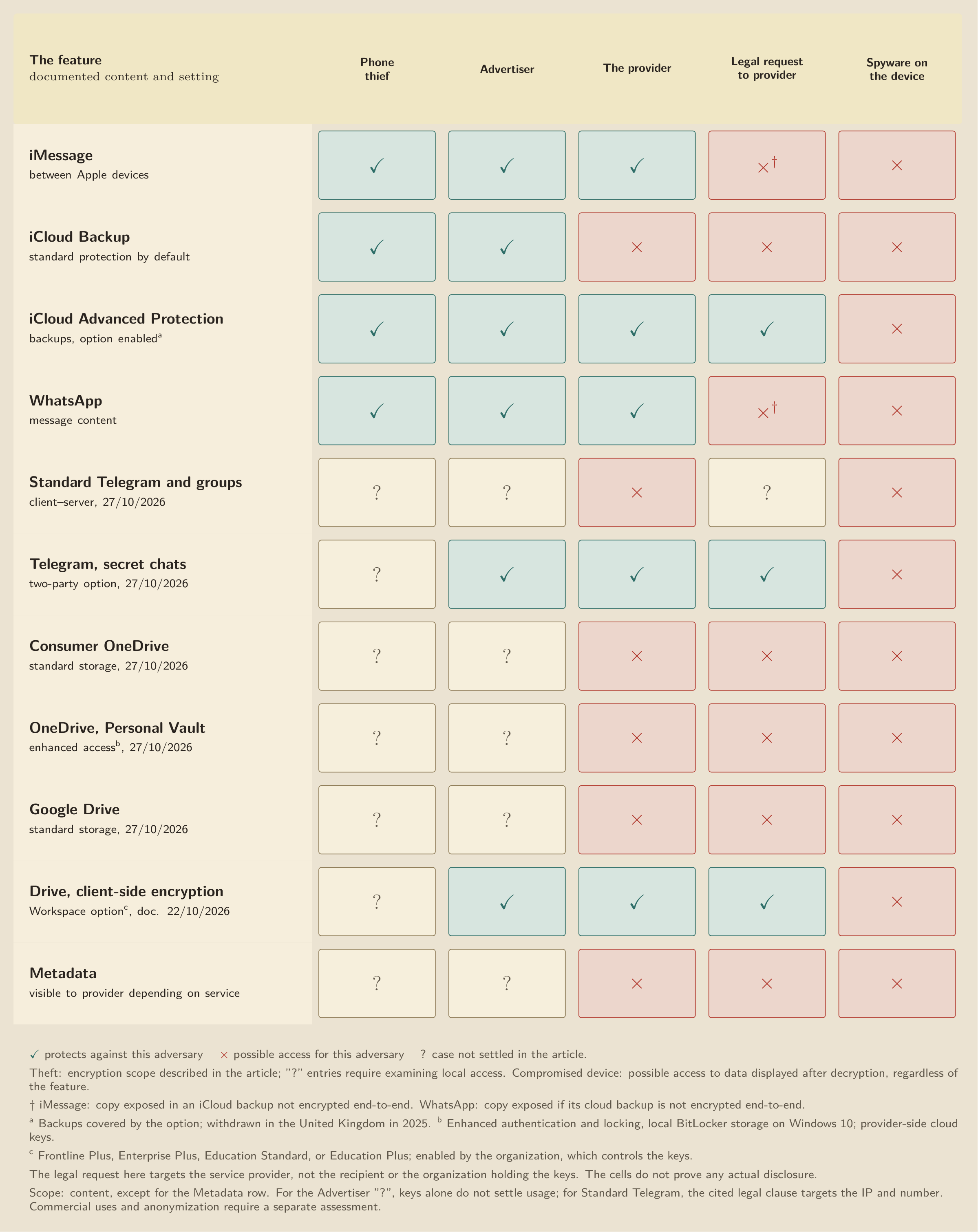
In the end I put everything into a table, one row per feature and one column per adversary.
 Tap to enlarge
Three subjects stayed outside my inquiry: the law country by country, spyware beyond the Citizen Lab’s four backups, and the data broker market. Nor did I find out how many people turn on the protections offered as options.
For my part, I come out of this inquiry less cynical and less at ease. Where end-to-end encryption applies, the provider does not read, and that can be proven. And a company that has lied on one point does not thereby make its mathematics false. But the envelope, the backup left on its factory setting, the legal demand, and the infected phone are still there. I no longer ask a service whether it protects my data; I look for which feature protects me, with which setting, and against whom. “I have nothing to hide” is no longer enough for me, because we close the bathroom door without hiding anything guilty. And the question of what there would be to hide is settled by whoever holds the data. I wonder how many people know which menu holds the protection they would need.
References
What has changed
- : The text is rewritten as a narrative, and its title does not change. It keeps its fifty-one sources and draws from them facts it did not give before: the FTC's actions against Facebook since 2011, the number of iCloud categories encrypted with and without Advanced Data Protection, the attack on the order of Telegram messages, the Stanford study of the call records of 823 volunteers, the details of the Netflix and Massachusetts governor re-identifications, and the effect of App Tracking Transparency measured on 1,759 apps. The sections that gave the reader a method and the reference to two other articles are removed. What prompted it: The article now tells the story of the inquiry and leaves the reader to draw the conclusion. Each new fact was checked again in its source, and the text says so when three studies could be read only in their abstract. The first diagram no longer carries a sentence that draws a conclusion.
- : The text is rewritten from the author's discussions with people close to him about what happens to our data. The investigation is expanded to Telegram, Microsoft and Google Drive, as well as the sale, reuse and anonymization of data. What prompted it: The article now starts from the experience that gave rise to it and distinguishes encryption, permitted uses and the risk of re-identification. The additional services and their options are examined as of the dates of the documents consulted, with their sources and limitations.
- : The method used is identified as the same as in another paper in the corpus. What prompted it: The ledger for this text has carried “same method as the paper on sorting” since it was written, and this sentence had never reached a reader.
- : Blanket cynicism is named as an error of inference, with its reference. What prompted it: The ledger for this text has carried this link since it was written, and it had never reached a reader.