
Do the health justifications for ancient prohibitions hold up?
Some religious or traditional rules acquire a health reason after the fact: pork is said to be forbidden because the pig keeps its toxins, and sleeping on the right side is said to spare the heart. Physiologists, doctors who treat reflux and sleep disorders, and anthropologists have each measured, in their own field, these claims about the body
Published · Updated
The explanation sounds as if it came out of a biology textbook, and that is probably why it travels so well. According to it, the pig is the only animal unable to rid itself of its toxins, which supposedly stay locked in its meat. I have heard it often, from Muslims who saw in it the wisdom of their rule and from people who are not Muslim and repeated it without knowing where it came from. Another version almost always follows close behind, the one about hygiene. In this version, the pig wallows in mud and eats anything at all, and all of it ends up on our plate.
A religion also governs smaller gestures. You lie down on your right side, you enter a place of prayer with your right foot and the bathroom with your left, and these gestures end up punctuating the whole day. For sleep, people readily add a doctor’s reason: the right side is supposed to spare the heart.
For a long time I let these explanations pass with a shrug. Then I realized that they claim something precise about the body, and the body, for its part, can be measured. So I took them at their word, one by one, promising myself not to draw anything from them against the rules themselves.
The pig and its toxins
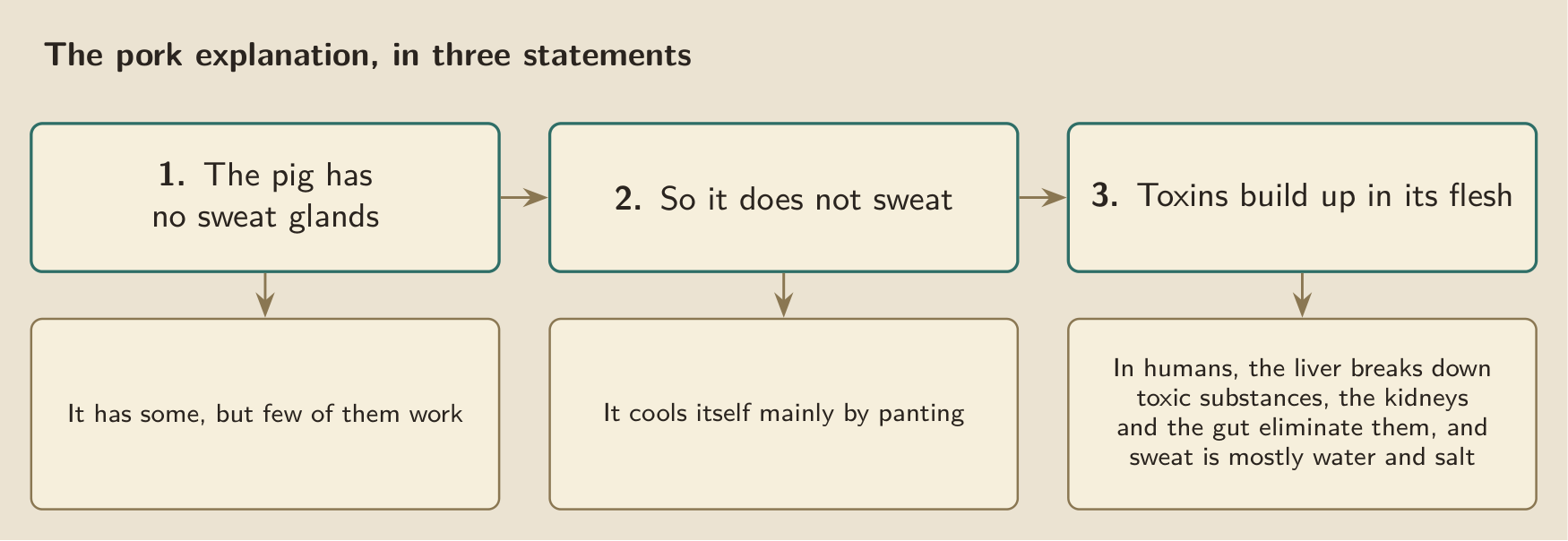
Taken at its word, the explanation about pork says very little. It names no toxin and does not say how the pig should have got rid of them. In the most complete version I was able to piece together, everything goes through sweat: the pig supposedly has no sweat glands, so it does not sweat, and its toxins build up in its flesh. I thought I was checking one sentence, and I was holding three, hooked onto one another.
 Tap to enlarge
The first gave way almost at once. The pig does have sweat glands, but few of them work, and a thick layer of fat under the skin slows the loss of its heat (Mayorga et al. 2019). To cool down, it relies mostly on its breathing, by panting (Mayorga et al. 2019). So the legend gets one point right, since the pig sweats poorly, and I found it almost touching that it is wrong only about the anatomy.
The third sentence interested me more, because it carries all the rest. Even granting the pig that it does not sweat at all, I could not see how its muscles would fill up with poison. In humans, sweat is mostly water and salt. As for the rest, the liver breaks down toxic substances, the kidneys and the gut get rid of them, and sweat plays only a small part in their removal (Baker 2019).
In the same review, I came across an old acquaintance. The idea that sweat purges the body has been around for years, to the point that some people recommend spending several hours a day in a sauna to cleanse themselves of their toxins. The author finds next to no evidence for it to date (Baker 2019). I smiled when I realized that the pig legend blames the animal for lacking a purge that physiologists already deny to humans. These measurements concern us, and I assume, without having read it anywhere, that the pig works no differently.
That left the word toxin, which no one has ever explained to me. For me, a toxin is a poison made by a living being, like a snake’s venom. The explanation about pork names no substance, everyone fills it as they please, and I have never managed to grab it by any precise end.
The known risks of pork
I could have closed the file there, rather pleased with myself. But a false legend does not make a meat harmless, and I went to read the complaints doctors really have about pork.
In 2015, a working group of the International Agency for Research on Cancer, the World Health Organization agency that classifies the causes of cancer, looked into red meat, pork included. It also examined processed meat, salted or smoked, and placed the two at different levels. For red meat, the evidence in humans remains limited, and the risk is counted in the amount eaten each day (Bouvard et al. 2015). The group also notes that salting, smoking or cooking at very high temperature can produce substances that cause cancer (Bouvard et al. 2015). Four years earlier, a team had brought together the large studies that follow people for years. It set the meat they eat against the cancers of the colon and rectum that strike them (Chan et al. 2011).
Pork also has a risk all its own, the tapeworm, a flatworm that can settle in the intestine of anyone who eats undercooked meat containing its larvae. The pig picks up these larvae by swallowing the worm’s eggs shed in human excrement, where sanitation is lacking (Centers for Disease Control and Prevention s. d.). The loop made me slightly dizzy, since the pig catches it from us before passing it on to us. So the hygiene argument did hold something, provided one speaks of a parasite, insufficient cooking and poorly disposed excrement, rather than of a dirty animal that supposedly eats anything at all.
There remained a more cautious version, served to me when the others fell: the rule supposedly had a health reason in its day, even if no one knows which one any more. I turned it every which way without finding a hold. A reason that cannot be named escapes all measurement, and it proves nothing either.
The right side
For sleep, I was hoping for a clear verdict, with a winning side and a losing side. Doctors had what they needed to decide, since they study the sleeper’s position to treat two diseases, reflux and apnea (Khoury et al. 1999; Ravesloot et al. 2012). On the heart, on the other hand, I found no measurement, and I will say nothing about it.
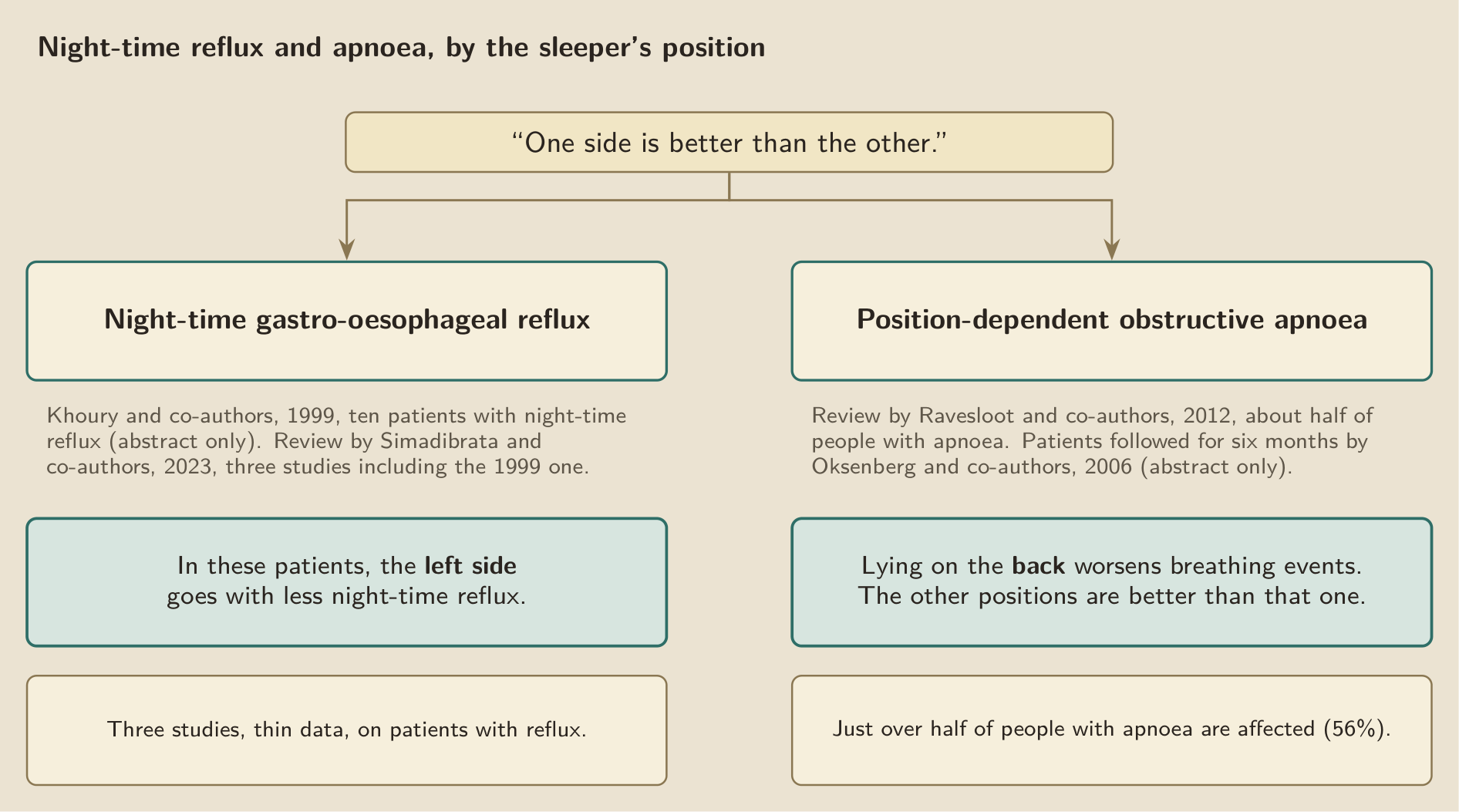
In people with reflux, stomach acid rises into the esophagus, the tube that runs down from the throat. The medical guidelines published in 2013 for treating them cite three trials in which, lying on the right side, the muscle that closes the bottom of the esophagus relaxes (Katz et al. 2013). In 1999, a small team served ten patients a fatty dinner at six in the evening and a snack at ten. Then it let them sleep however they liked, with a probe in the esophagus and a position sensor taped to the breastbone. Their esophagus bathed longer in acid when they slept on the right (Khoury et al. 1999).
Ten people is not many, and I could only read the abstract of their article. In 2023, a review found only three studies on the question, that one included. It associates the left side with less nighttime reflux in these patients, and admits itself that the data are thin (Simadibrata et al. 2023).
I gave a little laugh when I read that. For these patients, the side that tradition recommends would rather be the wrong one. Then I held back, because making the left side a new rule for everyone would have meant making the same mistake in the other direction.
Sleep apnea muddied the question in another way. In people with apnea, the throat closes at times during sleep, and breathing stops. A 2012 review gathered the studies on these patients: in a little over half, the pauses depend on position and multiply on the back (Ravesloot et al. 2012).
The remedy offered to them delighted me with its simplicity. In 2006, a team followed for six months seventy-eight of these patients, who had been invited to sleep with a tennis ball fastened to their back, to keep them from staying on their back. Of the fifty who returned the questionnaire, nineteen were still using it, and those who had given it up without learning to avoid their back mostly said it was uncomfortable (Oksenberg et al. 2006). Here again, I only read the abstract. For them, the question sets the back against everything else, and the right is not distinguished from the left (Ravesloot et al. 2012).
 Tap to enlarge
I was looking for the better side, and I came away with two other questions, better for what and for whom. Besides, someone who sleeps on the right out of fidelity to their tradition does not do it for their esophagus, and these measurements do not touch their reason.
Prohibitions studied elsewhere
I wanted to see prohibitions other than the ones I knew. In South Africa, in the Eastern Cape province, a team asked pregnant isiXhosa women about the foods they are forbidden (Chakona and Shackleton 2019). The length of the list surprised me: meat, fish, potatoes, fruit, beans, squash and eggs. In one of the communities, a sixty-six-year-old grandmother explained to the researchers that a pregnant woman who eats eggs will have too much appetite for sex, and that this can pass to the child if it is a girl (Chakona and Shackleton 2019).
The women get these rules from their mother or their grandmother. The authors are worried about it, because the forbidden foods are among the most nourishing and some of these women risk going short of them (Chakona and Shackleton 2019).
The case that troubled me most comes from the Fiji Islands. On the island of Yasawa, people live largely from the sea, and the fish there poisons people. More than half the adults interviewed had already been poisoned at least once, with symptoms that lasted a week, and sometimes a month. Doctors have a name for this illness, ciguatera, the most common form of fish poisoning (Henrich and Henrich 2010).
In three villages, two researchers first asked the women to name from memory the foods they forbid themselves. They then showed them a list of seventeen foods, into which they had slipped the most dangerous fish, such as moray eel and barracuda, and less risky ones, such as sea turtle and shark (Henrich and Henrich 2010). Now the taboos of pregnancy and breastfeeding fell precisely on those species. During those months, the women are poisoned less often, and yet the two researchers take care not to see this as proof that the taboos are the cause (Henrich and Henrich 2010).
These taboos are passed on within the family, then from older women known for their knowledge, and a woman who breaks them exposes herself to a sanction, from her neighbors or from the beyond. For the two researchers, a practice can thus protect for generations without the women who follow it knowing from what (Henrich and Henrich 2010).
This case bothered me, and I do not much like admitting it. I had set out with the idea that these health reasons are always tacked on after the fact, and I could no longer write that. I had to take up each explanation on its own terms, without an overall verdict.
Reasons found after the fact
It remained to understand why sincere people hold so much to these explanations, and a Swedish experiment gave me a lead. In 2005, researchers showed volunteers pairs of photos of women’s faces, asking them each time which one they found more attractive. Then they were asked to explain their choice (Johansson et al. 2006).
On some trials, a card trick worthy of a conjurer had swapped the photos, and the volunteers found themselves commenting on the face they had just rejected. At most a quarter of these swaps were noticed. The other volunteers explained without batting an eye why they preferred that face, sometimes to the point of absurdity, like the “I chose her because I love blondes” spoken in front of a brunette (Johansson et al. 2006). The following year, the team ran the experiment again with eighty volunteers, collected four hundred and eighty explanations from them, and found very few differences between those for real choices and those for rigged ones (Johansson et al. 2006).
I reread this passage several times, a little worried about my own reasons. In 2019, a researcher defended a thesis with a provocative title, “Rationalization is rational”: finding reasons for ourselves after the fact would serve us, instead of betraying a weakness (Cushman 2019). Both pieces of work remain fragile, the first because a laboratory experiment does not tell everything about life, the second because it proposes a theory without putting it to the test. If they are right, we act first and find the reason afterwards, and from the inside that reason looks for all the world like a reason that came before the act.
So someone who defends their rule in the name of health can believe in it without lying, and I wonder how many of my own reasons were born the same way.
I have not examined the origin of these rules or their history, and I found no measurement on sleep and the heart. The price these rules make their followers pay would also call for another inquiry.
For my part, I believe the rule loses very little when its explanation falls. Someone who follows it out of fidelity, attachment or habit loses only an argument, the one they used against others in the name of their health. The mocker is just as wrong, because a false explanation does not make ridiculous a rule that people follow for other reasons. Faced with this kind of explanation, I now run a little test: I ask myself whether pork would have been credited with virtues in a tradition that had recommended it. I bet it would, without being able to prove it, and an explanation that would work just as well for the opposite rule explains neither one.
These measurements leave aside another question, which matters more to me. These gestures that punctuate the day end up becoming obsessive and ever-present. I think they can even reprogram a brain to the point of anxiety. And that is what led me to ask myself questions about the human being, who would not have the right to live in peace and would always have to keep questioning. A mind that keeps brooding over the same subject wears itself out, I believe it ends badly, and one could go mad from it.
References
What has changed
- : The text is rewritten as a narrative, and its title does not change. It keeps its fourteen sources and draws from them facts it did not give before: the layer of fat that hampers the pig in losing its heat, the protocol of the 1999 study on reflux, the tennis ball offered to people with sleep apnea, the foods forbidden to pregnant women in South Africa, how often people on Yasawa are poisoned by fish, and the details of the experiment on rigged choices. The list of questions to keep in mind and the reference to another article are removed. What prompted it: The article now tells the story of the inquiry and leaves the reader to draw the conclusion. Each new fact was checked again in its source, and the text says so when two studies could be read only in their abstract. The two diagrams no longer carry a sentence that draws a conclusion.
- : The text is rewritten from the author's own memories, and each health explanation is checked again source by source. What prompted it: The text now starts from the conversations in which these explanations circulate, and an independent review checked each sentence against the source it cites.