
Why is rejection so frightening?
A phone you dare not pick up, a room you dare not enter. Researchers have studied where this fear comes from, how it takes hold of the body, and how it recedes
Published · Updated
I once saw someone freeze in front of their phone, because they had to call strangers and their fear was too deeply rooted. I wondered why. Thinking it over, I arrived at the fear of rejection, which is often closely tied to the fear of being judged by others.
This fear also affected me more or less directly, because I had spotted it in myself, and I managed to overcome it by several means. Today, I understand how it works, and it is almost behind me.
You may dread picking up a phone, walking into a room, speaking in front of a group, or writing to someone whose opinion matters. Your heart speeds up, your throat tightens, and you already picture yourself making a fool of yourself, falling short, or being unmasked.
An alarm that prefers to ring for nothing
A network rather than a center
In 2000, Joseph LeDoux, who devoted his career to these circuits, described fear as a set of circuits that detect danger and respond to it, in which the amygdala held an important place (LeDoux 2000). In 2012, Kristen Lindquist and her coauthors compiled brain imaging studies devoted to emotions (LeDoux 2000; Etkin and Wager 2007; Lindquist et al. 2012, 2015). They found little sign of a region specific to each emotion (LeDoux 2000; Etkin and Wager 2007; Lindquist et al. 2012, 2015).
The amygdala, often called the “fear center,” does not detect social threats on its own (Lindquist et al. 2012). It works as part of a network with the prefrontal cortex, at the front of the brain (Etkin and Wager 2007; Giustino and Maren 2015). Detection there is fast and automatic, whereas regulation by the prefrontal cortex comes more slowly (Giustino and Maren 2015).
In 2007, Amit Etkin and a colleague likewise compiled imaging studies, this time on anxiety (Etkin and Wager 2007; Giustino and Maren 2015). In socially anxious people, the amygdala and another region, the insula, activate more than in others when facing an emotionally charged face or as the moment to speak approaches (Etkin and Wager 2007; Giustino and Maren 2015). These results are group averages (Etkin and Wager 2007; Peschard and Philippot 2017).
Better a false alarm
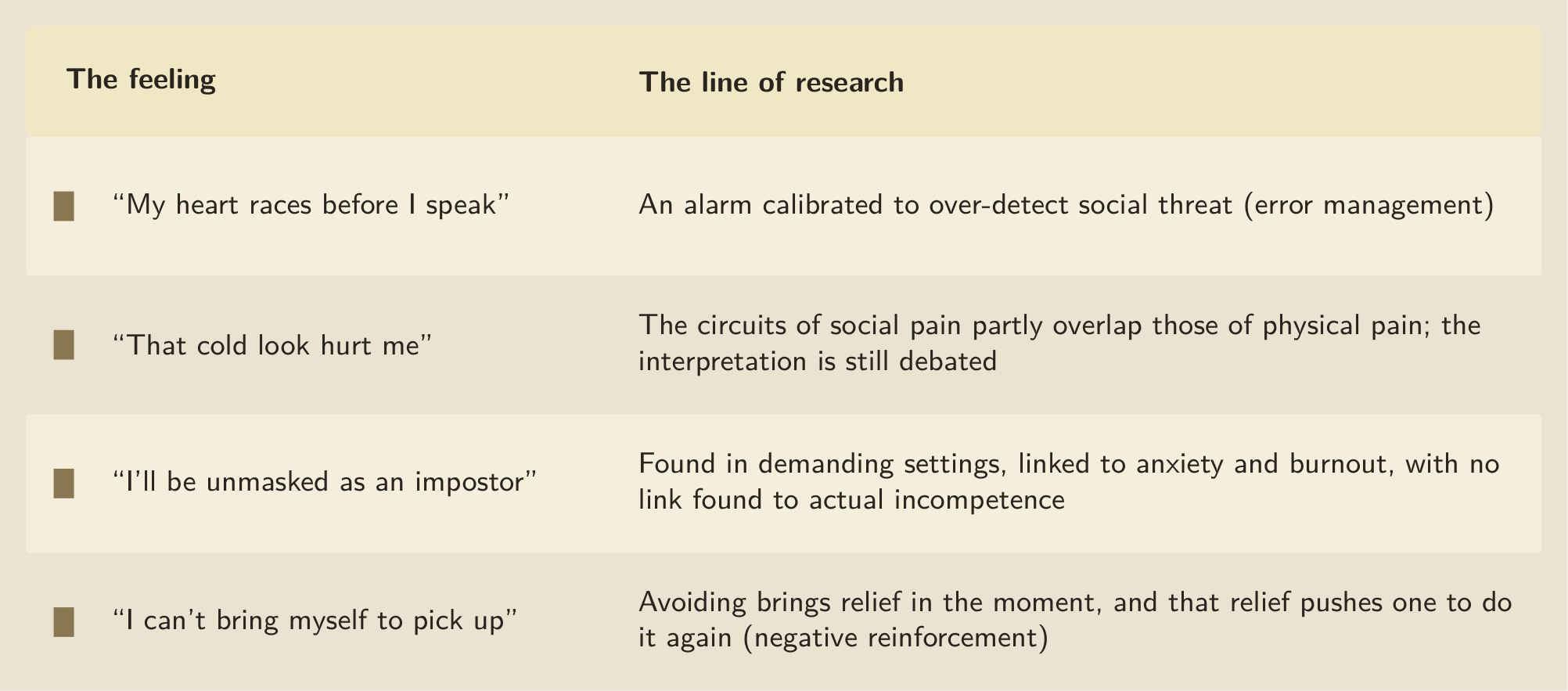
In 2006, Martie Haselton and a colleague described a logic of error management: better a false alarm than a missed danger (Haselton and Nettle 2006). For our ancestors, missing a danger of exclusion could cost them their lives, whereas a false alarm cost a moment of discomfort and a little energy (Haselton and Nettle 2006). With such a gap, natural selection favors a system that often rings for nothing, and we have inherited it (Haselton and Nettle 2006).
The idea that being driven from the group could kill is a reconstruction, which field measurements have not settled (MacDonald and Leary 2005). The cost of a misstep has fallen in most environments, and the alarm is thought to have remained set to the old danger (Haselton and Nettle 2006).
Bad weighs more than good
In 2001, Roy Baumeister and his coauthors summed up an imbalance in a single phrase: bad is stronger than good (Baumeister et al. 2001; Paolini et al. 2024). In 2024, a team measured this weight of the negative in more than one hundred and fifty thousand people (Baumeister et al. 2001; Paolini et al. 2024). In it, bad weighs more than good, especially when people can withdraw from the contact that bothers them (Baumeister et al. 2001; Paolini et al. 2024). This study examined encounters between different groups, and not attention to signs of disapproval (Baumeister et al. 2001; Paolini et al. 2024).
The body in overdrive
In rats, LeDoux reported that bodily reactions to a threat travel from the amygdala to the brainstem, at the base of the brain (LeDoux 2000). When these relays are damaged, the rise in blood pressure, immobility, or the release of stress hormones disappears, each separately (LeDoux 2000).
Interoception is the brain’s reading of signals from the body, and Hugo Critchley mapped its underpinnings in 2004 (Critchley et al. 2004). According to one model, a racing heart and a tight throat, once read by the brain, would feed back into the sense of threat (Critchley et al. 2004). Critchley was measuring body awareness, and his work does not establish this loop (Critchley et al. 2004).
When we are shut out
Two neighboring pains
In 2012, Naomi Eisenberger described a partial overlap between the brain circuits for social pain and those for physical pain (Eisenberger 2012; MacDonald and Leary 2005). The parallel concerns mainly the distressing aspect of pain, and less the place in the body where it is felt (MacDonald and Leary 2005). Its precise interpretation is still debated, and shared regions do not make two pains identical (Eisenberger 2012; MacDonald and Leary 2005). French already speaks of a breakup that “blesse” (wounds), a humiliation that “fait mal” (hurts), or a contempt that “meurtrit” (bruises) (Eisenberger 2012; MacDonald and Leary 2005).
In 1995, two psychologists described the need to belong as a fundamental human need (Baumeister and Leary 1995; MacDonald and Leary 2005). Rejection threatens this bond with others, on which everyone depends (Baumeister and Leary 1995; MacDonald and Leary 2005). In 2005, a review argued that a sign of exclusion can trigger a strong, automatic perception of threat, like a snake or a spider, and that people often react to a threat to their place in the group as they do to a threat to their physical safety (MacDonald and Leary 2005).
A ball game
Kipling Williams developed Cyberball, a computer ball game in which strangers suddenly stop passing the ball to the participant (Williams 2007). Within a few minutes, the participant feels hurt, even when they know that a computer is distributing the passes and that they have nothing to lose (Williams 2007). The effect also appears when the exclusion comes from a despised group, or in a trivial situation (Williams 2007). Williams brought these experiments together in 2007, in a review devoted to ostracism, the fact of being kept out (Williams 2007).
Sensing it coming
Not everyone reacts at the same threshold (Downey and Feldman 1996). In 1996, Geraldine Downey and a colleague described a profile of people who expect rejection and spot it faster than others (Downey and Feldman 1996). Their scale focused on intimate relationships (Downey and Feldman 1996). In these people, an unanswered message, a curt tone, or a misread glance is enough to set the whole scenario in motion, and they respond to a rejection that has not yet taken place (Downey and Feldman 1996).
Memory and attention retain episodes of rejection better than episodes of acceptance (Baumeister et al. 2001). We remember being snubbed, and we forget uneventful welcomes, so that we judge ourselves less accepted than we are (Baumeister et al. 2001).
A painkiller
In 2010, a team led by Nathan DeWall reported that paracetamol, a common painkiller, reduced felt social pain (DeWall et al. 2010; Eisenberger 2012). The researchers had started from the parallel between the two pains (DeWall et al. 2010; Eisenberger 2012). I have read neither the study itself nor any study that may have replicated it.
Believing yourself an impostor
The cycle
In 1978, Pauline Clance and a colleague gave a name to a feeling they observed in high-achieving women: that of being an impostor about to be unmasked (Clance and Imes 1978; Bravata et al. 2020). Their observations came from clinical practice, and not from a population survey (Clance and Imes 1978; Bravata et al. 2020).
These women attributed their successes to luck or a misunderstanding, and saw in their doubts the proof of a deception (Clance and Imes 1978). A degree passed for a fluke, a promotion for a mistake by management, and a compliment for politeness (Clance and Imes 1978). Clance and her colleague called this loop the impostor cycle, and no experiment has yet put it to the test (Clance and Imes 1978; Bravata et al. 2020).
Where it is found
In 2020, Dena Bravata compiled the studies on this feeling in a systematic review, a methodical survey of published work (Clance and Imes 1978; Bravata et al. 2020). It is found in demanding environments, among bright students, physicians, researchers, or recognized executives (Bravata et al. 2020). It goes along with anxiety and exhaustion, and the review finds no link with actual incompetence (Bravata et al. 2020). The compiled studies did not all define it in the same way (Clance and Imes 1978; Bravata et al. 2020).
Placing yourself among others
In 1999, David Dunning and a colleague compared participants’ test results with the rank they thought they held (Kruger and Dunning 1999; McIntosh et al. 2022). The lowest performers overestimated their rank, and the top performers underestimated theirs (Kruger and Dunning 1999; McIntosh et al. 2022). In 2022, another team challenged the explanation they had given, a lack of skill coupled with a lack of perspective on one’s own knowledge (Kruger and Dunning 1999; McIntosh et al. 2022). These studies do not measure a general link between self-doubt and incompetence (Kruger and Dunning 1999; McIntosh et al. 2022).
Avoiding
Relief
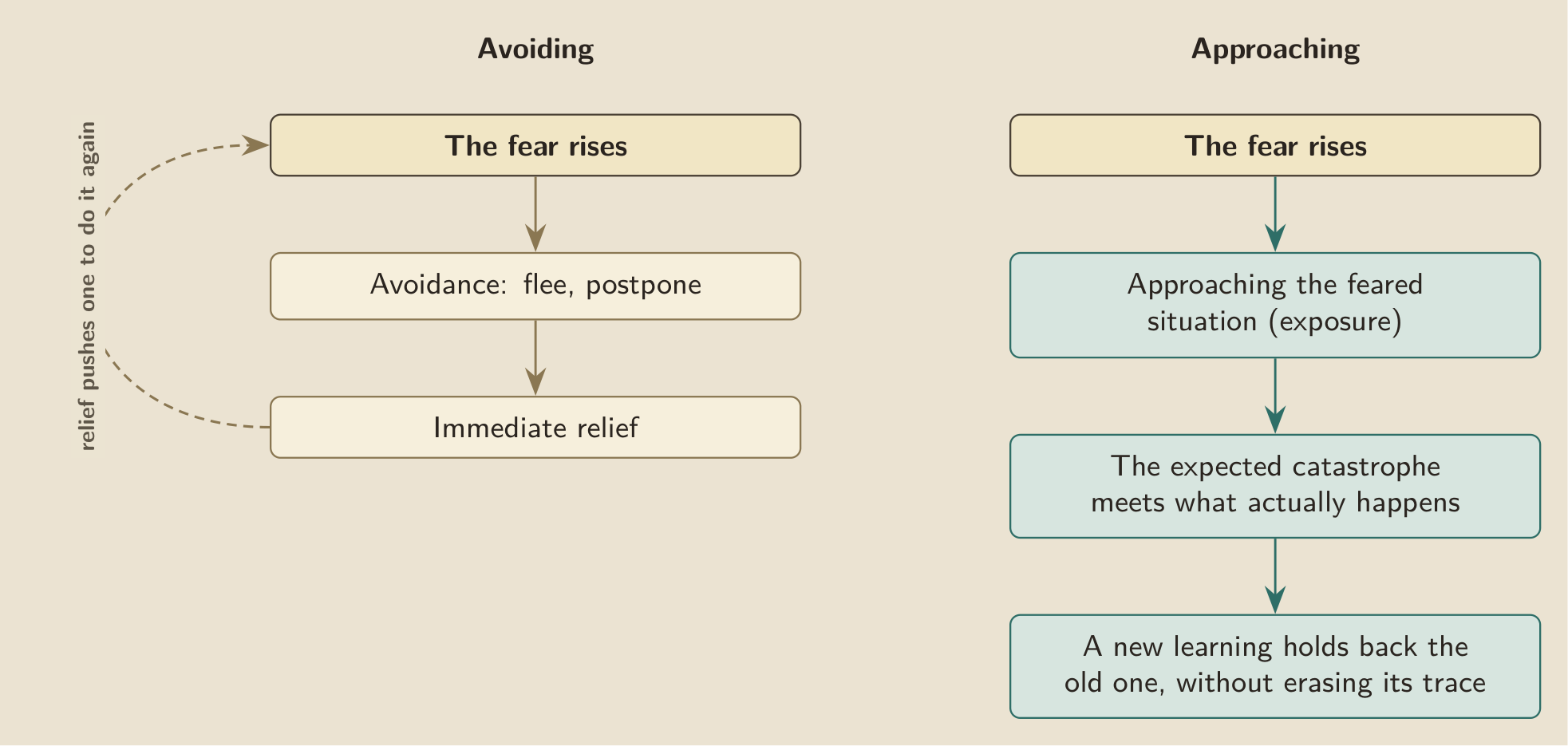
Letting the phone ring relieves anxiety in the moment, and that relief then pushes you to do it again (Krypotos 2015). This is negative reinforcement, described by Angelos-Miltiadis Krypotos in a review on avoidance learning (Krypotos 2015). The same review examines other mechanisms, such as expectations and information, without treating them all as unconscious (Krypotos 2015).
 Tap to enlarge
Under the gaze of others
In 1997, Ronald Rapee and a colleague described the socially anxious person as someone who pictures themselves under the negative gaze of an audience, real or imagined (Rapee and Heimberg 1997). Their model was formulated for social phobia (Rapee and Heimberg 1997).
To get through it, this person prepares every word, avoids eye contact, rehearses in their head, or cuts the exchange short (Craske et al. 2014; Weisman and Rodebaugh 2018). Psychologists call these actions safety behaviors (Craske et al. 2014; Weisman and Rodebaugh 2018). During the exchange, their attention turns toward themselves and toward signs of threat (Rapee and Heimberg 1997). They listen less well, lose the thread, and commit the blunders they dreaded, then attribute them to their incompetence, whereas they come from this monitoring (Rapee and Heimberg 1997). Rapee and his colleague placed this self-focused attention at the center of social anxiety (Rapee and Heimberg 1997).
A threat seen as larger
Before an encounter, socially anxious people overestimate both the risk of making a misstep and the severity of its consequences (Etkin and Wager 2007; Peschard and Philippot 2017). In 2017, Virginie Peschard and a colleague studied the tendency to attribute anger to neutral faces and voices (Etkin and Wager 2007; Peschard and Philippot 2017). Highly socially anxious people do so more often, whereas their ability to read others’ emotions remains intact (Etkin and Wager 2007; Peschard and Philippot 2017). I have read only the abstract of their article, which specifies that the participants did not undergo a diagnostic interview (Peschard and Philippot 2017).
Unlearning a fear
A trace that remains
Unlearning a fear does not erase it: new learning is acquired, which curbs the old one without removing its trace (LeDoux 2000; Etkin and Wager 2007) (Giustino and Maren 2015). Researchers call this extinction (Giustino and Maren 2015). Fatigue, pressure, or a different context can bring the fear back for a time, and then the new learning regains the upper hand (Giustino and Maren 2015).
Approaching
In 2014, Michelle Craske and her colleagues described exposure on the basis of this learning: approaching the dreaded situation confronts the expected catastrophe with how it actually unfolds (Craske et al. 2014; Craske et al. 2022; Weisman and Rodebaugh 2018). The result does not come down merely to seeing anxiety disappear; it also depends on a different expectation, learned and then retrieved later (Craske et al. 2014; Craske et al. 2022). Avoidance and certain safety behaviors can hinder this learning, with effects that vary according to the context (Craske et al. 2014; Weisman and Rodebaugh 2018) (Craske et al. 2014; Weisman and Rodebaugh 2018). In 2022, the same team emphasized that retrieving the new learning at the right moment matters as much as acquiring it (Craske et al. 2014; Craske et al. 2022; Weisman and Rodebaugh 2018).
 Tap to enlarge
When fear becomes a disorder
For some people, these fears become disabling and fall under social anxiety disorder (Mayo-Wilson et al. 2014; Hofmann and Smits 2008). In 2005, a large American survey led by Ronald Kessler estimated that slightly more than twelve percent of people experience social phobia over the course of their lives (Kessler et al. 2005). This figure counts disorders that meet official diagnostic criteria, and not ordinary shyness (Kessler et al. 2005). The authors distinguish diagnosis from the need for care, because the recorded cases do not all call for the same treatments (Kessler et al. 2005). They also specify that disorders classified as mild can weigh as heavily as chronic physical illnesses (Kessler et al. 2005).
Well-supported treatments exist, notably cognitive behavioral therapy with exposure, which works on thoughts and behaviors (Mayo-Wilson et al. 2014; Hofmann and Smits 2008). In 2014, Evan Mayo-Wilson’s team compared treatments for social anxiety across a large number of trials (Mayo-Wilson et al. 2014). There, this therapy ranks among the best-supported approaches, on par with medication or ahead of it depending on the case (Mayo-Wilson et al. 2014). The analysis covers only adults, and it often compares different trials with one another rather than treatments tested side by side (Mayo-Wilson et al. 2014). In 2008, another analysis, based on trials that compared treatments with a placebo, already pointed in the same direction (Mayo-Wilson et al. 2014; Hofmann and Smits 2008).
For my part, I now see this fear as an alarm rather than as a judgment. It was set for a very old danger, and the force with which it rings says nothing about the worth of the person who hears it. One philosopher, Guy Kahane, proposes a criterion along these lines: the origin of a belief disqualifies it only if the mechanism that produces it ignores the truth (Kahane 2011).
References
What has changed
- : The text is rewritten as a narrative, starting from a scene the author witnessed, and ends with his own view. What prompted it: The article now tells the researchers' discoveries one after another, with their reservations. The passages that drew a conclusion along the way are removed, as are the three figures. The sources are retained, and none is added.
- : The greater weight of the negative is now quantified, together with the boundary of what it covers. What prompted it: The text relied on a 2001 review. A 2024 meta-analysis of 238 samples quantifies the principle and shows that it is moderated by the possibility of opting out. It concerns contact between groups, as the text states.10.1037/bul0000439
- : The distributed fear network is supported by quantitative syntheses, not only by narrative reviews. What prompted it: Two neuroimaging meta-analyses from 2012 and 2015 find little evidence that a category of emotion resides in a distinct region.10.1017/s0140525x1100044610.1093/cercor/bhv001
- : Overestimating the threat of being evaluated is measured outside a clinical group, and the parenthesis that restricted the scope is removed. What prompted it: The claim, which concerns a behaviour, had only a neuroimaging meta-analysis as its source. A 2017 behavioural measure in a non-clinical sample establishes over-attribution with intact decoding ability.10.1016/j.jbtep.2017.06.003
- : The passage on seminars states the mechanism without claiming that it overlaps with what they sell, and refers to the paper that keeps this question open. What prompted it: The text gave a comparative verdict, “overlaps with a principle established by clinical research”, which this paper cannot support. The paper on the price of conviction devotes six sections to establishing that no trial compares the method with a cheap alternative under equal motivation. A reservation that bounded this sentence had also disappeared during the voice revision.
- : The reduction in social cost is now limited to particular contexts. What prompted it: The claim was made without a boundary, in a corpus that documents elsewhere settings where exclusion remains a major and lasting cost.