The promises of everyday life
Does artificial intelligence damage our brain, threaten our species, and rush toward its own ruin?
Three fears circulate, often mixed together: that AI weakens our thinking, that it threatens the survival of our species, and that it ends up devouring itself. An inquiry into what research actually establishes, what it advances as an uncertain risk, and what the hype adds on top
0. Introduction: three boxes to sort the fears
Three questions keep returning as soon as one speaks of the dangers of artificial intelligence, and they almost always arise together, like one and the same foreboding. The first is intimate: by dint of delegating to the machine our calculations, our writing, our routes, are we going to lose the use of our own faculties? The second is vertiginous: does AI threaten even the survival of our species? The third is stranger: might AI not be condemned to destroy itself, to choke on its own production? These three worries are legitimate, and they deserve better than a reassuring shrug or a catastrophist shiver, for each covers facts of very unequal solidity.
The difficulty is not to answer yes or no, but to sort. Any claim about the dangers of AI falls into one of three boxes that we have every interest in never confusing: what is established, that is, measured and replicated; what belongs to hype, that is, to extrapolation and to the announcement effect; and what is reasoned speculation, that is, a real but uncertain risk, advanced by serious researchers without being taken for granted. The right answer is neither “all is well” nor “the end is near”: it is to say, for each sentence, into which of the three boxes it belongs.
The march of the text follows this sorting. It first looks at what delegating a function does to the mind, then weighs the real strength of the evidence on cerebral “atrophy”, next examines what serious research advances on the existential risk and what the critique opposes to it, and finally describes the thesis of “self-destruction” before qualifying it. This order is not decorative: beginning with the cognitive anchors the point in the measurable, and ending with model collapse makes it possible to distinguish a documented degradation from a fantasised spontaneous death.
The test that will guide the reading comes down to one question. When a sentence asserts a danger of AI, ask yourself whether it states an established fact, a media extrapolation, or an uncertain risk taken seriously by research, and refuse the slide from one register to another. A correlational proof is not a causal proof, a preprint is not a replicated result, and a risk judged possible is not an announced event.
Two precautions frame the point. This text weighs the strength of the evidence on the three questions posed, the brain, the survival of the species and self-destruction; it does neither the technical review of alignment, nor the forecasting of employment, nor the environmental assessment, subjects flagged without being treated. And it holds itself to a symmetry: scrutinising just as hard the sources that alarm, preprints and spectacular figures, as those that reassure, for overexcitement has no camp.
1. What “delegating” does to the mind
Let us begin with the most solid ground, for without it the sequel would turn to opinion. Delegating a mental task to an external support has a name in cognitive psychology. Cognitive offloading denotes the use of a physical action or an external tool to reduce internal mental load, like writing down a note rather than holding a number in mind, and it is a documented phenomenon, neither new nor specific to AI (Risko and Gilbert 2016). Every technique of inscription, from writing to the calculator, transfers outside a part of what the head did alone, and generative AI is only the latest link in a very long chain (Risko and Gilbert 2016).
A famous experiment showed that this transfer modifies what we retain. When people expect to be able to consult a piece of information again later, they memorise it less well itself but retain better where to find it, a shift of memory from content toward its address (Sparrow et al. 2011). The internet then works as a shared external memory, to which we entrust knowledge while keeping only the access path (Sparrow et al. 2011). This result, often summed up by the phrase “Google effect”, nourished the idea of a memory that externalises itself (Sparrow et al. 2011).
Caution is called for, however, for part of this work has aged badly. The most spectacular strand of the founding study, that of an automatic priming toward the idea of a computer when faced with a hard question, did not hold up to replication, neither in a large reproduction project in the social sciences, nor in a later independent replication (Camerer et al. 2018; Hesselmann 2020; Gong and Yang 2024). The core “I retain where rather than what” resists better, but a recent meta-analysis shows that it is conditional, modulated by cognitive load, the type of device and the knowledge already possessed, rather than automatic and universal (Camerer et al. 2018; Hesselmann 2020; Gong and Yang 2024). In other words, the effect exists, but it depends on context instead of applying everywhere and always (Camerer et al. 2018; Hesselmann 2020; Gong and Yang 2024).
One must nonetheless refrain from seeing in it a pure impoverishment, for the same theoretical framework insists on the other side. Cognitive offloading is often adaptive: entrusting a tedious operation to the outside frees mental resources for higher-level tasks, and this is precisely why the species has never ceased inventing supports for thinking (Risko and Gilbert 2016). The useful question is therefore not “should we delegate”, to which the history of techniques has already answered, but “what do we delegate, and do we keep the capacity to take back control when the tool is missing” (Risko and Gilbert 2016).
A neighbouring mechanism deserves noting, for it resembles a slope. Resorting to an external source for a first series of questions increases the probability of resorting to it afterward, including for easy questions one could have handled alone, which describes a dynamic of self-reinforcing dependence (Storm et al. 2017). Each delegation makes the next delegation more probable, not because the faculty disappears, but because the habit of leaning on the tool consolidates itself (Storm et al. 2017).
Neuroimaging offers the clearest illustration of what delegating does during the action. When participants navigate freely in streets they know, the hippocampus and the prefrontal cortex encode the topology of the network and the possible paths; but when they follow a GPS, this activity linked to route planning fades, as if the brain ceased to explore the options that are decided in its place (Javadi et al. 2017). One must read this result for what it is: a lesser solicitation of a region during the delegated task, not an anatomical shrinking of the organ (Javadi et al. 2017).
None of this, moreover, waited for AI to be theorised. Research on automation has long described “automation complacency”, that over-confidence in an automatic system which lowers vigilance and the detection of errors, a phenomenon studied well before language models (Parasuraman and Manzey 2010). The lesson of this first round is therefore measured: delegating a function reduces its exercise, sometimes the cerebral engagement during the action, and this is real. But “real” does not yet mean “durably damaged”, and it is the next jump that must be examined closely.
2. “Does AI atrophy the brain?” The real strength of the evidence
Since 2025, several studies have been relayed as the proof that AI “damages” the brain, and it is here that one must weigh instead of repeat. The most commented is an electroencephalographic study conducted in a laboratory at MIT. It compared the cerebral connectivity of people writing an essay depending on whether they helped themselves with a language model, a search engine or nothing, and observed the lowest connectivity among the AI users, along with a weaker sense of being the author of their own text, its authors speaking of an accumulation of “cognitive debt” (Kosmyna et al. 2025). The result is suggestive and deserves attention (Kosmyna et al. 2025).
It demands, however, to be cited with its limits, on pain of making it say more than it can. This study is a preprint not peer-reviewed, bearing on a small sample, and a single measure of neuronal engagement during a task documents neither an atrophy nor a durable damage (Kosmyna et al. 2025). The expression “cognitive debt” is a metaphor proposed by the authors, not an established clinical diagnosis, and confusing a momentarily lower connectivity with a lesion would be exactly the slide of register that this text forbids itself (Kosmyna et al. 2025).
A second study, often cited alongside, comes from an industry survey. Questioning hundreds of knowledge workers about their use of generative AI, it reports that greater confidence in the tool goes together with a lesser effort of critical thinking, whereas self-confidence goes together with more critical thinking, vigilance shifting from production toward verification (Lee et al. 2025). The picture is coherent with the idea of a mind that delegates (Lee et al. 2025). But these data are self-reported and correlational: they measure perceptions of effort, not an objective degradation of capacities, and they permit no causal conclusion (Lee et al. 2025).
A third study circulated widely for its striking result. Conducted on several hundred participants, it reports a negative correlation between the frequent use of AI tools and critical thinking capacities, mediated by cognitive offloading and more marked among the youngest (Gerlich 2025). The correlation is clear, and it joins common intuition (Gerlich 2025). Still, the study is cross-sectional and partly self-reported, which prevents it from establishing a direction of causality: it may just as well be that the people with the weakest critical thinking turn more to AI, a hypothesis of reverse causation that the protocol cannot rule out (Gerlich 2025).
A methodological counterpoint completes the picture and tempers it. A meta-analysis of the Google effect concludes that it is real but conditional, more marked on a smartphone than on a computer, attenuated among people with a broader base of knowledge, which speaks of an effect modulated by context rather than of a fatality (Gong and Yang 2024). Delegation therefore does not act in the same way on everyone or in all circumstances (Gong and Yang 2024).
The general state of the literature confirms this reservation rather than dispelling it. Recent systematic reviews devoted to generative AI and critical thinking arrive at heterogeneous results, very dependent on the design of the studies and on the pedagogical context, which is in itself the sign of a young and unstabilised field. When dozens of well-conducted studies point in different directions depending on how the tool is employed, the prudent conclusion is not “AI harms” nor “AI helps”, but “the effect depends on the use”.
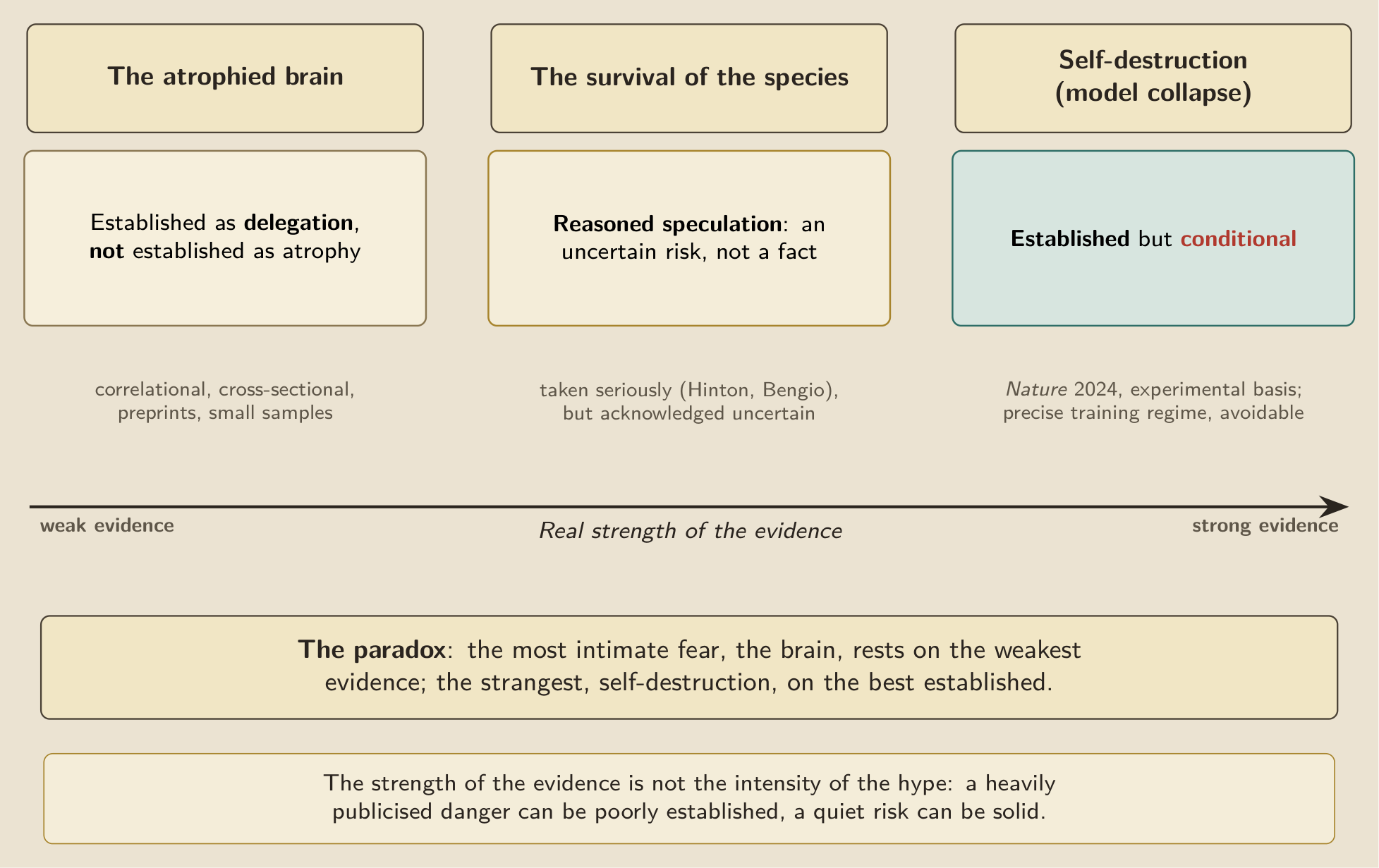
Hence an honest assessment, aligned on the strength of the evidence. The idea that AI “atrophies” the brain is not established: the available data are for the most part correlational, cross-sectional, often self-reported, on small samples or in preprint, and document short-term performance effects, dependent on context, without demonstrating a durable lesion. One must here hold both ends without letting go of one: showing that a worry is amplified by media overexcitement does not prove that it is imaginary, and that no atrophy is demonstrated does not prove that a massive and early use is without effect. The correct register for this fear is therefore “established as delegation, not established as atrophy”, and not “proven” nor “far-fetched”.
3. The existential risk: what serious research advances
Let us move to the question of survival, where the reflex is to dismiss together the prophets of doom and the skeptics. That would be to miss a notable fact: leading researchers take this risk seriously. In May 2023, a one-sentence statement affirmed that “Mitigating the risk of extinction from AI should be a global priority alongside other societal-scale risks such as pandemics and nuclear war” (Center for AI Safety 2023). This short wording was designed to gather, and it marks a threshold in the public debate (Center for AI Safety 2023).
What strikes is less the sentence than its signatories. It was signed by hundreds of researchers, among them Geoffrey Hinton and Yoshua Bengio, among the most cited computer scientists and both Turing Award laureates, as well as by the scientific and executive leaders of major AI laboratories (Center for AI Safety 2023). One cannot therefore file the existential worry on the side of amateurs or activists alone: a part of the people who build these systems share it (Center for AI Safety 2023).
This stance was prolonged in the scientific literature. An article published in a major journal by Bengio, Hinton and others argues that the growth of the capacities and autonomy of general-purpose systems could amplify their impact, up to large-scale social harms, malicious uses and an irreversible loss of human control, and calls for technical research and proactive governance (Bengio et al. 2024). The argument is not that catastrophe is certain, but that a rapid trajectory justifies preparing for it (Bengio et al. 2024). The logic is that of proportionate precaution: devoting a part of the efforts to reducing a serious and uncertain risk, as is done for other powerful technologies, without waiting for the definitive proof that would come too late (Bengio et al. 2024).
The institutional frame followed. An international report on the safety of AI, chaired by Bengio and issuing from the Bletchley summit, gathered nearly a hundred experts from thirty countries to draw up a state of the risks of general-purpose systems (Bengio et al. 2025). Its value holds to its method: it synthesises the existing literature rather than stating predictions, and distinguishes the families of risks, malfunctions, malicious uses and systemic risks, while assuming the uncertainty that surrounds them (Bengio et al. 2025). It is a document of prudent consensus, not a manifesto (Bengio et al. 2025).
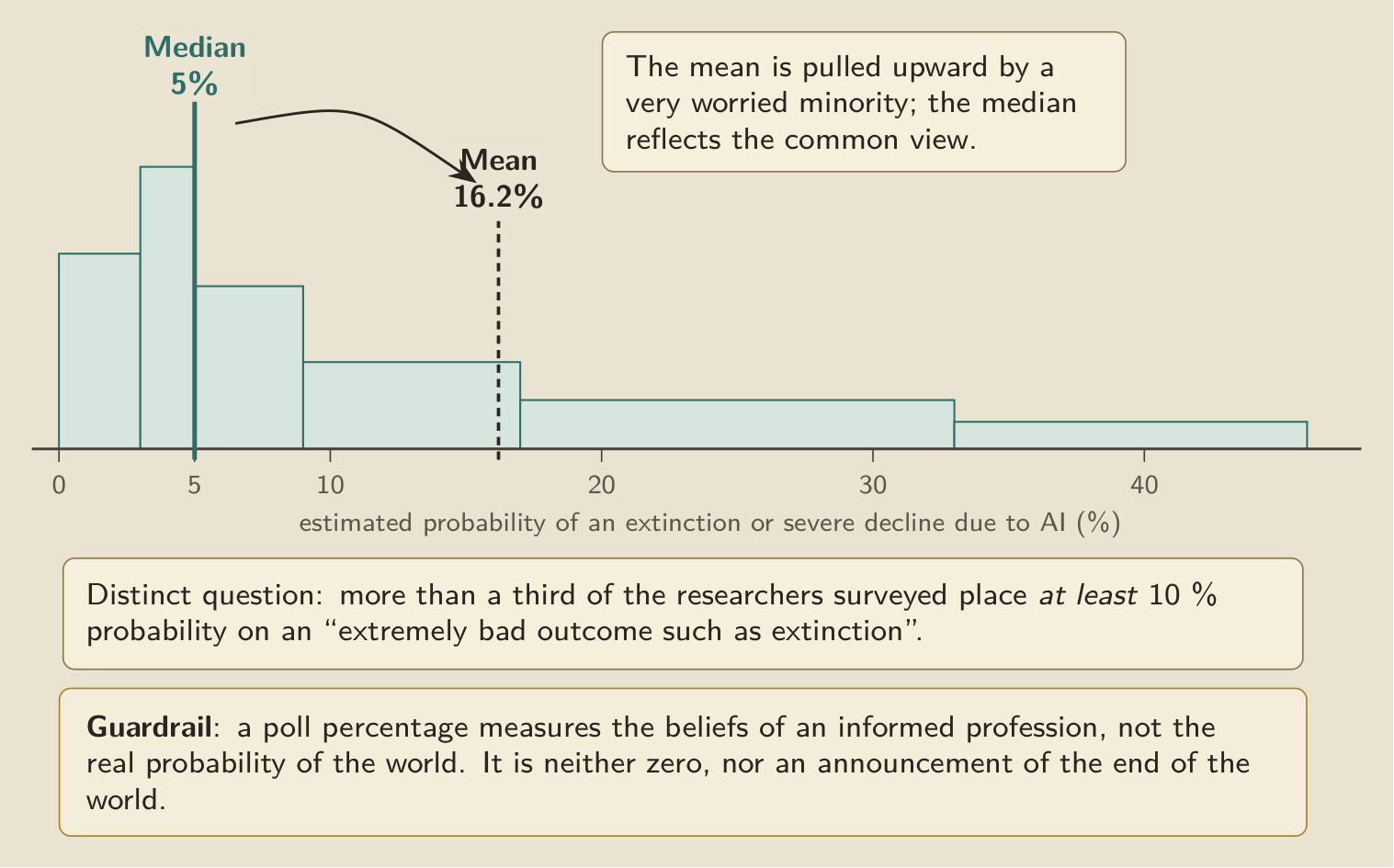
Opinion surveys of specialists give the quantified measure of this prudence. In a vast consultation of several thousand researchers having published in the major AI conferences, a first question bore on the probability of an extinction or a severe and permanent decline of humanity caused by AI: the median of the answers was 5%, for a mean of 16.2% pulled upward by a very worried minority (Grace et al. 2024). It is neither zero nor an announcement of the end of the world (Grace et al. 2024). A second, distinct question bore on an “extremely bad outcome such as extinction”: more than a third of respondents placed at least 10% probability on it, which describes a divided community, with assumed uncertainty, rather than a catastrophist consensus (Grace et al. 2024).
The right register for this risk is therefore reasoned speculation, and one must steel-man it without hardening it. Taking an uncertain risk seriously is not announcing its realisation, and honesty consists in reporting both that it is taken seriously by leading researchers and that they themselves acknowledge its uncertainty. The existential danger is neither an established fact nor a whim: it is a serious hypothesis, whose real strength is that of a debated probability, not of a certainty.
4. Catastrophism and its critique
To this prudence responds, in the media, an entirely different regime of discourse, made of alarming headlines and dates for the end of the world, and it calls for a critique that is itself serious. The most constructed comes from researchers who contest the very orientation of the debate. An influential article argues that large language models are “stochastic parrots”, capable of arranging linguistic forms in a plausible way without understanding of meaning, and that fixing attention on distant scenarios diverts from present and documented harms, bias, environmental costs, opacity and concentration of power (Bender et al. 2021). This voice has the advantage of bringing the gaze back toward what is already measurable (Bender et al. 2021).
From this position follows the so-called distraction thesis. It affirms that the narrative of existential risk, largely speculative, serves the interests of the dominant actors and diverts public and regulatory attention from the current wrongs of AI (Bender et al. 2021). The argument is admissible as a rhetorical warning, and it points to a real risk of agenda (Bender et al. 2021). But it must be noted that it has been put to the empirical test, and that the test did not entirely prove it right (Hoes and Gilardi 2025).
This is a point of honesty too rarely reported. An experimental study published in a major journal found that exposure to narratives of existential risk increased concern for catastrophic risks without decreasing concern for immediate harms, which contradicts the idea that one mechanically drives out the other (Hoes and Gilardi 2025). Distraction, to that extent, is less a verified law than a plausible but contested hypothesis, and citing it as an acquired fact would be to commit, in the reverse direction, the slide reproached to the alarmists (Hoes and Gilardi 2025).
Other critiques target the technical substance rather than the agenda. Researchers such as Melanie Mitchell argue that current systems remain very far from an autonomous general intelligence, and that the only existential scenario they judge plausible passes through a malicious human actor using the tool, not through a machine that would turn against humanity by itself (Mitchell 2024). This objection usefully shifts the question from “what if the machine woke up” toward “who holds the machine”, closer to the concrete risks (Mitchell 2024). It also recalls that “intelligence” and “autonomy” are not synonyms: a system can excel at producing text without wanting anything, and lending intentions to a model is a facility of language that blurs the analysis of the risk (Mitchell 2024).
The same skepticism must be applied to both camps, including to the surveys that quantify the fear. Expert consultations rest on limited response rates and on the self-selection of the most concerned respondents, so that their figures indicate a distribution of informed opinions rather than an objective estimate of the real probability of a catastrophe (Grace et al. 2024). A median percentage from a poll is not a measure of the world, it is a measure of the beliefs of a profession (Grace et al. 2024).
A point of agreement nonetheless runs through both camps, and it deserves to be put forward. What is best established in the whole existential debate is not the future, but the present: the biases, the discriminatory outputs, the opacity and the footprint of the large models are already-documented wrongs, independently of any extinction scenario (Bender et al. 2021). Recognising this does not diminish the long-term risk, but recalls that the most solid part of the file concerns current and measurable harms, not catastrophes to come (Bender et al. 2021).
The sorting therefore imposes itself here more than anywhere. Reasoned speculation, an uncertain risk examined by research, must not be confused with the catastrophism of announcement, which sets dates and promises the apocalypse, nor the critique of hype with the denial of the risk. One can hold three things together without contradicting oneself: that the existential risk is taken seriously, that it remains uncertain, and that its media overexcitement can indeed serve as a screen for the wrongs already here.
5. “Self-destruction”: model collapse
There remains the second fear, the most singular: AI would be doomed to devour itself. Against all expectation, it is here that the best-documented phenomenon of the file is found, and it bears a precise name. Model collapse denotes a degenerative process: recursively training a generative model on the data produced by the previous models degrades its performance across the generations, the model ending up poisoning itself with its own distorted image of reality (Shumailov et al. 2024). This result was established in a major scientific journal in 2024, and it belongs neither to intuition nor to anecdote; the article has since received an authors’ correction, in 2025, which does not modify its conclusions (Shumailov et al. 2024).
The mechanism unfolds in two stages that are worth distinguishing. At the early stage, it is the rare events, the tails of the distribution, that disappear first, for want of being sufficiently represented in the samples drawn at each generation; at the late stage, the model converges toward an impoverished distribution, of reduced variance, which no longer much resembles the original reality (Shumailov et al. 2024). The model first forgets the exceptional, then sags toward a handful of repeated patterns (Shumailov et al. 2024).
This degradation is not an accident but the composition of three errors. It results from the accumulation, generation after generation, of a statistical approximation error linked to finite sampling, an expressivity error linked to the network’s limits in representing the true distribution, and a learning error linked to the optimisation procedures (Shumailov et al. 2024). Each would be tolerable in isolation; it is their recursive stacking that pushes the system toward impoverishment (Shumailov et al. 2024).
The example reported by the authors makes the thing tangible. A model retrained on its own outputs, starting from an initial text on the architecture of medieval church towers, drifts from generation to generation until it produces a repetitive gibberish unrelated to the starting subject (Shumailov et al. 2024). The system ends up generating samples that the original model would never have produced, which gives the metaphor of poisoning a measurable reality (Shumailov et al. 2024). The loss of the distribution tails has a concrete consequence often neglected: it is precisely the rare cases, the unusual turns of phrase and the statistical minorities that fade first, so that the impoverishment is not neutral but erases diversity first (Shumailov et al. 2024).
The phenomenon had been announced by the same authors in an earlier preprint. There they introduced the idea of a defect that sets in when the tails of the distribution vanish, and drew from it a noticed practical consequence: data produced by humans will become all the more precious as the web fills with synthetic content (Shumailov et al. 2023). The scarcity of the real would become, in this framework, a resource (Shumailov et al. 2023).
Other works have generalised the finding beyond text. A team described a “Model Autophagy Disorder”, by analogy with a disease where the organism consumes itself, showing that in loops where the synthetic replaces the real without a sufficient supply of fresh data, the quality or the diversity of the generated images degrades across generations (Alemohammad et al. 2023). Another studied the interaction between generative AI and the internet, observing that models trained on mixtures including their own outputs saw their quality and their diversity decline from version to version (Martínez et al. 2023). The self-destruction thesis therefore has, contrary to the two preceding fears, a convergent experimental basis (Martínez et al. 2023).
6. Nuancing: AI does not die on its own
It would nonetheless be wrong to conclude that AI is condemned to scuttle itself, and it is here that the sorting makes all the difference. The collapse result holds for a precise training regime, not for AI in general. The decisive distinction is that between replacing and accumulating: when each generation is trained only on the outputs of the previous one, the system degrades, but when the synthetic data are accumulated alongside the original real data, collapse is avoided, a result held empirically and proven theoretically across several architectures (Gerstgrasser et al. 2024). The catastrophe scenario therefore supposes that one throws away the real, which no one has any interest in doing (Gerstgrasser et al. 2024).
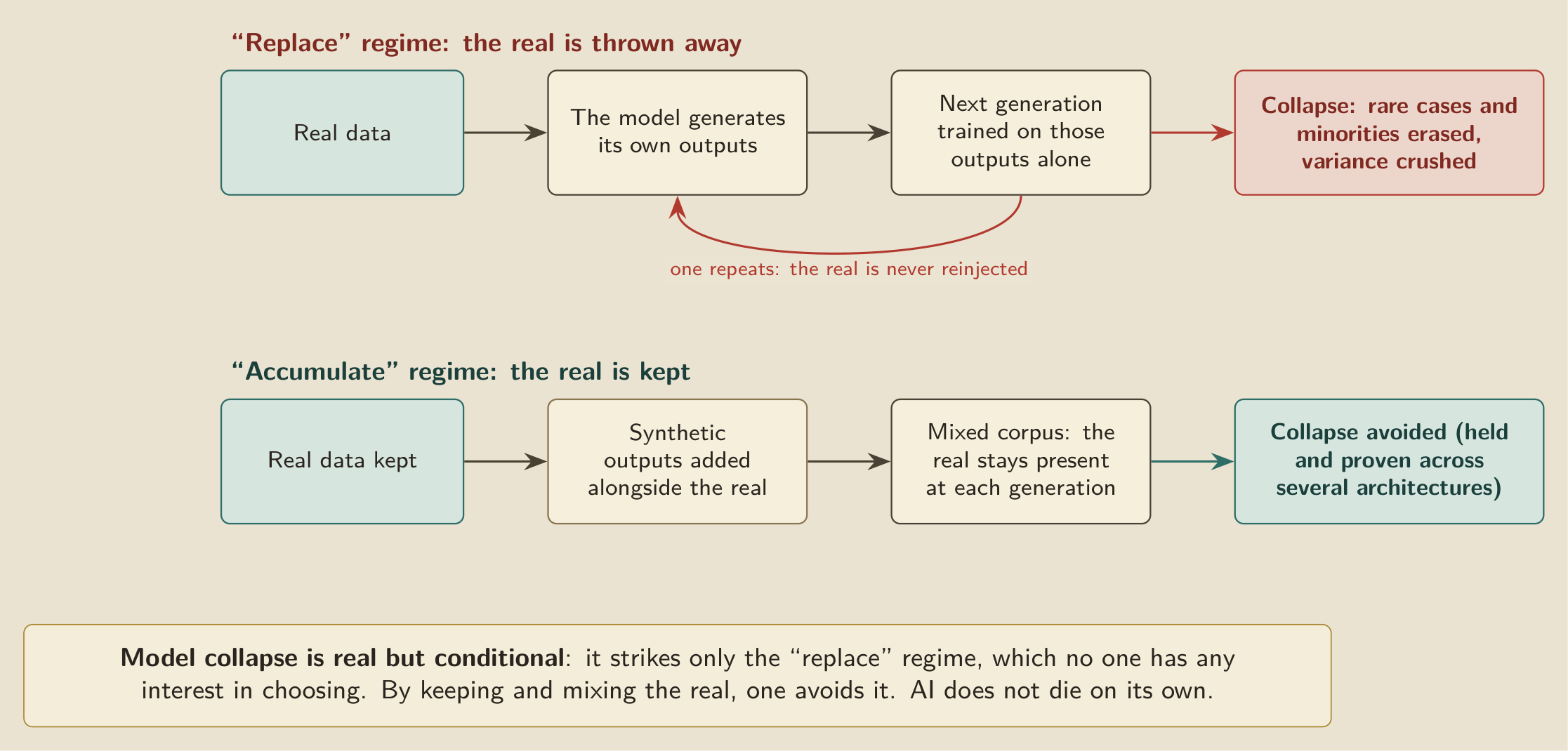
Other works refine this diagnosis further. An analysis in terms of scaling laws shows that the entry of synthetic data into the corpus does not produce a uniform collapse but a modification of the learning regimes, and that mixing human and synthetic data qualitatively changes the outcome compared with pure replacement (Dohmatob et al. 2024). The determining parameter is not the presence of synthetic content in itself, but the proportion of the real that is kept and the way it is mixed in (Dohmatob et al. 2024).
The most head-on critique bears on the realism of the scenario. A critical note underlines that the observed collapse is an expected statistical phenomenon, reproducible by a simple repeated resampling, and above all that the protocol of integral replacement does not reflect the real conditions of deployment, where laboratories mix human and synthetic data, filter, and periodically reinject the real (Borji 2024). The journal result keeps all its value as a warning; it does not describe a fatality on the ground (Borji 2024). In practice, data curation, quality filtering and the deliberate mixing of human sources are precisely the gestures that prevent the impoverishment described.
The real risk is therefore not the spontaneous death of AI, but the uncontrolled pollution of the common corpus. A study showed that a surprisingly large part of the web is made of machine-translated content, often of low quality, and that this phenomenon is particularly marked in low-resource languages, which documents a real impoverishment of the available material (Thompson et al. 2024). The danger holds less to a model training on itself than to the collective resource on which everyone trains degrading without anyone having decided it (Thompson et al. 2024). We find there a known structure of the commons: everyone has an interest in dumping cheap synthetic content, and the cost, the impoverishment of the shared corpus, is spread over all, so that the degradation advances with no assignable author (Thompson et al. 2024).
One must here keep a cool head about the figures. The estimates that circulate, according to which a majority of online text would be generated or translated by machines, vary enormously depending on the method retained, and “to contain AI” is not “to be mostly produced by AI”. These orders of magnitude signal a trend that we have good reasons to take seriously, but they do not constitute established facts and must not be cited as such.
The answer to the second question is therefore clear in its nuance. AI is not doomed to self-destruction: model collapse is a real but conditional risk, specific to a training regime that we know how to avoid, and the analogy of sterility holds as a warning about the quality of the common corpus, not as a prediction of an automatic technical extinction. The formula “AI devours itself” is true in a laboratory that decides it, false as a destiny.
7. Conclusion: answering by separating the registers
Everything comes back to the sorting announced at the start, and this sorting finally makes it possible to answer the questions without caricaturing them. On the brain, cognitive delegation is an established and ancient fact, but “atrophy” is not demonstrated, and the evidence advanced remains correlational, cross-sectional or preliminary, documenting short-term effects dependent on context rather than a durable damage. The fear is therefore not unfounded, it is badly calibrated: what is at stake is not a lesion, it is a habit of delegation whose extent and conditions can be discussed.
On survival, the answer holds in the distinction between reasoned speculation and catastrophism. The existential risk is taken seriously by leading researchers and by institutional reports, while remaining uncertain, quantified by modest median probabilities and by a divided community, which situates it far from the acquired fact as from the whim. Holding it as certain would belong to overexcitement, holding it as null to blindness, and the only tenable position is to see in it a serious hypothesis to be monitored without dramatising it.
On self-destruction, finally, the paradox is that the strangest fear rests on the best-established science, provided one reads it correctly. Model collapse is documented, but conditional: it strikes a training regime that we know how to avoid by keeping and mixing real data, so that AI does not die on its own, even if the common corpus can be impoverished for want of care. The good question is not “will AI go extinct”, but “will we know how to preserve the quality of the real on which it and we depend”.
There remains a simple, portable rule, valid well beyond this subject. Faced with any claim about the dangers of AI, ask into which of the three boxes it falls, the established, the extrapolated or the uncertain taken seriously, and refuse to be made to pass one off as another. The real dangers of AI deserve too much attention to be drowned in overexcitement, and too much seriousness to be brushed aside: naming them with precision is already beginning to deal with them.