
Can you change your life in three days?
Very expensive seminars, rooms in a trance, deeply moving testimonials. Researchers have studied each of these ingredients
Published · Updated
The film Gourou made me think of Tony Robbins’s seminars and their exorbitant prices (I was told about people willing to pay a staggering sum for a single one of them). Personally, that does not interest me. But I wanted to understand how they manage to convert people to that extent.
My research did not change my mind: to me, these are people riding a certain wave. And according to the studies, these seminars play heavily on psychological biases, notably the halo effect.
Tony Robbins’s fortune and his millions of followers give the impression that his method works. For some of the participants, these are intense and memorable experiences, and some make real progress.
Paying a high price
A sum you will not see again
An expense already incurred, which will not be recovered, is called a sunk cost, and Hal Arkes described its effect in 1985 (Arkes and Blumer 1985; Aronson and Mills 1959). Once the sum is committed, people cling to their purchase and place greater value on access that cost a lot, even when its content does not change (Arkes and Blumer 1985; Aronson and Mills 1959).
As early as 1959, Elliot Aronson had studied entry into a group: when it involved a humiliating rite, the group became more valuable in the eyes of those who had undergone it (Arkes and Blumer 1985; Aronson and Mills 1959).
In a 2011 working paper, Michael Norton and two colleagues observed that people place more value on an object they have made themselves, provided they have completed the task (Norton et al. 2011). The effect disappeared when the object was destroyed or when making it failed (Norton et al. 2011).
A more expensive fake pill brings greater relief
In 2008, a team offered volunteers two pills with no active ingredient, placebos, one at full price and the other discounted (Waber et al. 2008; Espay et al. 2015). The pain relief they reported followed the price tag (Waber et al. 2008; Espay et al. 2015) (Waber et al. 2008).
In 2015, Alberto Espay’s team found the price effect in Parkinson’s patients, in a trial where treatments were assigned at random without either the patients or the researchers knowing which was which (Espay et al. 2015). The fake treatment announced as expensive improved their movements more than the one presented as discounted (Espay et al. 2015). These improvements are real, sometimes measurable in the body, because the price tag alters expectations (Waber et al. 2008; Espay et al. 2015).
The same year as the first trial, another team had volunteers taste the same wine while placed in a brain imaging scanner (Plassmann et al. 2008). Presented as expensive, the wine was judged better, and the brain regions linked to pleasure responded more strongly (Plassmann et al. 2008).
I was unable to read these three studies in full, and their number of participants remains to be verified.
With no other point of reference, buyers often infer a product’s quality from its price, and an expensive product seems better even when nothing is known about its effectiveness (Rao and Monroe 1989). In 1989, Akshay Rao and Kent Monroe reviewed the research on this shortcut (Rao and Monroe 1989). Their article brings together existing studies, without any experiment of their own (Rao and Monroe 1989).
The first number heard
Daniel Kahneman and a colleague described a phenomenon called anchoring (Tversky and Kahneman 1982). In front of participants, a number was drawn at random, then they were asked to estimate a quantity completely unrelated to it, and the number drawn steered their estimate (Tversky and Kahneman 1982). Rewarding accurate answers did not reduce the effect (Tversky and Kahneman 1982).
In an offer, the first amount announced serves as an anchor: after a full package at a very high price, a much cheaper seminar seems reasonable (Tversky and Kahneman 1982).
A third package
In 1982, Joel Huber and two colleagues showed that a third option, inferior to only one of the other two, makes people more often choose the one that outperforms it (Huber et al. 1982). With a package of four days at ten thousand and one of six days at fifteen thousand, a third, of three days at eleven thousand, would be shorter and more expensive than the first, but cheaper than the second. Only the first would outperform it, and that is the one people would choose more often (Huber et al. 1982).
Defending the expense
After paying, people tend to defend the expense rather than reexamine it, and Hal Arkes called this the escalation of commitment (Arkes and Blumer 1985; Dhanda et al. 2025).
In 2025, a team repeated three foundational experiments on this escalation, registering its protocol in advance so as not to be able to change it along the way (Arkes and Blumer 1985; Dhanda et al. 2025). The first was only partly replicated, and the other two did not yield the same result (Arkes and Blumer 1985; Dhanda et al. 2025). Even so, the authors maintain that the need to justify oneself in one’s own eyes can push people to defend a past decision (Arkes and Blumer 1985; Dhanda et al. 2025).
The price of belonging
In 1973, the economist Michael Spence described a degree as a signal: the employer uses it to estimate a candidate’s productivity (Spence 1973). His model concerns education, and is not sufficient to establish an effect of a seminar’s price (Spence 1973).
For some buyers, the high fee brings belonging and distinction, and that is the very appeal of the offer: the badge of a closed circle, meetings among people who have paid just as much. For others, the sum committed helps them keep their commitment, get up early, turn in the exercises, and see things through to the end.
A room that vibrates
A seminar day can last twelve hours or more, standing up, jumping to the beat of blaring music, with a shortened or canceled lunch break. A walk over hot coals sometimes completes the program.
Other people’s emotions
In 1993, Elaine Hatfield and two colleagues described emotional contagion: everyone tunes in to the emotion of the people around them, without noticing it (Hatfield et al. 1993; Barsade 2002). In 2002, Sigal Barsade described this contagion within a group as a wave that spreads, and studied its influence on the group’s behavior (Barsade 2002). A neighbor stands up in tears, and the movement spreads down the row, then through the section (Hatfield et al. 1993; Barsade 2002).
Fatigue
Little sleep, skipped meals, dancing, and shouting can reduce the ability to examine a message carefully (Killgore 2010; Petty and Cacioppo 1986; Lim and Dinges 2010). In 2010, Julian Lim and a colleague pooled seventy studies on sleep deprivation (Killgore 2010; Petty and Cacioppo 1986; Lim and Dinges 2010). Reasoning remained sound, but attention and speed dropped sharply (Killgore 2010; Petty and Cacioppo 1986; Lim and Dinges 2010).
According to a model published by Richard Petty in 1986, when people have less capacity to examine a message, they are more easily persuaded by its surface cues than by its arguments (Killgore 2010; Petty and Cacioppo 1986; Lim and Dinges 2010). He measured this in the laboratory, with distracted participants, without a seminar room and without looking at fatigue (Killgore 2010; Petty and Cacioppo 1986; Lim and Dinges 2010).
The majority
In Asch’s experiment, participants had to compare line lengths after hearing a majority of confederates, actors, give a wrong answer (Asch 1956; Bond and Smith 1996; Capuano and Chekroun 2024). Group pressure could alter their judgment (Asch 1956; Bond and Smith 1996; Capuano and Chekroun 2024). In 1996, a meta-analysis, which brings together the results of one hundred and thirty-three studies conducted in seventeen countries, found that this conformity varies across cultures (Asch 1956; Bond and Smith 1996; Capuano and Chekroun 2024). I have read only its abstract (Asch 1956; Bond and Smith 1996; Capuano and Chekroun 2024).
Another team found, in a perception task, that people conform more when answering in public than in private (Cialdini and Goldstein 2004; Sowden et al. 2018).
The aura of the stage
In 1963, Milgram published an experiment in which a figure perceived as legitimate, an experimenter in a lab coat in a laboratory, pushed ordinary people to follow instructions they would not have followed on their own (Milgram 1963).
In 1977, Richard Nisbett and a colleague measured the halo effect: a favorable impression on one point spills over onto the judgment of everything else (Nisbett and Wilson 1977). Their participants were not even aware of this influence (Nisbett and Wilson 1977).
Signing that very evening
Selling can begin before the end of the seminar, with spots at the next tier presented as limited and a discount that expires that very evening. In 2022, a meta-analysis on scarcity found effects that vary by product and situation, and only a marginal effect of time urgency when selling an experience (Barton et al. 2022). It mainly measured purchase intentions (Barton et al. 2022).
Everyone may also be asked to declare their goal in front of the room, then write it down and sign it. In a school diabetes prevention program, a team observed that public commitments went hand in hand with changes in behavior (HEALTHY study group et al. 2011). The program combined several methods, and it does not show how much the public declaration contributed (HEALTHY study group et al. 2011).
Transformed lives
Recovering from a low point
When people sign up at a low ebb, after a breakup, a failure, or burnout, the situation has a chance of improving with or without a seminar (Barnett et al. 2004). This return is called regression to the mean: after an unusual low point, people most often return toward their usual level (Barnett et al. 2004). In 2004, Adrian Barnett and two colleagues reminded epidemiologists how to spot and correct for this effect (Barnett et al. 2004).
The stories we hear
We hear about the successes, staged and shared, and much less about the people who drop out, relapse, or change nothing.
In 1998, Raymond Nickerson surveyed confirmation bias: after paying and choosing to believe, people notice confirmations and dismiss contradictions (Nickerson 1998).
Expectation
According to a review of studies conducted by Roger Greenberg, the patient’s expectations matter in the course and outcomes of psychotherapy (Greenberg et al. 2006; Guevarra et al. 2020). This work concerns therapies, not seminars (Greenberg et al. 2006; Guevarra et al. 2020). In 2020, a team showed that a placebo announced as such, a simple saltwater spray, could reduce volunteers’ distress when viewing negative images (Greenberg et al. 2006; Guevarra et al. 2020).
In 2008, Fabrizio Benedetti compiled the effects of placebos on the body, which operate through expectation and conditioning, the learned association between a signal and a response (Benedetti 2008). Real improvement can thus occur without any active ingredient (Benedetti 2008).
In 2015, Bruce Wampold took stock again for psychotherapy: very different approaches share trust, positive expectation, a mobilizing framework, and the feeling of being supported, and these common factors explain a large share of the results (Wampold 2015) (Wampold 2015).
Being monitored
Knowing that one is committed, observed, or required to record one’s progress can increase effort for a time (McCambridge et al. 2014; Rodrigues et al. 2015; Purssell et al. 2020). In 2015, a meta-analysis measured the effect of simply measuring a behavior, and found it to be small (McCambridge et al. 2014; Rodrigues et al. 2015; Purssell et al. 2020) (Rodrigues et al. 2015). Its authors point to signs of publication bias, the fact that studies without results are published less often, and do not find that the effect grows with the number of measurements (McCambridge et al. 2014; Rodrigues et al. 2015; Purssell et al. 2020).
For handwashing, the effect of being observed varies from four to sixty-five percent depending on the study, and it appears temporary in the two studies that measured its duration (McCambridge et al. 2014; Rodrigues et al. 2015; Purssell et al. 2020) (Purssell et al. 2020). In 2014, a review of this effect, called the Hawthorne effect, concluded that new concepts would be needed to study it, because its measurement remains so uncertain (McCambridge et al. 2014; Rodrigues et al. 2015; Purssell et al. 2020).
Returning to everyday life
Crying, shouting, breaking down, and then getting back up leaves a vivid memory. This breakthrough moment is an intense emotional state, different from a lasting change in habits. Without long-term follow-up, we do not know which habits still hold three months later, and testimonials given in the heat of the moment come before this return to everyday life.
The same accounts of lives turned around are found after a silent retreat, a demanding sports camp, or a religious conversion.
Who fills the room
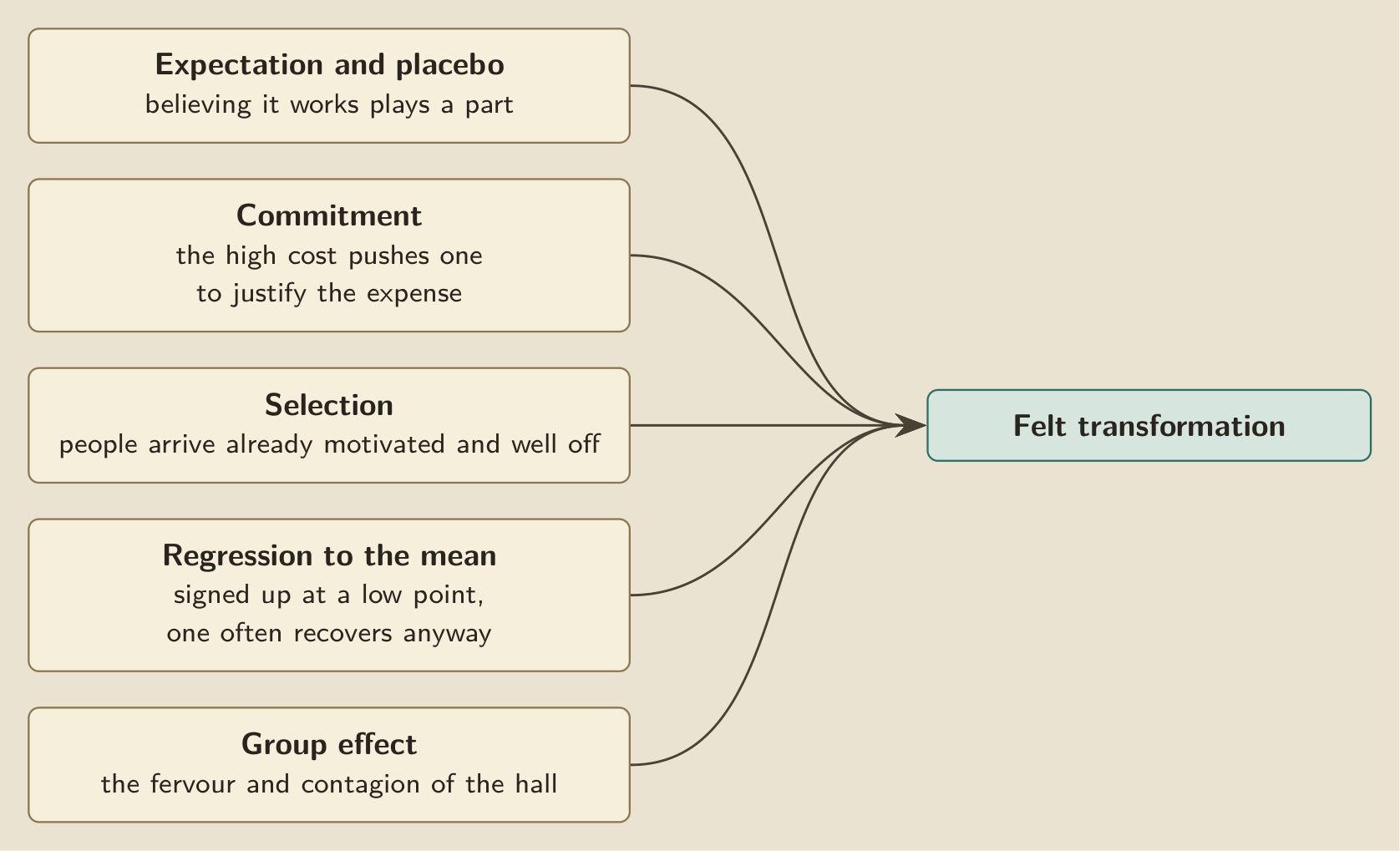
Paying such a sum and setting aside a week already requires uncommon means and determination. Not all employees can free up five working days and pay out of pocket. From the outset, then, the room brings together people who are wealthier and more driven than average, and their later success may come from these prior qualities. To sort this out, they would have to be compared with equally determined people who do not sign up, and none of the sources I read makes this comparison for a seminar (Theeboom et al. 2014).
 Tap to enlarge
The network, often called a mastermind in this circle, brings another kind of value: contacts, opportunities, access to ambitious peers.
Some high-end offers borrow from network marketing: tiers, ambassadors, certification to lead sessions in turn, commissions on spots sold, invitations to bring in the people around you. Their prosperity then depends on the arrival of new registrants at least as much as on the results of the participants already there.
The seller’s fortune
The businesses of these major figures live off the volume of events, licenses, books, and merchandise, rather than participant follow-up. Filling a stadium, holding a room for twelve hours, and securing thousands of signatures in a weekend are rare talents in sales, stagecraft, and communication.
Studies on coaching
In 2014, Tim Theeboom and two colleagues synthesized the studies on workplace coaching, the guidance of employees toward their goals (Theeboom et al. 2014) (Theeboom et al. 2014; Jones et al. 2015). They find effects on performance, well-being, the way people cope with difficulties, attitudes at work, and the pursuit of goals (Theeboom et al. 2014). Some of the people coached come away more motivated, with clearer priorities and greater support (Theeboom et al. 2014; Jones et al. 2015). These effects rely mainly on their own statements (Theeboom et al. 2014).
The authors themselves judge the evidence base to be limited and disparate (Theeboom et al. 2014). Comparing the studies with each other, they did not find that longer coaching works better, and they present this comparison as exploratory (Theeboom et al. 2014; Barnett et al. 2004).
Among these studies, few trials compare a method with a cheaper offer (Theeboom et al. 2014). A trial that would follow randomly selected participants for a year, alongside a similar group left out, is practically nonexistent (Theeboom et al. 2014).
References
What has changed
- : The text is rewritten as a narrative, starting from the author's question about these seminars: it tells the studies on price, on the atmosphere of the room and on testimonials one after another, and no longer shows its two figures. What prompted it: The title is unchanged, and all the sources are retained.
- : The passage on fatigue names what sleep deprivation actually impairs, sustained attention and speed, rather than reasoning. What prompted it: A meta-analysis of seventy studies, brought to light by the re-examination, finds reasoning accuracy spared. This better serves the text's argument, since it rests on processing capacity.10.1037/a0018883
- : Escalation of commitment is described as a robust phenomenon whose explanation in terms of admitting an error fails to replicate reliably. What prompted it: Preregistered replications of three foundational studies, published in 2025, reproduce only one in part. It is the route through personal responsibility, which the text invokes, that fails.10.1177/01461672251345021
- : The effect of knowing that one is observed now includes its size, instability and duration. What prompted it: A meta-analysis of forty-one randomised trials puts it at 0.09 with indications of publication bias, and a survey in healthcare settings finds magnitudes ranging from negative values to more than sixty per cent, fading over time. A text that demands orders of magnitude everywhere had to give its own.10.1037/hea000010410.1016/j.jhin.2020.07.028
- : The text explains why the standard of proof it demands is attainable in this field. What prompted it: Another paper in the corpus sets out the explicit rule that demanding from a field proof not required of any comparable field amounts to setting an asymmetric bar. This text set that bar without ever raising the question.
- : The discussion of the evidential value of an intense testimony refers to the paper that establishes it. What prompted it: This text relies on this point throughout without sourcing it, although another paper in the corpus makes it its central argument.