Why rejection is so frightening?
And why that fear, however violent, says nothing about your worth
0. Introduction: an alarm taken for a verdict
You have to pick up a phone, walk into a room where you are expected, speak in front of a group, or simply send a message to someone whose opinion matters. And there, without warning, the heart races, the throat tightens, an inner voice whispers that you are going to make a fool of yourself, that you are not up to it, that you will be unmasked. This sensation presents itself as a verdict: it seems to tell you something true about you, about your worth, about what others already think. It is this reading that must be examined, because it aims at the wrong target.
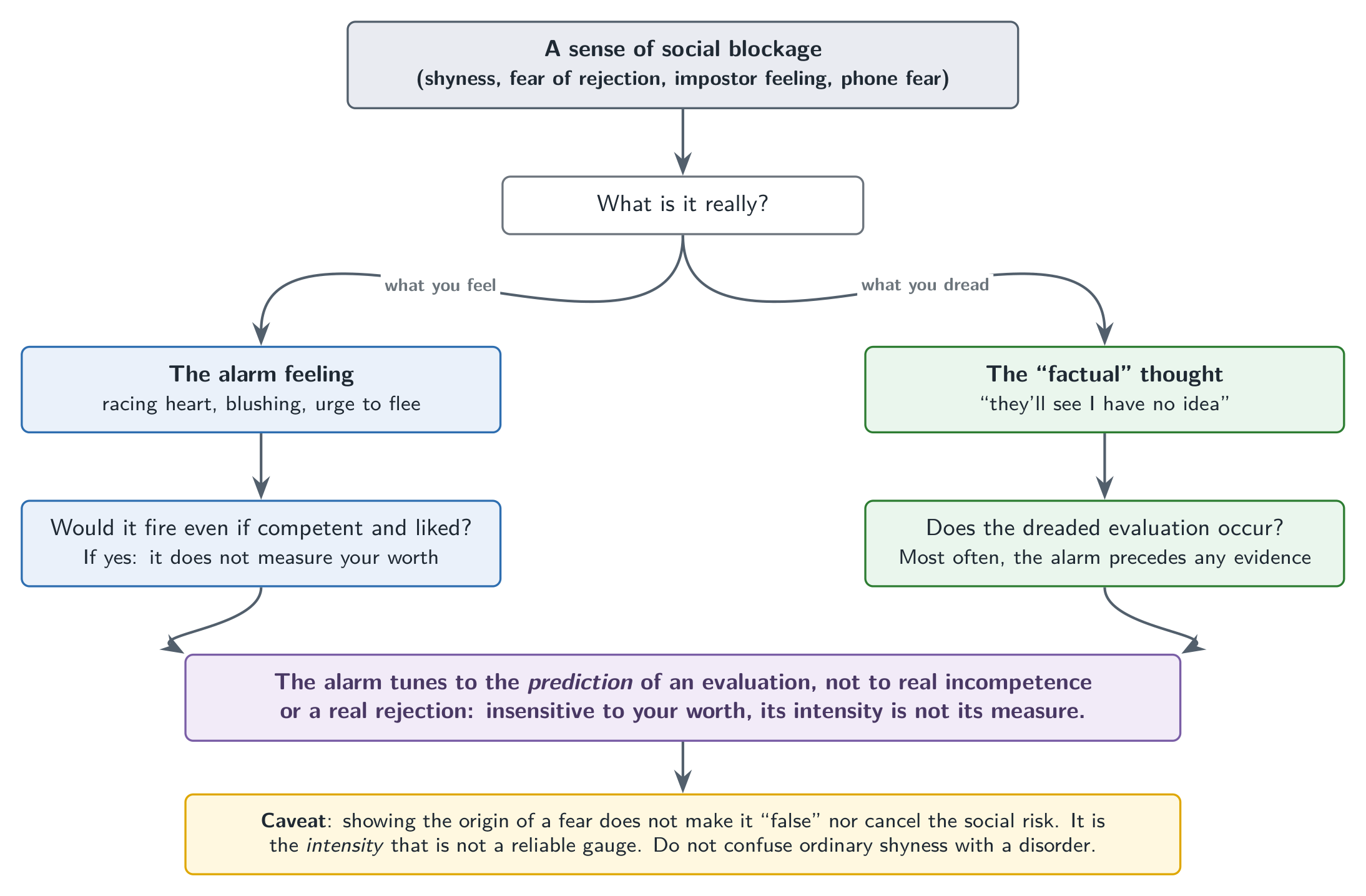
The fear of rejection, shyness and impostor syndrome are neither character flaws nor a truth about your worth: they are the predictable outputs of a social-threat detection system tuned to over-detect the danger of exclusion, and seeing their origin strips these sensations of their status as a verdict. The approach has four steps: lay out the feeling, show the mechanism that produces it, establish that this mechanism is insensitive to your real worth, then point to the concrete way out. This four-step march is not a mere presentational device, it follows the logic of the problem. You cannot decide to stop being afraid, but you can understand where the fear comes from, see that it does not prove what it claims, and act on what truly recalibrates it. Each step prepares the next, and it is the sequence, not an isolated trick, that lets you durably change your relationship to the sensation.
Two precautions, at once. The scope is the normal variation of social sensitivity; the border of disabling social anxiety disorder is flagged, without being treated in depth, and this text explains a mechanism rather than providing a therapeutic guide. We also take these fears seriously in their strongest form: they are intense, sometimes disabling, and the social risk they signal is real; it is their intensity taken as a measure, not their existence, that is in question.
A test will guide the whole reading. Ask yourself: would this alarm fire even if you were perfectly competent and liked? If the answer is yes, then its intensity does not measure your worth, it measures something else. The illusion is tenacious because the sensation is physical, immediate, total: when the body sounds the alarm, the message received is not “careful, an evaluation is possible”, it sounds more like “you are in danger, therefore you are at fault”. The leap from one to the other happens without one noticing, and it is that leap, not the sensation itself, that is the reading error. The whole text comes down to making that leap visible, so one stops making it automatically.
1. The social alarm system
Let us start with the mechanism, because everything flows from it. The brain has a social-threat detection system, a distributed network linking the amygdala and the medial prefrontal cortex, and in social anxiety this system shows heightened reactivity to evaluation cues, like a face that closes or a silence that settles in (Etkin and Wager 2007; Giustino and Maren 2015). This system is not a flaw: it is tuned to over-detect danger, following an error-management logic where a false alarm is better than a missed danger, which leads it to produce many false positives by design (Haselton and Nettle 2006). One can grasp the idea through its arithmetic. Being wrong does not cost the same in both directions: missing a real danger of exclusion could once cost your life, whereas a false alarm costs only a little discomfort and energy spent for nothing (Haselton and Nettle 2006). Subjected to this imbalance over hundreds of thousands of generations, the winning setting is the one that rings too often rather than too late, and we inherited that setting. The alarm that flares for a message left unanswered is therefore not broken; it does exactly what it was selected for, in a world where the price of a social misstep is no longer anything like fatal (Haselton and Nettle 2006).
A widespread oversimplification must be defused at once. The amygdala is not “the fear centre”: fear emerges from a distributed network, and reducing it to a single structure is misleading, as is any account that would lodge an emotion in a single slot of the brain (LeDoux 2000; Etkin and Wager 2007). What one can say, more soberly, is that threat detection is fast and automatic, whereas the prefrontal regulation that tempers it is slower, which explains why you feel the alarm before you can reason about it (Giustino and Maren 2015). The sensation comes first and the argument that relativises it comes after, which explains concretely why one feels it before having been able to discuss it.
Several settings reinforce the bias further. The system gives more weight to negative signals than to positive ones, an imbalance the research sums up in the formula that bad is stronger than good, and which steers attention toward cues of disapproval rather than approval (Baumeister et al. 2001). To this is added a probable bodily loop: the racing heart and tight throat are reread by the brain through interoception, and these signals from the body would feed back into the feeling of threat, so that the alarm could sustain itself, on an interoceptive model that is plausible but still theoretical (Critchley et al. 2004). One senses that something is wrong because the body activates, and the body activates because one senses that something is wrong. This loop probably contributes to giving anxiety its texture of self-evidence. The bodily sensations, palpitations, sweaty palms, short breath, are taken for proof that a danger is there, when they are probably above all the echo of the alarm, read by the body and sent back to the brain (Critchley et al. 2004). Learning to recognise this loop, to see in the racing heart an effect of the alarm and not its cause, is already enough to loosen the grip a little, for one stops looking outside for a danger that in fact comes from within, a mere echo of the alarm returned by the body.
It remains to understand why this system is so sensitive. Such a setting was adaptive when exclusion from the group threatened survival: being driven from the tribe, long ago, could kill, and the alarm has stayed calibrated on that ancestral danger while the real cost of a social misstep has fallen sharply (Haselton and Nettle 2006). Finally, a detail that matters for what follows: when one learns to no longer be afraid, extinction does not erase the original trace, it adds a new learning that inhibits the old one, which explains why a fear one believed overcome can return under stress (Giustino and Maren 2015). This point has a soothing consequence for anyone who thinks they have relapsed. If a fear one thought defeated resurfaces on a bad day, it does not mean that the work done has been erased or that one is back to square one (Giustino and Maren 2015). The inhibitory learning is only overwhelmed for a time by context, stress or fatigue, and it re-establishes itself afterward. The fear that returns does not cancel the progress, it reminds you that progress consolidates through repetition rather than in one go.
2. The fear of rejection
At the centre of this alarm lies rejection, and one must measure what it represents for the brain. Social exclusion hurts, and not only figuratively: it would recruit a partial overlap with the circuits of physical pain, so that feeling rejected partly activates the same regions as a bodily injury, even if the exact interpretation of this overlap remains debated (Eisenberger 2012; Macdonald and Leary 2005). This kinship is not just an image, even if language betrays it everywhere: a breakup “wounds”, a humiliation “hurts”, one is “bruised” by contempt, and every language reaches for the vocabulary of physical pain to speak of social hurt (Eisenberger 2012; Macdonald and Leary 2005). Research suggests that this metaphor has a concrete basis, shared regions activating in both cases, a seductive but still debated reading, which sheds light on why grief can kill the appetite, knot the stomach or prevent sleep, as a bodily pain would (Eisenberger 2012; Macdonald and Leary 2005). None of this is a whim: the need to belong is a fundamental human need, and it is because it is so vital that its threat triggers so strong a reaction (Baumeister and Leary 2017).
The force of this reaction shows itself in situations where it makes no rational sense. Ostracism hurts even when it comes from a group one despises, or in a perfectly trivial situation, the sign of an automatic alarm rather than of a clear calculation of what one really has to lose (Williams 2007). The experiments show it starkly. In a virtual ball game where strangers suddenly stop passing to you, participants feel hurt within minutes, although they know they are playing against a computer and have objectively nothing to lose (Williams 2007). The alarm does not sort a rejection that matters from an insignificant one: it fires first, and the reasoning comes after, too late to prevent the sting. This automaticity is the mark of a survival system, not of a considered judgment about the real stakes. Some people, moreover, have a high rejection sensitivity: they anticipate and detect rejection more easily, which amplifies the reaction without any real rejection having even occurred (Downey and Feldman 1996). In these people, the scenario often plays out entirely in the head, before any interaction. A message read without an immediate reply, a slightly curt tone, a misread glance are enough to set off the cascade, and one then reacts to an anticipated rejection that may never have happened (Downey and Feldman 1996). Rejection sensitivity has the peculiarity of tending to verify itself: by dint of anticipating hostility, one becomes wary or distant, which sometimes ends up provoking the coldness one feared. A surprising study, but an isolated one still to be confirmed, suggests that a common painkiller, paracetamol, would reduce the felt social pain (DeWall et al. 2010; Eisenberger 2012). The result is intriguing, only it rests on small samples and its replication remains fragile, which makes it a lead rather than a proof.
That all of this is intense says nothing about the real severity of the present situation. Since the alarm targets an ancestral vital danger, it is strong by design, and this strength is a trait of the system, not information about what is at stake here and now (Macdonald and Leary 2005). It must be said plainly: that exclusion hurts does not mean a rejection has occurred, because anticipated pain fires on the prediction of a rejection, not on its reality. One last bias completes the distortion: memory and attention retain episodes of rejection more than of acceptance, which drags down the estimate one makes of one’s own social acceptability (Baumeister et al. 2001). One remembers the time one was snubbed, one forgets the hundred times one was welcomed without a problem. This asymmetry of memory manufactures a skewed statistic about oneself. If the mind files one rejection for ten warm welcomes and then recalls only the rejections, the inner balance one draws from it is mathematically biased, and one believes oneself far less likeable than one really is (Baumeister et al. 2001). The impression of being often rejected tells you more about the sorting done by memory than about the real frequency of rejections.
3. Impostor syndrome
The same alarm produces one of its most tenacious outputs: the feeling of being a fraud about to be unmasked. This impostor syndrome is very widespread, and it strikes notably people who are objectively high-performing, which should already raise a flag about what it really measures (Clance and Imes 1978; Bravata et al. 2020). The scale of the phenomenon by itself defuses part of its charge. The feeling of imposture touches a very large share of the population, and particularly demanding circles, brilliant students, doctors, researchers, recognised executives, exactly where one would expect it to be absent (Clance and Imes 1978; Bravata et al. 2020). If so many competent people feel it, it is an unreliable signal of incompetence, and it is far more likely to accompany high standards and social comparison than mediocrity (Bravata et al. 2020). Research is clear on this point: it is associated with anxiety and burnout, not with real incompetence; it is a miscalibrated self-monitoring, not a diagnosis of level (Bravata et al. 2020).
The paradox deepens when one looks at who doubts. According to an often-reported effect, competent people would tend to underestimate their relative level, while the less competent would overestimate theirs, so that doubting oneself would correlate poorly with actually being bad (Kruger and Dunning 1999). This observation must be taken with caution, part of it possibly owing to a statistical artefact rather than to a genuine psychological law. The explanation advanced is intuitive: to know that one is weak in a field, one must already master its rules enough to measure the remaining gap, and the less competent, lacking that measure, would tend to believe themselves above average (Kruger and Dunning 1999). At the other end, the most competent see the full extent of what they have not yet mastered, and this panorama feeds doubt rather than confidence. The feeling of being an impostor is, in many cases, the sign that one knows enough to measure one’s own ignorance, the exact opposite of what it claims to announce (Bravata et al. 2020). Doubt, far from being a symptom of incompetence, often accompanies the lucidity of one who knows enough to see what he still ignores. The feeling of imposture is, on this reading, one more output of the social alarm: it predicts an unmasking that, most of the time, never comes.
Why, then, does it resist contrary evidence so well? Because it sustains itself through circular reasoning: successes are attributed to luck or a misunderstanding, and doubts are taken as proof of the deception, which makes the experience perfectly impervious to disproof (Clance and Imes 1978). Each success, instead of reassuring, becomes proof that one has once again managed to fool everyone, and the trap closes. One spots this trap by a simple sign: no proof of competence disarms it. A degree becomes a fluke, a promotion an error of the hierarchy, a compliment mere politeness (Clance and Imes 1978). As long as the verdict of imposture is held to be true in advance, every contrary fact is reinterpreted to confirm it. It is this looping functioning that sustains the suffering, independently of the real level of competence (Clance and Imes 1978; Bravata et al. 2020).
4. The fear of the phone and of interaction
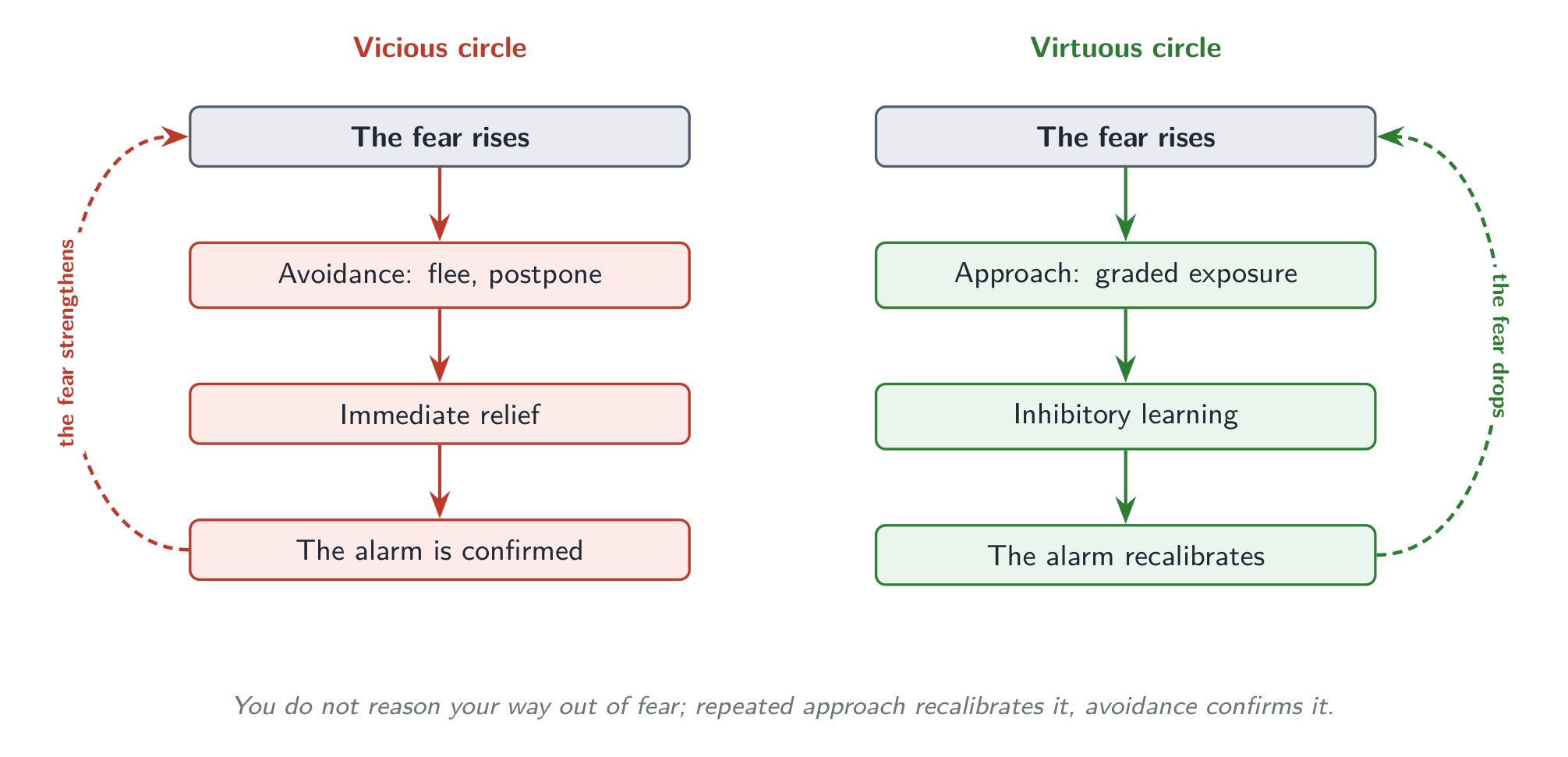
Let us go down to the most concrete level, that of the small situations that paralyse: picking up the phone, walking into a room, speaking without a script. The central spring here is avoidance. Avoiding an evaluative situation relieves in the short term, and that is exactly what reinforces the fear in the long term, through a mechanism of negative reinforcement: fleeing feels good at once, so one does it again, and the fear grows (Craske et al. 2022; Weisman and Rodebaugh 2018). One learns, without meaning to, that the only way to feel better is not to go. Take the phone that rings. The anxiety rises, you let it ring, and at once comes relief: the threat recedes, the heart slows (Craske et al. 2022; Weisman and Rodebaugh 2018). This relief acts as a reward, and the brain quickly learns that avoiding pays. The next time, avoidance comes sooner and more easily, the fear has grown a little, and the repertoire of avoided situations widens, from the phone to emails, from emails to meetings (Craske et al. 2022; Weisman and Rodebaugh 2018). An ordinary unease thus ends up restricting, little by little, the situations one allows oneself, without any notable event to signal it.
The detail of the situations confirms the mechanism. Anticipatory anxiety facing an unscripted, evaluative situation follows a well-described cognitive model, in which one represents oneself as seen negatively by an audience, real or imagined (Rapee and Heimberg 1997). To hold on, one then deploys safety behaviours: preparing each word, avoiding eye contact, rehearsing mentally, cutting the exchange short; yet these behaviours maintain the anxiety by preventing one from learning that the predicted catastrophe does not happen (Weisman and Rodebaugh 2018). Worse, during the interaction, attention turns toward oneself and toward threat cues, which degrades performance and then feeds the conviction of having failed (Rapee and Heimberg 1997). One monitors oneself so much that one speaks badly, and one concludes that one speaks badly because one is bad. This turning of attention is one of the cruellest springs of social anxiety. Focused on his own discomfort and on what he imagines others think of him, the anxious person listens poorly, loses the thread, multiplies the blunders he dreaded, then takes these slips for confirmation of his incompetence (Rapee and Heimberg 1997). Attention turned toward oneself thus partly creates the result it fears, and closes the prophecy. Turning attention instead toward the other and toward the task, rather than toward one’s own inner dashboard, is often enough to smooth the exchange.
A telling link must be named here. It is exactly this fear that certain personal-development offers promise to cure at a high price, while the mechanism that recalibrates it is known, public and cheap. The contrast deserves to be stressed, without cynicism. What seminars charge several thousand euros under the name of self-transcendence covers, in essence, a principle that clinical research has established and which costs nothing: gradually approaching what one avoids. The staging and the fervour of a group can really give the impulse of a first step; the mechanism that does the work, however, belongs to the public domain, and anyone can take it up by their own means. And one sees why it is so tenacious: avoidance is rational in the short view, since the fear drops immediately, and entrapping in the long term, since the alarm is never disproved, which explains why a fear can persist for years with not the slightest real danger.
5. Why none of this is a verdict?
We arrive at the heart of the matter. All that precedes describes a mechanism, and one must now draw the logical consequence about what the fear proves. The principle is borrowed from the philosophy of knowledge: an origin disqualifies a belief only if the process that produces it is insensitive to the truth, and it is this criterion that must be applied here (Kahane 2011). If the alarm fired by faithfully tracking your real worth, its intensity would be information; if it fires while ignoring it, it is not.
And that is indeed the second case. The alarm fires on the prediction of an evaluation, not on your real incompetence nor on an established rejection, and being insensitive to your worth, its intensity is not its measure. Since the system is moreover tuned to produce false positives, an intense alarm is expected even in the absence of any danger, which makes it unreliable information about the real situation (Haselton and Nettle 2006). The same reasoning holds, and this matters, for a rejection that really happened: that it hurt does not establish that it said something true about your worth, because the pain of a rejection does not certify the judgment that caused it. An example makes the idea tangible. A smoke detector that shrieks every time one toasts bread is not an instrument for measuring fire: its cry proves no blaze, it signals only that a sensitive threshold has been crossed (Haselton and Nettle 2006). The social alarm works the same way, and its intensity tells you about the sensitivity of the detector, not about the reality of the danger nor about your worth. No one concludes from his smoke detector that he is a bad cook; yet that is the reasoning one constantly holds with the social alarm.
It must be put in one tenable sentence. The intensity of the fear measures a prediction of the system, not a fact of the world, and confusing the two turns a sensation into a verdict on oneself. That said, the skepticism must stay symmetric: the risk of evaluation is real, the alarm is not absurd, and what is in question is its calibration, not its existence. This symmetry is essential so as not to fall into the opposite excess. To say that the intensity of the fear is not a reliable gauge does not amount to claiming that no social risk exists: some situations genuinely deserve caution, some circles are harsh, some judgments do fall for real. The point is finer, and that is what makes it solid: the alarm is right that there is a stake, and wrong about its magnitude, so that one can listen to what it signals without swallowing what it quantifies. Research confirms it in its own way: social anxiety is characterised by an overestimation of evaluative danger, which shows that the alarm over-predicts rather than measures (Etkin and Wager 2007). One finds the same gap in the detail of the predictions. Those who suffer from social anxiety overestimate both the probability that a misstep will occur and the severity of its consequences, two errors that compound to inflate the perceived threat (Etkin and Wager 2007). Asked afterward, the evaluation others actually made turns out almost always to be far more lenient than the one inflicted on oneself in advance. The gap between the predicted catastrophe and the observed reality is, by itself, the measure of the poor calibration. This over-prediction is found, on average, right down into brain activity. Imaging studies observe, in highly socially anxious people and at the group scale, heightened reactivity of the amygdala-prefrontal network to faces and evaluation cues, including when these cues are neutral or ambiguous (Etkin and Wager 2007; Giustino and Maren 2015). The system thus lights up for cues that are in no way threatening, which makes visible, down to the neural activity, the gap between what the alarm announces and what the situation really contains (Etkin and Wager 2007). The fear is in no way imaginary, its substrate is indeed there; what is in question, once again, is what this activity predicts, not the fact that it exists.
6. The way out: recalibrate, do not force
There remains the practical question: if the alarm is poorly calibrated, how does one recalibrate it? The answer flows from the mechanism, not from willpower. What recalibrates the alarm is repeated exposure, the approach, through an inhibitory learning in which the brain learns that the situation predicted as dangerous is not (Craske et al. 2022; Weisman and Rodebaugh 2018). This recalibration flows from repeated experience, not from an effort of forcing oneself through gritted teeth: it is the repeated approach that rewrites the prediction, gradually, as the announced catastrophes fail to occur (Craske et al. 2022). Conversely, avoidance and safety behaviours prevent this relearning, which explains why the intuitive strategy, avoiding to feel better, fails (Weisman and Rodebaugh 2018). Concretely, recalibrating resembles taming, not vanquishing. One chooses a somewhat dreaded but manageable situation, exposes oneself to it, stays until the alarm subsides on its own, then starts again a notch further (Craske et al. 2022; Weisman and Rodebaugh 2018). Each time, the brain records a disproof: the announced catastrophe did not happen, and the prediction corrects itself by a degree. This new learning does not erase the old, it covers and inhibits it, which takes repetition and explains why a single brave attempt never suffices (Craske et al. 2022). One is not, moreover, bound to wait until one’s back is against the wall to begin. The principle holds for small everyday fears as for large ones: making the call one keeps putting off, raising one’s hand in a meeting, starting the conversation one avoids, while staying long enough to feel the alarm ebb rather than fleeing at the first unease (Craske et al. 2022; Weisman and Rodebaugh 2018). Each repetition files one more datum in the case that disproves the catastrophe, and it is the accumulation of these disproofs, not an isolated heroic act, that ends up recalibrating the threshold (Weisman and Rodebaugh 2018). The spring is not exceptional courage; it is patient repetition, step by step, of a slope that looks steep only when one looks at it from below.
One must also know where the border lies. When the fear becomes disabling, that is, when one tips into social anxiety disorder, well-supported treatments exist, foremost among them cognitive-behavioural therapy with exposure (Mayo-Wilson et al. 2014; Hoffman and Smits 2008). For the full-blown disorder, then, one does not start from nothing. Comparisons of studies place this therapy among the best-supported approaches against social anxiety, on a par with or ahead of medication depending on the case, and with benefits that hold over time (Mayo-Wilson et al. 2014; Hoffman and Smits 2008). This deserves to be known, because many endure in silence a suffering for which effective answers exist, for lack of knowing that the border of care has been crossed (Kessler et al. 2005; Mayo-Wilson et al. 2014). But the bulk of these fears stays below that threshold. They are a very widespread normal variation, and their frequency in the population shows that they belong to ordinary functioning, not to an individual flaw (Kessler et al. 2005). That is why one must carefully distinguish the normal variation, shyness, stage fright, from the clinical disturbance, on pain of pathologising the ordinary and turning a sensitivity into an illness (Kessler et al. 2005; Mayo-Wilson et al. 2014). The useful border does not run through the intensity felt on a given day, which can be sharp in anyone, but through the durable impact: does the fear prevent working, forming bonds, living as one would wish, to the point of organising one’s existence around avoidance? (Kessler et al. 2005; Mayo-Wilson et al. 2014) Below it, one is dealing with a sensitivity, sometimes painful but ordinary; beyond it, with a disorder that warrants support. Mixing the two leads either to dramatising a banal shyness or to minimising a real distress, two symmetric errors (Kessler et al. 2005).
The right reframing fits in a few words. A high social sensitivity is in itself neither an illness nor a flaw; it is an alarm setting, with its costs and its benefits, for the same vigilance that makes one suffer also makes one attentive to others. And the way out passes neither through denial of the fear nor through the effort of forcing oneself through gritted teeth; it passes through approaching, in small steps, what one avoids, to let the mechanism recalibrate itself.
7. Conclusion: shifting the reading
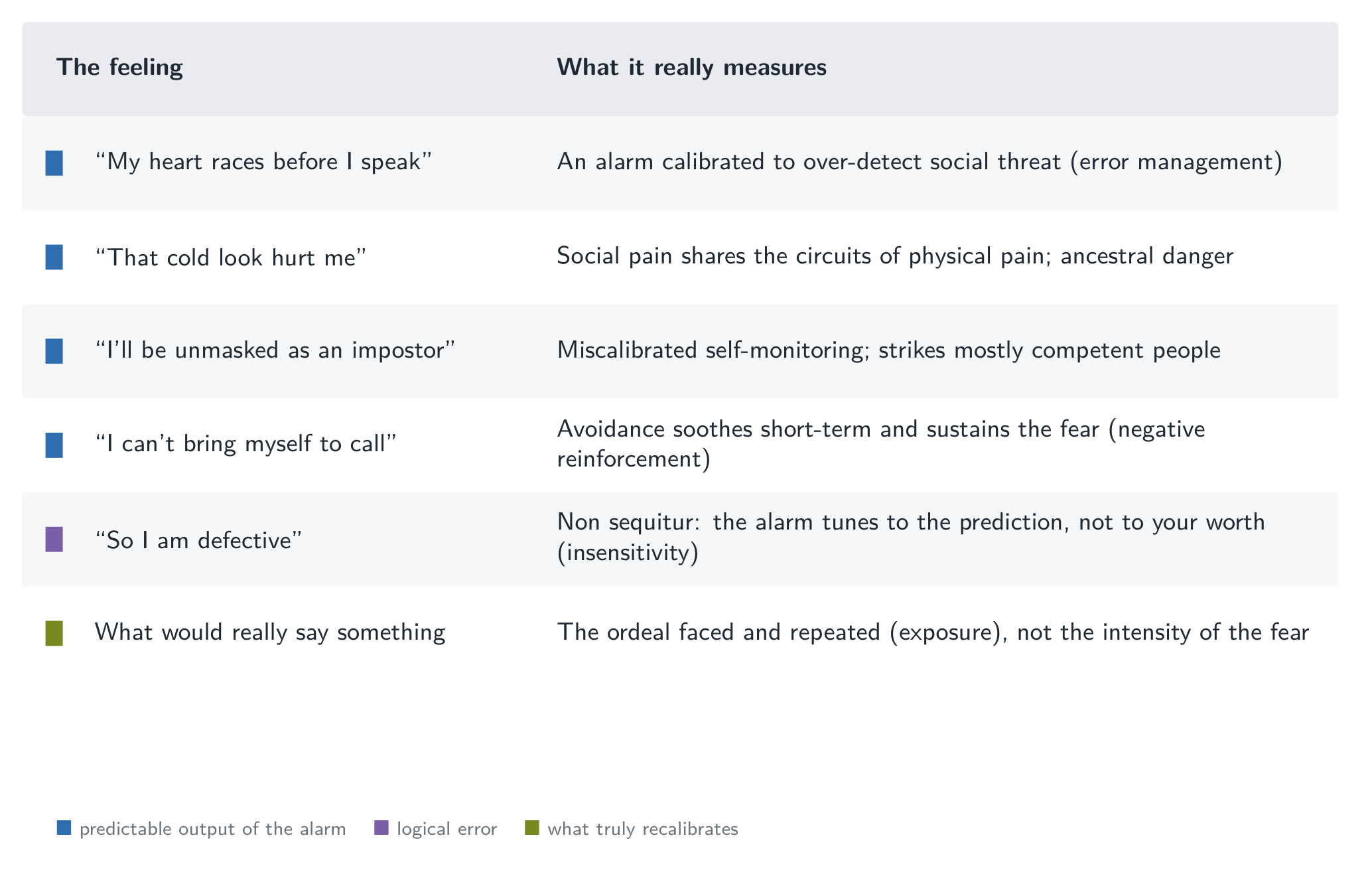
The whole point lies in a shift of reading. It is about moving from “I am defective” to “my alarm system is sensitive, and that recalibrates”, which changes everything about how one lives the sensation. The portable tool boils down to one question, the one posed at the start: would this fear fire even if I were competent and accepted? If the answer is yes, then it speaks of my alarm, not of my worth. This question has a practical merit: it can be asked in the moment, at the very instant the alarm sounds, and it shifts attention from the content of the fear to its mechanism. Instead of asking “am I really useless?”, a question with no exit, one asks “is my detector not, right now, doing what it is set to do?”, which hands back control. It is not a soothing mantra, it is a reframing that holds because it is accurate.
One must guard against the opposite misreading. This shift does not deny the real social risk, it only strips the intensity of the fear of its authority as a verdict, which is neither the same thing nor an encouragement to recklessness. This point keeps the argument honest. Rereading the alarm as information to be calibrated does not authorise charging headlong into every social situation without discernment, for the world contains real risks of evaluation and real consequences. The reframing strips the fear of its authority as a judge, it does not strip it of its usefulness as an indicator, and so one keeps the information while discarding the verdict. Seeing the mechanism of a sensation does not make it false: it strips it only of its status as proof, its capacity to count as a verdict on your worth. The sensation remains, real and sometimes painful; what it loses is the right to pronounce a sentence on who you are. There is something liberating in this simple change of angle. To stop asking a sensation to settle what it is incapable of measuring is to give oneself back the freedom to judge otherwise, on evidence rather than on shivers. Shyness, stage fright, doubt do not vanish for all that, and they do not have to vanish for one to learn to live with them without obeying them. One can be afraid and move forward all the same, precisely because one has stopped taking the fear for an oracle.
There remains then a simple, portable rule, valid well beyond the phone one dares not pick up: treat the alarm as information to be calibrated, not as a judge, and approach rather than flee when the real stake is low. The fear will not vanish on command, and that is not the goal. The goal is to stop reading it as a verdict, and to let it, through repeated approaches, come back down to its proper measure, that of one signal among others, and not that of a judge.