Why do the most educated have fewer children, and why that does not mean the world is getting dumber?
The education-fertility gradient is a solid fact. The conclusion often drawn from it, a world filled with minds increasingly unable to think about their own survival, is not. An inquiry into what demography actually establishes, and into the leap it does not license
0. Introduction: the intuition that frightens
The idea circulates, often in a low voice, sometimes as a science-fiction joke in which the bright minds fade out while the crowd multiplies. Educated people have few children, and late. The others, less qualified, younger, more precarious, have more. Extend the curve in a straight line and the conclusion seems to impose itself: the world would fill with ever more mediocre minds, until a humanity unable to think about its own survival. It is a powerful intuition, because it rests on things everyone observes around them, and it is exactly the kind of intuition this work takes seriously enough to examine rather than to dismiss or to swallow.
Let us say it at once, to mislead no one. The starting fact is real: the most educated do have fewer children, and later. But the leap from that fact to “the world is getting dumber” is not established, and the honest answer separates the demographic observation from the inference grafted onto it, which does not follow. The whole difficulty lies in that slide, which looks like plain common sense put into an equation and which in fact hides three logical jumps. A true fact is accepted, a false conclusion is attached to it, and the whole passes for obvious.
To judge it correctly, three things that get blurred the moment one touches the subject must be kept apart. Correlation, first: the fact that schooling and fertility move together, which is observed and undeniable. Causation, next: the question of what produces what, which a curve alone cannot answer. Heritability, finally: what would actually be transmitted by genes, rather than by money, school or background. Schooling is not intelligence, and measured intelligence is not a destiny written in DNA. Keeping these three planes distinct already defuses most of the catastrophist reasoning, because that reasoning only holds by confusing them.
The inquiry proceeds in five steps, each answering a stage of the argument under examination. Establish the fact, the gradient between education and fertility. Place it on the world map, with recent figures, to see where children are born. Understand why fertility falls as a country develops, which turns an apparent oddity into a known mechanism. Then dismantle the leap to the so-called dysgenic thesis, where the inference goes off the rails. And name, finally, the real long-term issue and the real lever, which are not the ones fear points to.
One more clarification, on the tone of the inquiry. This text does not seek to reassure at all costs nor to deny what worries. It seeks to separate, within a single sentence that seems to flow naturally, the part that describes the world from the part that judges it. The observation that the most educated have fewer children is descriptive and verifiable, and it will be established without detour. The conclusion that humanity would impoverish is, for its part, a heavy prediction, which mixes biology, psychometrics and an implicit judgment on the worth of people, and which therefore demands proof of an altogether different weight. Placing these two levels side by side is not a methodological affectation, it is what makes it possible not to confuse a camera with a courtroom.
1. The fact: the more educated you are, the fewer children, and later
Let us start by granting the intuition what it gets right, for it has a solid factual base that it would be dishonest to downplay. The level of education, especially that of women, is associated with lower fertility, and this relationship holds from one country to the next and from one era to another (Breierova and Duflo 2004; Balbo et al. 2012). This is no saloon impression nor a passing fashion: it is one of the best-documented regularities of contemporary demography, verified across dozens of countries and several generations.
The same level of education goes together with a later age at first birth (Mills et al. 2011; Balbo et al. 2012). Women who pursue long studies start their reproductive lives later, through the years of degrees and then the first years of a career, which mechanically narrows the available biological window. The gradient combines two effects that must be distinguished so as not to mistake its scope. A postponement of births to a more advanced age, first, which could be only a shift in time. A completed fertility that remains lower among the most educated, next, even once postponed and finally realized pregnancies are taken into account (Balbo et al. 2012; Mills et al. 2011). In other words, some postponed births do happen later, and others never happen at all. Postponement does not erase the whole gap.
This gradient is not merely a matter of constraints suffered by women who secretly want large families. It also holds for the desired number of children, not only the realized number: the most educated aim on average at smaller families (Balbo et al. 2012). The relationship is moreover stronger for women’s education than for men’s, which already points the explanation toward the female condition and the trade-offs it commands, rather than toward some mysterious sorting of minds (Breierova and Duflo 2004). Here is a first clue that unsettles the dysgenic story: if the engine were intelligence, there is no reason it would act mainly through the mothers’ schooling.
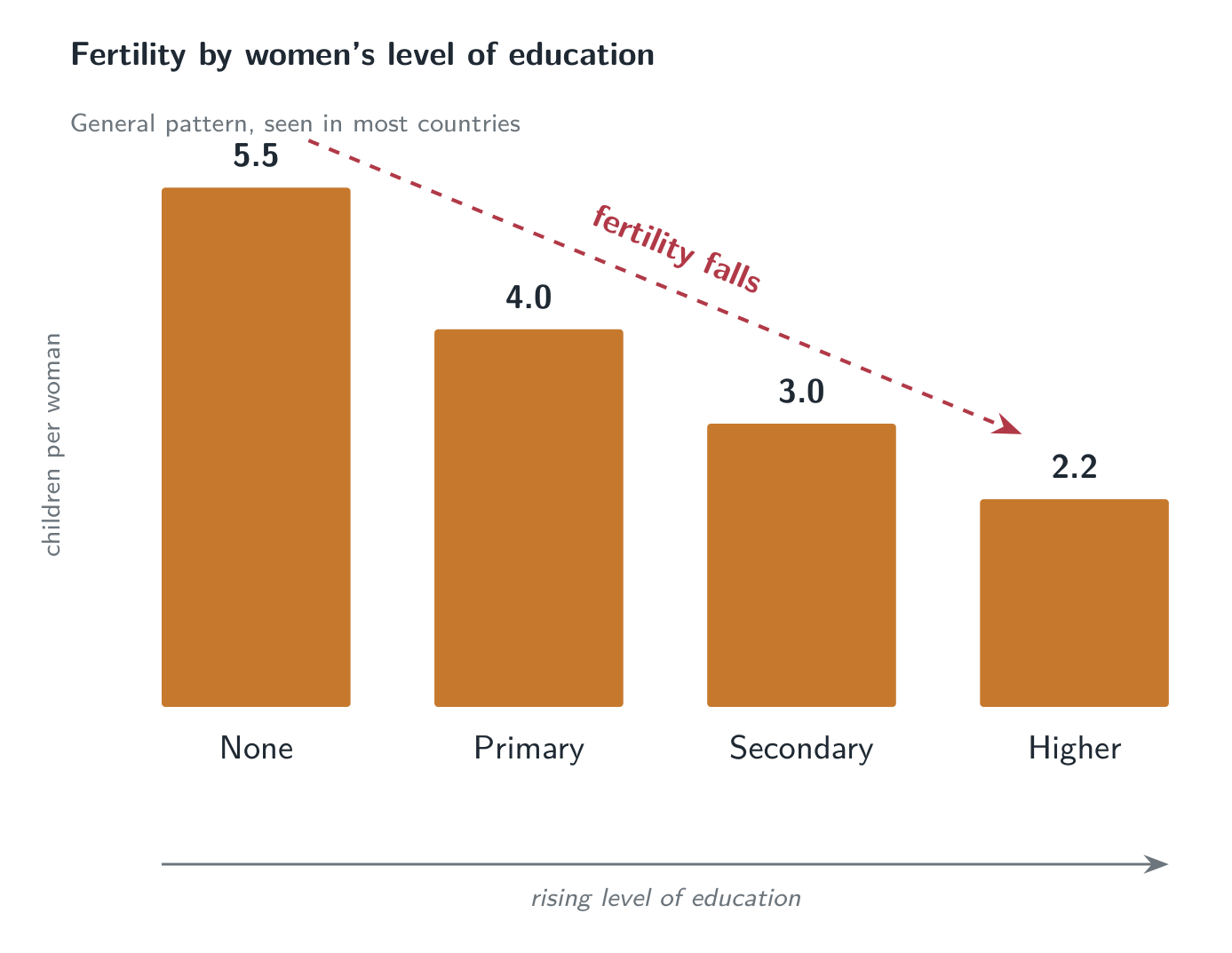
Why this regularity, then? The mechanisms are known, measured, and have nothing esoteric about them. The first is opportunity cost: the more qualified a woman is, the more the time devoted to children is paid for in foregone wages and a career put on hold, so that each child costs all the more as the person has invested in her own training (Balbo et al. 2012; Becker and Lewis 1973). The second is access and control: education improves the use of contraception and reproductive autonomy, that is, the concrete ability to decide when and how many, where the absence of school often leaves those decisions to others or to chance (Breierova and Duflo 2004). The third touches desire itself, since a higher level of education goes with a smaller ideal family size, and not only with a difficulty in reaching a wished-for large family (Balbo et al. 2012).
Other factors push the same way and complete the explanation of the gradient without invoking anything genetic. Women’s participation in the labor market and urbanization accompany lower fertility, because they change the cost, the housing and the daily organization of life with children (Balbo et al. 2012). To this is added a trade-off that economists formalized half a century ago: as parents invest more in each child, their health, their education, their activities, they have fewer of them, the trade-off between quantity and quality (Becker and Lewis 1973; Black et al. 2004). Finally, education delays the formation of the couple and the age at marriage or union, which pushes back the start of reproductive life by the same amount (Balbo et al. 2012; Mills et al. 2011). Run through the list: cost of time, access to contraception, desire for a smaller family, work, the city, investment per child, later union. Nothing in it evokes a sorting of intelligences. Everything evokes trade-offs in the face of costs and freedoms, the trade-offs of people who have more choices.
Take the most ordinary case to see the mechanism at work, with nothing genetic about it. A woman who finishes a master’s degree around twenty-three, then looks for a stable job, then a home in which to welcome a child, does not start a family at the same age as another who entered the workforce early. The simple calendar of studies pushes back the first birth, and that delay cuts into final fertility because the fertile window itself does not lengthen (Mills et al. 2011; Balbo et al. 2012). If, on top of that, each child costs all the more in deferred career the higher the qualification, the targeted number falls without any intelligence coming into play (Balbo et al. 2012; Becker and Lewis 1973). What we observe is not a species sorting itself, it is a schedule filling up, and people who, having more options, use them differently from their grandmothers.
2. The world map: where children are made, and where they are born
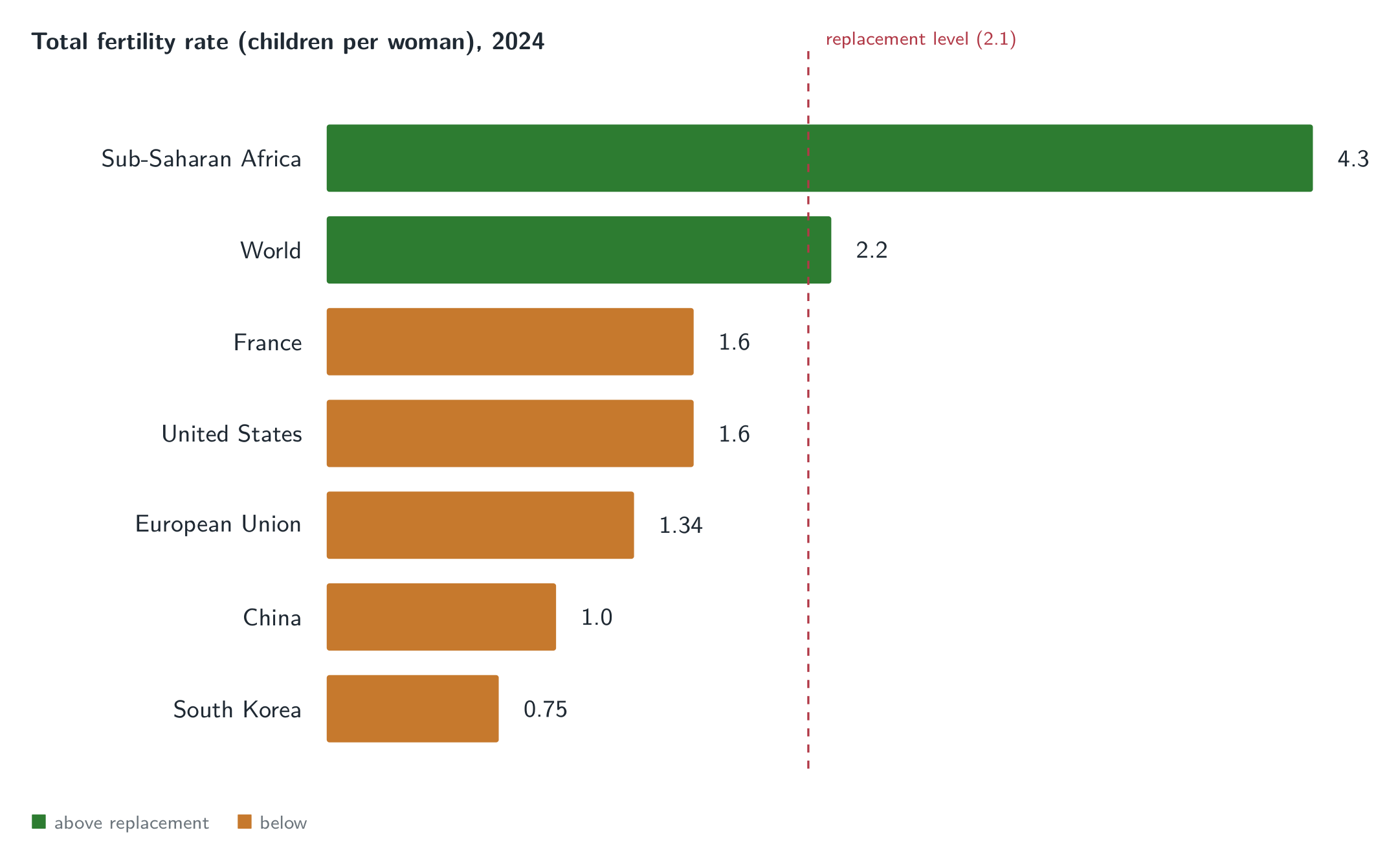
Let us move from the individual gradient to the global snapshot, with recent and dated figures, for it is that snapshot which feeds the fear. World fertility is today around 2.2 children per woman, thus close to the replacement level, which stands around 2.1 (GBD 2021 Fertility and Forecasting Collaborators 2024; United Nations, Department of Economic and Social Affairs, Population Division 2024). The world as a whole is therefore no longer in demographic explosion, contrary to an image inherited from the 1970s and still stuck in many minds.
The average hides a considerable gap, and it is the gap that matters. In the European Union, fertility fell to about 1.34 children per woman in 2024, its lowest level since records began, clearly below replacement (GBD 2021 Fertility and Forecasting Collaborators 2024; Eurostat 2026). At the other end, sub-Saharan Africa has the highest fertility of the major regions, on the order of four children per woman (GBD 2021 Fertility and Forecasting Collaborators 2024; Bongaarts 2017). Between the two, very contrasting situations that forbid any single narrative. South Korea breaks records for low fertility, around 0.7 to 0.8 children per woman, a collapse without equivalent in modern history (GBD 2021 Fertility and Forecasting Collaborators 2024; United Nations, Department of Economic and Social Affairs, Population Division 2024). France ranks among the highest fertilities in Europe, around 1.6 children per woman in 2024, while remaining below replacement itself (INSEE 2025; GBD 2021 Fertility and Forecasting Collaborators 2024). The United States is also below the threshold, around 1.6 (Centers for Disease Control and Prevention, National Center for Health Statistics 2025; GBD 2021 Fertility and Forecasting Collaborators 2024). China and Japan are very low, around one child per woman in China and 1.2 to 1.3 in Japan (GBD 2021 Fertility and Forecasting Collaborators 2024; Vollset et al. 2020). Note in passing that these very-low-fertility countries are among the most schooled in the world, which is enough to show that a country’s level of education in no way protects it from falling birth rates.
From these gaps follows a geography of growth, and it is precisely that geography which feeds the opening intuition. Most of the coming demographic increase is concentrated in sub-Saharan Africa and South Asia, that is, where fertility remains high (Vollset et al. 2020; United Nations, Department of Economic and Social Affairs, Population Division 2024). Since these regions today have a lower average level of education than rich countries, one pictures a future peopled in growing proportion by less-schooled persons, and from there one slides, without noticing, toward the idea of a less intelligent future. The slide is so quick that one does not see it happen. It must therefore be slowed down and looked at.
One last figure, before that, already defuses part of the panic. The world population, though still rising, is seeing its pace slow, and reference projections anticipate a peak toward the end of the century, around ten billion, followed by a plateau (Vollset et al. 2020; United Nations, Department of Economic and Social Affairs, Population Division 2024). The curve that the intuition extends to infinity is in reality bending, and today’s high-fertility regions are precisely those where the transition is under way. The present is not the future frozen, it is a snapshot of a movement.
An objection deserves to be addressed at once, for it is at the heart of the fear. Yes, growth is concentrated where average education is today lower (Vollset et al. 2020; United Nations, Department of Economic and Social Affairs, Population Division 2024). But the word that matters in that sentence is “today”. These same regions are seeing the strongest progress in schooling, and their level of education is rising fast, at the same time as their fertility is beginning to fall (Lutz and KC 2011; Roser, Max and Ortiz-Ospina, Esteban 2023). Judging the future on the snapshot of the instant is to confuse a runner’s position at the start with the one he will hold at the finish. The transition that took Europe from large families to small ones is under way elsewhere, with a few decades of lag, and nothing indicates it will stop midway (Bongaarts 2017; Lutz and KC 2011).
3. The demographic transition: why fertility falls with development
To understand these gaps, a framework is needed, and demography has one, robust and old: the demographic transition. As a country develops, as education progresses, as incomes rise and mortality recedes, its fertility passes from a high regime to a low one (Bongaarts 2017; Lutz and KC 2011). This is the decisive point the catastrophist intuition ignores: high-fertility regions are not of a different nature from ours, they are at a different moment of the same trajectory that Europe traveled a century ago.
A central spring of this shift is the survival of children. The decline in infant mortality precedes and accompanies the decline in fertility: when children stop dying young, parents no longer need to have many for a few to remain into adulthood (Breierova and Duflo 2004; Bongaarts 2017). The high fertility of poor regions then appears for what it largely is, a rational response to a high risk, and not a mark of improvidence or blindness. When the risk falls, behavior follows.
Above all, one fact directly unsettles the image of a world dumbing down. The average level of education in the world has not fallen, it has risen sharply over recent decades, with schooling on the rise and illiteracy in retreat almost everywhere, including in high-fertility regions (Lutz and KC 2011; Roser, Max and Ortiz-Ospina, Esteban 2023). While people worry about an impoverishment, humanity has never been as schooled, and it is increasingly so, generation after generation. The transition itself is near-universal across cultures once certain thresholds of development are crossed, even if its timing varies from one country to another (Bongaarts 2017). What repeats everywhere is therefore not a fatality of stupidity, it is the shift toward smaller families as one becomes educated and survives.
A nuance is in order, so as not to oversell the idea that development would always and indefinitely lower fertility. At very high levels of development, some studies have observed a slight rebound, a J-shaped relationship between the development index and fertility, a debated result that has not been confirmed everywhere (Myrskylä et al. 2009). The trajectory is therefore a strong tendency, not a mechanical law without exception. This caution does not change the overall picture, it simply makes it more honest.
The European historical example makes the thing tangible and cuts short the idea of a curse reserved for others. A century and a half ago, large families were the rule across the whole continent, in a very poorly schooled population struck by high infant mortality (Bongaarts 2017; Lutz and KC 2011). As school became general, as children stopped dying young and women gained autonomy, fertility fell until it passed, today, below replacement (Breierova and Duflo 2004; Bongaarts 2017). No one seriously argues that Europe became less intelligent by becoming schooled; it even experienced, over the same period, the rise in cognitive scores described by the Flynn effect (Pietschnig and Voracek 2013; Flynn 1987). The scenario feared for high-fertility regions is, give or take, the one we ourselves went through, and it came with no decline of the mind.
4. The leap that does not hold: from the gradient to the fear of decline
Here we are at the heart of the subject. The gradient exists, the map is real, the transition explains it. What remains is the leap, the one that gives the whole thing its flavor of catastrophe: going from “the most educated have fewer children” to “the species is becoming cognitively poorer”. This leap has a name, the dysgenic thesis, and it collapses as soon as one examines it closely, on the plane of facts as on the plane of logic.
The first obstacle is massive and purely empirical. Over the twentieth century, scores on intelligence tests did not fall, they rose sharply, on the order of three IQ points per decade in many countries, what is called the Flynn effect (Pietschnig and Voracek 2013; Flynn 1987). The very direction of this evolution contradicts the dysgenic prediction of a cognitive impoverishment of populations: during the period when decline was being announced, measured performance was climbing (Pietschnig and Voracek 2013; Flynn 1987). One detail is revealing. The largest gains are on abstract reasoning, the kind of task most sensitive to school, to abstraction and to environment, which points toward acquired causes rather than a genetic improvement impossible in so few generations (Pietschnig and Voracek 2013; Flynn 1987). A slowdown or even a reversal of these gains has indeed been observed recently in some rich countries, which the proponents of decline readily brandish. But the studies that compare brothers within the same families place this reversal on the side of the environment rather than a genetic selection between families (Bratsberg and Rogeberg 2018). This within-family corpus is still limited, and it is on that basis, not as a closed proof, that the observed ebb leans toward the environment (Bratsberg and Rogeberg 2018).
The second obstacle is conceptual, and it targets the word hidden behind the whole affair: intelligence, slipped surreptitiously in place of schooling. The level of education attained depends heavily on the socioeconomic environment, on family income, on the quality of the school, on the neighborhood, on cultural capital; it is not the direct readout of a genetic intelligence (Hanscombe et al. 2012; Breierova and Duflo 2004). And even where one measures a heritable part, a classic and consequential confusion lurks: the heritability of a trait, estimated in a given environment, implies neither a genetic difference between groups nor a trajectory frozen in time (Turkheimer 2000). A trait can be partly heritable and still move fast under the effect of the environment, as height jumped in a century without mutation. The Flynn effect is the living demonstration of this applied to cognitive scores.
Transmission across generations confirms this diagnosis rather than refuting it. Cognitive skills pass largely through the environment, school, nutrition, stimulation, the language heard and practiced, all factors modifiable by collective action (Hanscombe et al. 2012; Ritchie and Tucker-Drob 2017). Improvements in nutrition, health and schooling raise cognitive performance at the scale of an entire population, and not of an isolated individual (Ritchie and Tucker-Drob 2017). Better still, the effect of school is not only correlated with better scores, it is causal: quasi-experimental studies, which exploit for instance an extension of compulsory schooling, show that one additional year of schooling raises IQ by on the order of one to five points (Ritchie and Tucker-Drob 2017; Brinch and Galloway 2011). Education does not merely reveal a pre-existing intelligence, it develops a measurable part of it, it being understood that the distance between a score and intelligence itself calls here for the same caution as the one opposed to the adverse camp (Ritchie and Tucker-Drob 2017; Brinch and Galloway 2011). Adoption and twin studies confirm, moreover, that the shared environment counts for childhood cognitive outcomes, in addition to the genetic part (Haworth et al. 2009; Hanscombe et al. 2012). To this is added a statistical mechanism often forgotten in decline scenarios: regression to the mean means that the children of parents with extreme scores, high or low, tend to return toward the population mean, which brakes any simple drift accumulated over several generations (Turkheimer 2000).
An image helps grasp why heritability does not say what it is made to say. Human height is strongly heritable within a given population: between two people of the same country, a good part of the height gap is due to their genes. And yet average height jumped by several centimeters in a century, under the sole effect of nutrition and health, without the slightest mutation (Turkheimer 2000). A trait can therefore be highly heritable between individuals and climb rapidly for everyone when the environment improves. What holds for height holds for cognitive scores, and that is exactly what the Flynn effect shows: a rise of the whole population over a few decades, far too fast to be genetic in origin (Pietschnig and Voracek 2013; Flynn 1987). Confusing the heritability of a gap within a group with the cause of a gap between groups, or with a trajectory over time, is the error the thesis repeats at every floor (Turkheimer 2000). The dysgenic reasoning needs intelligence to be at once fixed by genes and legible in the number of children; yet it is neither, since school manufactures it in part and the environment makes it vary from one generation to the next (Ritchie and Tucker-Drob 2017; Brinch and Galloway 2011).
Honesty requires not caricaturing the adversary, for an argument that fights only a scarecrow is worth nothing. The best piece of the dysgenic file does exist: work on polygenic scores, notably conducted in Iceland on population data, detects a slight selection against the genetic variants associated with educational attainment over recent generations. But the effect is tiny, and during the same period the level of education and IQ actually observed nonetheless rose, the environment prevailing very largely over that signal (Kong et al. 2017; Pietschnig and Voracek 2013). There is therefore a real, measured signal that it would be dishonest to deny (Kong et al. 2017; Pietschnig and Voracek 2013). Two precautions frame it, in both directions. This genotypic signal and the gains of the Flynn effect are not measured in the same currency, the one bearing on genetic variants and the other on largely environmental phenotypic scores, so that one cannot subtract them term by term to proclaim a balance (Kong et al. 2017; Pietschnig and Voracek 2013). The most serious version of the opposing thesis, that of Woodley, relies precisely on this, arguing that the phenotypic gain and the genotypic erosion would bear on distinct constructs, liable to coexist without offsetting each other (Woodley and Meisenberg 2013; Pietschnig and Voracek 2013). This objection compels caution without overturning the central finding, for the burden of demonstrating a decline of heritable intelligence, measurable and not confounded with the environment, remains on the side of whoever asserts it, and the clues advanced in that sense remain contested (Woodley and Meisenberg 2013; Pietschnig and Voracek 2013). What is established to date is more sober than a numerical balance, and more solid: the capacities actually observed have risen, and the genotypic selection signal, supposing it real, remains of a magnitude far below the variations of environmental origin (Kong et al. 2017; Pietschnig and Voracek 2013).
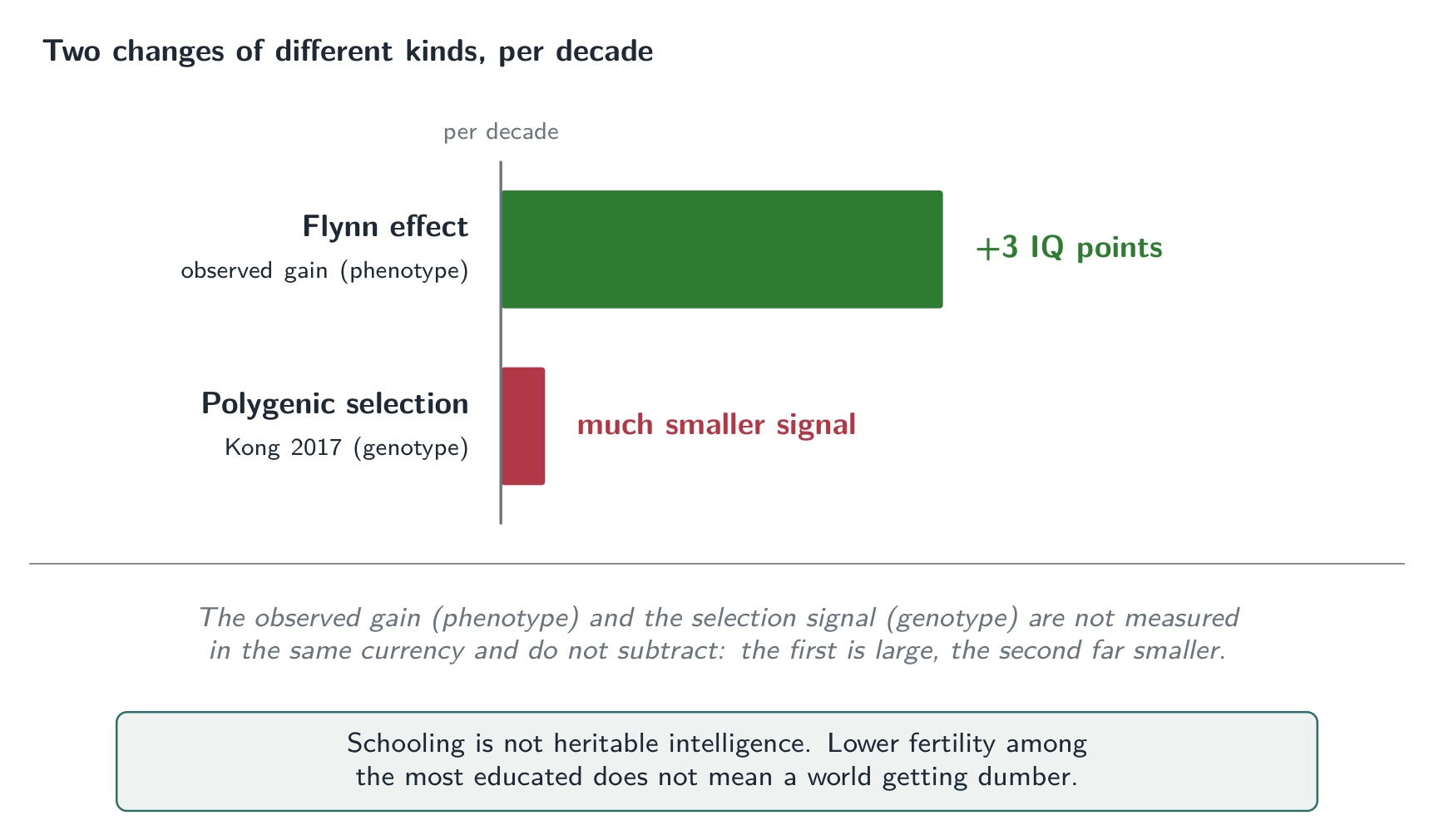
As for the dysgenic thesis as a whole, it must be situated in order to be judged. It is marginal in mainstream science, historically tied to eugenics, and its empirical claims are contested by the community of specialists (Sear 2021; Lynn and Harvey 2008). Its central inference, “the educated have fewer children therefore the species impoverishes”, confuses schooling with a heritable intelligence and ignores environmental gains: it is a chain that does not follow from its premises, even when each premise taken alone contains some truth. The popular framing that accompanies it, the image of “the ignorant who breed”, adds to the fallacy a pure class stereotype, presented as an observation when it is none. And even taking the dysgenic camp’s estimates at face value, the IQ decline they predict from fertility differentials remains small, on the order of a few tenths of an IQ point per decade, while over the same span the Flynn effect was adding close to three points per decade (Woodley and Meisenberg 2013; Pietschnig and Voracek 2013). At each level of examination, the leap shrinks, then disappears.
5. The real long-term issue: aging, not dumbing down
If the dysgenic worry deflates, that does not mean low fertility is without consequence. It has one, serious, but of a wholly different order from the one feared, and it is worth naming so as not to replace a false fear with a false relief. A fertility durably below the replacement threshold leads to the aging of the population and to the rise in the ratio of inactive elderly to active people, what is called the dependency ratio (Vollset et al. 2020; United Nations, Department of Economic and Social Affairs, Population Division 2024). Fewer children today means tomorrow fewer active people to finance the pensions, the health and the care of an older population.
It is this, and not a cognitive impoverishment of the species, that demographers identify as the central issue of low-fertility countries: a problem of work, of pensions, of financing, therefore of economics and social organization (Vollset et al. 2020). The debate is real, sometimes harsh, and it bears on concrete levers. Yet none of these levers consists in sorting births. Pronatalist policies have a limited and variable effectiveness across countries, and aging is instead addressed by several combined paths, the employment of seniors and of women, productivity gains, immigration (Balbo et al. 2012). These are choices of society, legitimately debated, and they say nothing about the worth of the persons who are born or not born.
It is worth measuring the scale of this real problem, so as not to underestimate it while correcting the false fear. When a population ages durably, the number of active people per elderly person falls, which weighs on pensions, on the health system and on growth (Vollset et al. 2020; United Nations, Department of Economic and Social Affairs, Population Division 2024). Countries like Japan or South Korea, with very low fertility, are already experiencing this concretely, with projections of a marked reduction of their working-age population (GBD 2021 Fertility and Forecasting Collaborators 2024; Vollset et al. 2020). The answer, however, belongs to the register of collective choices, and the range is known: length of working life, employment of women, productivity gains, immigration, support for families who want children without being able to afford them (Balbo et al. 2012). Discussing these levers is healthy and necessary. Confusing them with a sorting of births by diploma would be an error of reasoning as much as a moral fault, and it would in addition be a mistake about the problem (Vollset et al. 2020).
6. The real lever: educate, especially girls
The most striking thing, at the end of the reasoning, is that the solution is found exactly where fear thought it saw the problem. The education of girls is one of the most powerful predictors of both a lower fertility and a higher human capital (Breierova and Duflo 2004; Lutz and KC 2011). The same gesture, schooling a girl, lowers the number of children of the next generation and raises its capacities. Where the panic saw a lost race between the educated and the others, the data show a single lever acting in the right direction on both counts. The education of mothers also reduces infant mortality and improves the health and schooling of children, setting off a circle in which each generation starts from higher up (Breierova and Duflo 2004).
The consequence is clear and runs against the decline narrative. Extending education in high-fertility regions raises human capital while lowering fertility, that is, the exact opposite of a dysgenic spiral (Lutz and KC 2011; Breierova and Duflo 2004). Projections that explicitly incorporate the level of education, and not only the number of heads, show, moreover, a rising global human capital, even with a population that keeps growing for a few decades (Lutz and KC 2011; Vollset et al. 2020). The future that the data sketch is not a dumber world peopled by an ignorant crowd, it is a world more schooled than all those that preceded it.
Two mechanisms complete the picture and show that this lever has nothing of a coercion. Access to family planning reduces unwanted births, particularly where fertility is high, which simply brings the number of children closer to the number families actually wish for (Bongaarts 2017). And the decline in infant mortality, by securing the survival of children, reduces the need to have many, which starts the transition from within (Breierova and Duflo 2004; Bongaarts 2017). Investing in school and in health is therefore not only just on the human plane, it is the most effective tool to act, in the right direction, on fertility as on capacities. Fear prescribed distrust of other people’s birth rates. The data prescribe opening schools for them.
One can sum up the reversal in a stroke. The starting thesis amounted to wishing that the supposedly less gifted would have fewer children, in a logic of sorting. The data reply that the path which lowers fertility where it is high is exactly the one that raises capacities, namely school, and first of all girls’ schooling (Breierova and Duflo 2004; Lutz and KC 2011). There is therefore no tragic trade-off to settle between the number and the quality of a population: the same investment acts on both in the desired direction (Lutz and KC 2011; Breierova and Duflo 2004). What was presented as an inescapable threat, against which one could do nothing but lament, turns out to be a classic development problem, with a proven lever already at work (Lutz and KC 2011; Vollset et al. 2020).
7. Conclusion: the honest map
At the end of the inquiry, one can draw the map, which clearly separates what holds from what collapses. The fact is established: the most educated have fewer children and later, and the demographic transition redistributes growth toward the regions least schooled today. The inference, however, is not: cognitive dysgenic decline does not follow from that fact, because schooling is not intelligence, because intelligence depends massively on the environment, and because measured capacities have gone up instead of down. What is solid and what is merely a leap must not travel together under the same air of obviousness.
What remains is to keep distinct three registers that get mixed the moment one touches this subject, and it is there that the most important thing is at stake. What is a fact, demography, which is verified with figures in hand. What belongs to a choice of society, family, fiscal and migration policies, which is debated and voted. And what belongs to worth, which follows from no statistic. No person is worth their diploma, and the number of children of a people is not a verdict on its intelligence. The fear of the opening fed on a real fact and on a faulty reasoning grafted onto it. The fact deserves to be looked at squarely, without extending it where it does not lead, and without making it say what neither measurement nor decency allows one to conclude.
There remains one deep reason to distrust this kind of prediction, beyond this particular file. Each time a reasoning slides from “those people have fewer, or more, children” to “humanity will decline”, it commits the same logical leap that this text has dismantled piece by piece, and it does so while dressing in exact figures that lend it a borrowed authority. That this type of reasoning has, in the past, served as a warrant for disastrous policies is a fact to keep in mind, but it is not what refutes it: the facts themselves do (Sear 2021; Lynn and Harvey 2008). Rigor, here, does not consist in choosing a side in a panic, but in refusing the leap that turns a fertility statistic into a verdict on the worth of peoples. The fact remains the fact, and it is genuinely interesting to understand. The fear hung on it, however, does not withstand examination.